Ghana Youth Leaders Validate National Strategic Action Plan at National Youth Leaders Forum
From Districts to the National Stage: Building a Robust Youth Governance Framework
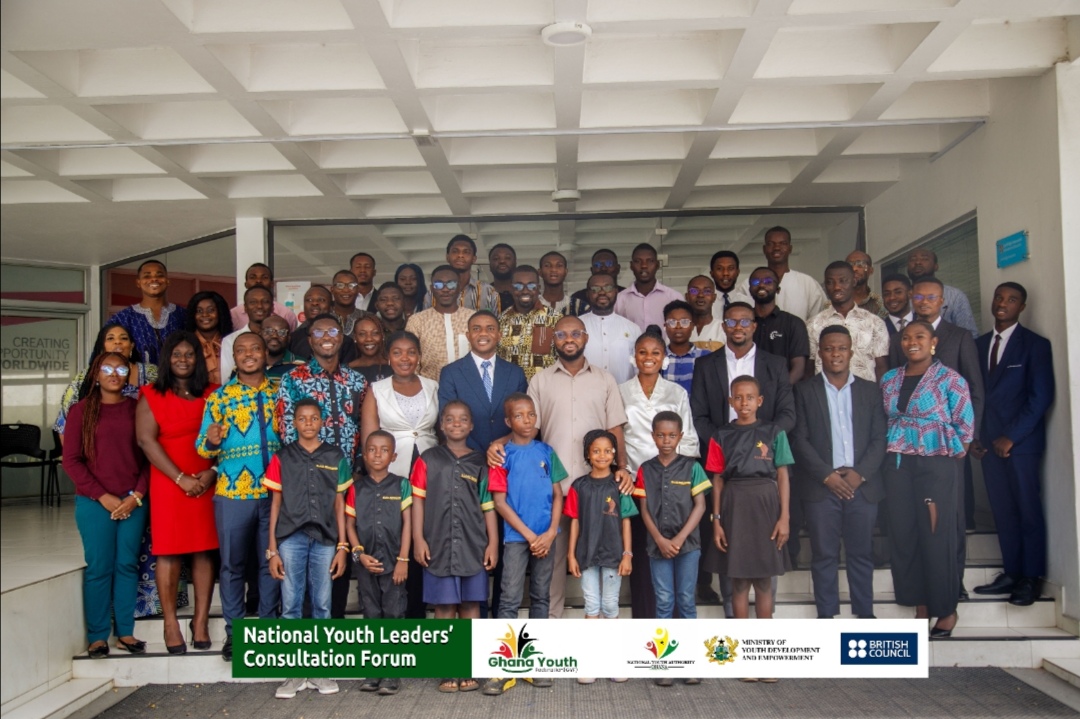
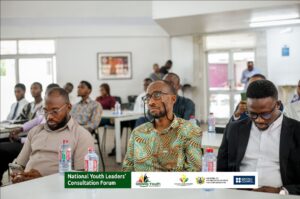
A renewed call for youth unity, stronger collaboration, and coordinated national action echoed through the British Council Auditorium in Accra on Thursday December 4, 2025, as hundreds of youth leaders converged for the National Youth Leaders Forum organized by the Ghana Youth Federation (GYF).
The high-level gathering brought together representatives of major youth networks, civil society organizations, government agencies, and development partners to validate the National Strategic Action Plan (NSAP)—a unified framework expected to guide youth development programming and policy implementation across Ghana.
National Coordinator Presents Strategic Action Plan: “Nothing for the youth without the youth”
Delivering the main presentation of the day, Mr. Ali Ibraheem, National Coordinator of the Ghana Youth Federation, unveiled the draft National Strategic Action Plan, describing it as a product of extensive consultation and a commitment to youth-inclusive policymaking.
He explained that shortly after the federation’s activation in September, interim executives and partners held a strategic retreat to map out a unified direction for national youth engagement.
“We could not develop this document without youth input,” he said.
“Nothing for the youth without the youth.”
To ensure inclusiveness, he noted that the draft had already been shared through a dedicated WhatsApp platform for review and feedback from youth leaders nationwide.
Demographic and structural realities driving the strategy
Mr. Ibraheem emphasized that the strategic plan is grounded in Ghana’s demographic and socio-economic landscape:
- 73% of Ghanaians are under age 35, offering a powerful demographic advantage.
- Youth unemployment is rising rapidly, demanding urgent intervention.
- Only 4% of youth groups are formally registered, limiting coordination and influence.
- 60% of young people lack adequate digital literacy, despite widespread smartphone use.
“These figures present both a challenge and an opportunity,” he said. “They shaped our approach in developing a simple, practical, and action-oriented strategy.”
Four key objectives and strategic pillars
The NSAP focuses on four major objectives:
- Representation
- Empowerment
- Policy advocacy
- Civic participation
These are supported by strategic pillars such as institutionalization, district mobilization, youth diplomacy, and flagship programs.
A major initiative is the upcoming Ghana Youth Index Report, which will highlight activities and impacts of youth organizations across the country.
Mobilizing 267 districts by 2026
Mr. Ibraheem announced an ambitious nationwide mobilization plan:
“We aim to activate youth structures in all 267 districts by the end of 2026. The interim executives alone cannot achieve this. We need every leader here.”
Several districts have already begun organizing, he revealed.
Technical Working Groups open for all
He urged youth leaders to join the newly formed Technical Working Groups (TWGs), which will finalize and operationalize the strategic plan across nine thematic areas.
Transition, governance, and leadership criteria
He outlined strict requirements for the upcoming transition from interim executives to elected leaders, emphasizing age-limit enforcement to keep leadership genuinely youth-centered.
“If you exceed the age bracket—even after 340 days in office—you will be disqualified,” he stated.
Funding model and operational systems
The federation has drafted a GHS 5.83 million budget, expected to be funded by government allocations, private sector support, and international development partners.
He disclosed that the GYF Secretariat, database system, and website are near completion, promising improved coordination and information flow.
He closed with a call to action:
“Join us. Mobilize your communities. This federation belongs to all of us.”
GYF President Sherif Ghali: “Our biggest problem is disunity”
Addressing the gathering, Mr. Sherif Ghali, President of the GYF, delivered a passionate message emphasizing that the youth sector’s greatest obstacle is internal division—not government interference.
“We have a very developed youth ecosystem, but it is weak,” he said. “We spend more time fighting each other than fighting for progress.”
He criticized the tendency of youth groups to undermine each other before decision-makers, warning that such behavior weakens national youth influence.
“To be taken seriously as a youth force, we must first be united,” he said.
He announced upcoming engagements with Ghana’s national leadership to present a unified youth agenda.
NYA CEO Ayariga: Federation complements national youth development
The Chief Executive Officer of the National Youth Authority, Mr. Osman Abdulai Ayariga, Esq., commended the GYF for strengthening youth organizing and representation.
“Coming together under one umbrella does not reduce your individual power—it multiplies it,” he said.
He affirmed that the federation’s independent structure makes it a strong partner in advancing youth interests nationwide.
NEIP: Ghanaian youth are highly entrepreneurial
Representing the National Entrepreneurship and Innovation Programme (NEIP), Mr. Casper Sunday Capoli reaffirmed that most Ghanaian youth are eager to start businesses but lack essential support.
He pledged NEIP’s readiness to collaborate with the federation on entrepreneurial development.
Civil Society calls for action-driven youth empowerment
Dr. Joseph Kobla Wemakor, Executive Director of Human Rights Reporters Ghana, emphasized that youth empowerment must be backed by consistent action and resources.
“Empowerment is a right,” he noted. “The strategic plan must translate into real opportunities.”
Keynote Speaker: Implementation is Ghana’s biggest challenge
In the keynote address, Dr. Elom Hillary Otchi urged youth leaders to move beyond policy documents and focus on implementation, accountability, and digital skills.
“We must prepare young people not just for today, but for the emerging future,” he said.
A new chapter for Ghanaian youth leadership
The National Youth Leaders Forum concluded with overwhelming agreement on the need for coordinated mobilization, unified advocacy, and structured participation.
With the National Strategic Action Plan nearing validation, many leaders expressed optimism that the GYF is ushering in a new era of accountable, united, and empowered youth leadership.