Frafra–Ga-Dangme Relations Deepen with Historic Courtesy Call
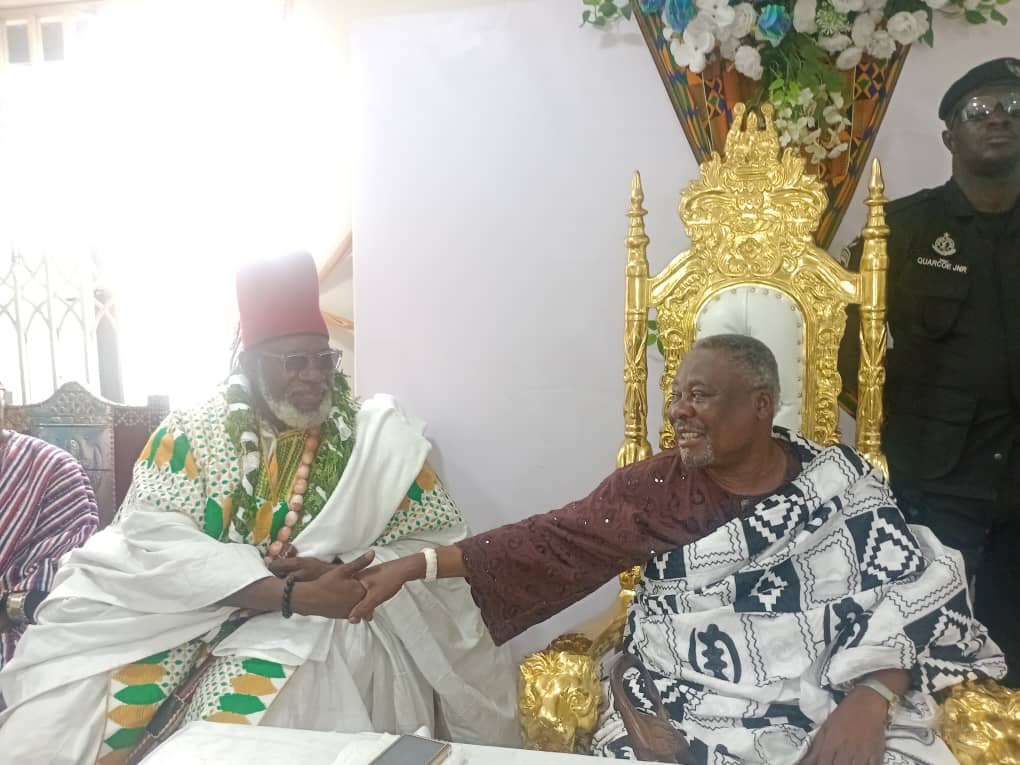
Story By Nii Okpoti Odamtten / Muhammed Faisal Mustapha
The Frafra Chief of Greater Accra, Naba Alhaji Abass Baba Nyaaba Akayezia, on January 14, 2026, led a high-powered delegation of elders on a courtesy call to the Nungua Traditional Council, marking a significant step toward strengthening relations between the Frafra community and the Ga-Dangme traditional authorities.
The delegation was formally received by the Paramount Chief of Nungua, His Royal Majesty Oboade Nortse King Dr Odaifio Welentsi III, who also serves as President of the Greater Accra Regional House of Chiefs.
The visit formed part of deliberate efforts to regularise, deepen, and institutionalise long-standing relations between the Frafra people resident in Accra and their traditional hosts in Nungua.
Elders and members of the Frafra community in Accra joined the visit, paying homage to the Nungua Mantse and seeking his guidance and continued support for their peaceful stay and coexistence in the Greater Accra Region.
Though brief, the ceremony was rich in symbolism and colour, featuring traditional drumming, dances, and war chants from both communities an expressive demonstration of mutual respect, cultural pride, and unity.
“This visit is not ceremonial alone; it is a reaffirmation of our shared commitment to peace, respect, and coexistence,” Naba Nyaaba Akayezia stated.
In his address, the Accra Frafra Chief expressed profound gratitude to the Nungua Mantse and his council for the warm reception, underscoring the Frafra community’s resolve to strengthen ties with the traditional authorities of their host land.
He offered a brief historical account of Frafra migration to southern Ghana, noting that the movement dates back to the colonial era, when administrative policies and economic structures concentrated development and employment opportunities in the south.
“Our presence in Accra is part of Ghana’s broader internal migration story one driven by opportunity, resilience, and the search for livelihoods,” he explained.
Responding to the delegation, His Royal Majesty Oboade Nortse King Dr Odaifio Welentsi III described the visit as both timely and significant, noting its importance in reinforcing harmony between migrant communities and indigenous authorities.
He acknowledged that while there is no direct, extensively documented historical link between the Frafra people and the Ga-Dangme, both groups share broader West African ancestral migration narratives.
“Our histories may not converge at one point, but they flow from the same African river of migration, settlement, and identity,” the Nungua Mantse observed.
He described the meeting as the beginning of a stronger and more structured bond between the Frafra community and the Ga-Dangme people.
The Nungua Mantse encouraged both communities to deepen their relationship through peaceful coexistence, cultural exchange, intermarriage, business partnerships, and joint celebrations.
In a gesture of goodwill, he extended an advance invitation to the Frafra Chief and his people to participate in this year’s Homowo Festival in Nungua in July, assuring them that Ga-Dangme land should be regarded as a second home.
“You are welcome not as strangers, but as partners in the shared destiny of Greater Accra,” he said.
The Paramount Chief commended the Frafra community for its contribution to the social and economic life of Accra, describing their presence as a living testament to Ghana’s cultural integration and national unity.
He urged the community to remain united, support one another, and uphold good conduct while living in the capital.
Importantly, he advised the Accra Frafra Chief to seek formal recognition from the Greater Accra Regional House of Chiefs, noting that such recognition would strengthen leadership legitimacy and ensure orderly administration of the community’s affairs.
He further cautioned against the indiscriminate conferment of chiefly titles, stressing that leadership appointments must not be confused with traditional chieftaincy structures.
“Customary authority must be preserved. Titles should not dilute tradition or create confusion where order is required,” he cautioned.
“This visit is not ceremonial alone; it is a reaffirmation of our shared commitment to peace, respect, and coexistence.”