
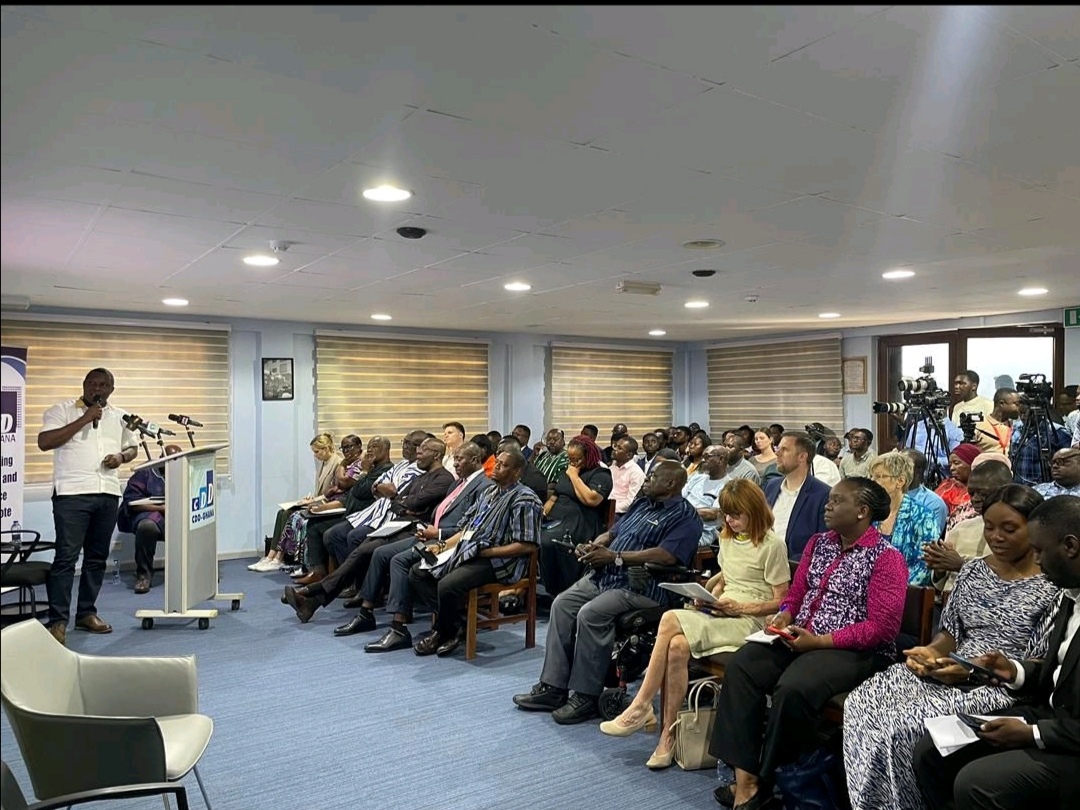
Accra, February 19, 2026 – Illegal mining is increasingly threatening Ghana’s water and environmental security, Deputy Director of A Rocha Ghana, Daryl Bosu, has warned, as the Center for Democratic Development (CDD-Ghana) released its first-year assessment of President John Dramani Mahama’s administration.
Speaking at CDD-Ghana’s forum, Bosu said forest reserves affected by mining rose from 45 to 50 within the year, with over 5,500 hectares degraded.
“Despite more than 1,400 arrests, prosecutions remain below four per cent,” Bosu noted.
He welcomed the revocation of Legislative Instrument 2462, which had permitted limited mining in forest reserves, but cautioned that enforcement gaps, political interference, and alleged complicity of some security personnel continue to undermine progress.
Bosu added that Ghana risks severe water insecurity by 2030 if pollution trends persist, calling for immediate and sustained action.
The forum evaluated the Mahama administration across six thematic areas: democracy and governance; anti-corruption and accountability; economy and jobs; environment and social development; foreign affairs and regional integration; and defence, security, and peacebuilding.
Presenting the report, Dr. Kojo Pumpuni Asante said Mahama assumed office in 2025 with a 56 per cent electoral mandate but faced declining public trust, high perceptions of corruption, and economic strain.
Only 28 per cent of citizens expressed trust in the president prior to the 2024 elections, while 82 per cent believed corruption in government was widespread.
CDD-Ghana commended steps such as publishing a Code of Conduct for appointees, initiating a Constitutional Review Committee, and expanding civil society consultations.
Yet, the think tank flagged challenges including transition-related violence involving party-affiliated groups and the Presidential Transition Act’s inability to regulate mid- and lower-level handovers.
Parliament’s frequent use of certificates of urgency, with 54 per cent of bills passed within a week, was also highlighted as a potential threat to legislative scrutiny.
The unprecedented removal of the Chief Justice in September 2025, though procedurally compliant, drew calls for full publication of investigative findings to strengthen public confidence.
On anti-corruption, CDD-Ghana welcomed initiatives like “Operation Recover All Loot,” amendments to the Public Financial Management Act, and drafting a new National Anti-Corruption Action Plan.
Still, the think tank questioned the $20,000 gift threshold under the presidential code of conduct and flagged low prosecution rates, allegations of selective justice, and coordination gaps among oversight bodies.
Panel discussant Beauty Emefa Nartey of the Ghana Anti-Corruption Coalition described these efforts as promising “signals” but stressed the need for measurable benchmarks, institutional independence, and sustained funding to achieve durable reform.
Economically, Professor Atsu Amegashie noted early gains, including reduced fuel prices, a sharp drop in food inflation from 28.3 per cent to 4.9 per cent, falling treasury bill rates, and a reduction in debt-to-GDP from 61.8 per cent to 45 per cent following debt restructuring.
Government also reported creating 330,000 jobs. Yet, he warned that revenue-to-GDP remains around 16 per cent, limiting fiscal space, and cautioned against “jobless growth,” urging private-sector-led employment, reduced business costs, and stronger monetary transmission so lower treasury bill rates translate into cheaper commercial lending.
Addressing defence and security, retired Colonel Festus Aboagye said the Ghana Armed Forces, though professional, remain materially overstretched, with inherited debt obligations and declining budgets slowing modernization.
On the Bawku conflict, he noted tensions escalated before the 2025 transition. In June 2025, military deployment doubled from about 400 to 800 personnel to contain violence, allowing trade and movement along the Walewale–Bawku–Bolgatanga corridor.
Engagement of an Asante mediation committee, he said, was the most decisive action beyond containment, though the conflict remains unresolved. Col. Aboagye cautioned against treating Bawku purely as a rule-of-law issue, emphasizing the need for sustained mediation and broader peace architecture.
Highlighting deeper institutional challenges, he cited the August 6 helicopter crash that killed eight personnel, pointing not only to equipment shortages but a culture where political imperatives can override professional advice.
He also referenced a recruitment exercise in which six young women died, attributing the issue to youth unemployment and structural pressures evidenced by roughly 30,000 applicants.
He called for digital reforms to ensure transparent recruitment and a comprehensive national disarmament strategy, emphasizing that national security coordination structures must return to strictly civilian, constitutionally defined roles.
Overall, CDD-Ghana concluded that while the Mahama administration has shown responsiveness and achieved early macroeconomic stabilization, enforcement gaps and structural weaknesses remain across governance, anti-corruption, environmental protection, and national security.
The think tank urged a shift from crisis containment and policy signaling to deeper institutional redesign capable of delivering sustainable peace, accountable governance, and long-term economic recovery.
Bosu’s warning on illegal mining underscores the urgency of integrating environmental security into this broader governance and institutional reform agenda.
Without decisive action, he said, Ghana risks water shortages, degraded forest reserves, and broader ecological instability that could undermine both development and public confidence in state institutions.
By Joseph Kobla Wemakor
