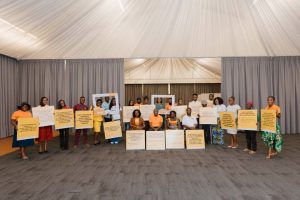
Ghana has been urged to strengthen local support for childhood cancer care to improve survival rates and give affected children a better chance of recovery.
The Country Coordinator of World Child Cancer, Ms. Adwoa Penaman Boateng Desu, made the call at the organisation’s NTOBOA FAIR initiative in Accra .
She expressed concern over the survival gap between children diagnosed with cancer in Ghana and those in high-income countries, stressing that greater local investment and collective action were needed to ensure that a child’s chances of survival were not determined by where they were born.
According to her, while about eight to nine out of every 10 children diagnosed with cancer survive in high-income countries, fewer than five out of 10 survive in Ghana and similar settings.
Ms. Boateng Desu said the disparity highlights the need to strengthen early diagnosis, access to appropriate treatment and supportive care while reducing the financial and logistical difficulties confronting affected families.
She stressed that many childhood cancers are curable when detected early and treated appropriately, making timely access to quality care critical to improving outcomes.
She explained that the NTOBOA FAIR draws inspiration from the Ghanaian tradition of people pooling resources to support a common cause and is intended to encourage greater local ownership of childhood cancer care.
According to her, addressing childhood cancer cannot be left solely to hospitals, health professionals, government or international development partners, but requires the involvement of the wider society.
She therefore called on individuals, businesses, communities and corporate organisations to contribute towards childhood cancer care through funding, technical expertise, medical equipment and supplies, as well as advocacy.
Ms. Boateng Desu said Ghana had already recorded significant progress in childhood cancer care through partnerships and sustained interventions over the years.
These efforts, she noted, had contributed to improvements in survival rates, enhanced training for healthcare professionals and the expansion of shared-care centres, helping to bring some services closer to children and their families.
However, she cautioned that sustaining these gains and reaching more children would require stronger domestic support and long-term commitment.
She said building a sustainable childhood cancer care system requires Ghanaians to take greater ownership of the progress already made while mobilising the resources needed to address existing gaps.
Ms. Boateng Desu expressed optimism that collective action could significantly change the outlook for children diagnosed with cancer in Ghana.
She said every child who receives timely diagnosis and appropriate treatment has a better opportunity not only to survive but also to return to school, pursue their ambitions and contribute meaningfully to society.
GH¢11.6m Target for Childhood Cancer Care
Speaking at the event, the Sub-Saharan Africa Regional Finance Manager for World Child Cancer, Mr. Saviour Senanu Bruce, disclosed that the organisation is seeking to raise GH¢11.6 million to support children affected by cancer in Ghana.
“We are here today to raise funds to support children affected by childhood cancer in Ghana,” Mr. Bruce said.
“Our fundraising target is GH¢11.6 million. Although this may appear to be a substantial amount, it is modest when measured against the cost of childhood cancer care and the number of children who need support.”
He said the organisation intends to mobilise the funds through corporate partnerships, individual donations, fundraising events and public appeals.
Mr. Bruce said accountability and transparency would remain central to the fundraising effort, assuring donors that resources would be used for their intended purposes.
“As we mobilise these resources, we must ensure that every donation delivers value for money. Funds donated for a particular purpose must be invested in the activities for which they were intended,” he said.
He said World Child Cancer had over the years trained healthcare professionals, supported diagnosis and treatment, provided supportive care and awarded scholarships.
The organisation has also supported the provision of infrastructure, medical equipment and medical consumables.
“As an organisation, we account for every pesewa we receive. We do this accurately and diligently, ensuring transparency in everything we do,” Mr. Bruce said.
High Cost of Treatment
Mr. Bruce said the financial burden associated with childhood cancer remains a major challenge for many families, with the cost of care varying according to the type of cancer, stage at diagnosis and when treatment begins.
He cited the example of a child diagnosed with a brain tumour, whose estimated cost of care could reach about GH¢162,140.
He cautioned that the figure was only an estimate and that actual expenditure could, in some cases, be two or three times higher.
According to him, the cost begins with diagnosis, which may require laboratory investigations, MRI and CT scans and other tests to determine the nature and extent of the disease.
Treatment brings additional expenses, including surgery, medication and medical consumables.
Beyond clinical treatment, Mr. Bruce said children and their caregivers also require supportive care throughout their stay in hospital.
He said children undergoing treatment need adequate nutrition, while caregivers may require accommodation, transportation and communication support to remain connected with family members at home.
The psychological impact of a cancer diagnosis on children and their families also adds to the overall burden of care.
“This is just one case. It shows why our GH¢11.6 million fundraising target is modest compared with the scale of the need,” he said.
70% Earmarked for Clinical Care
Mr. Bruce said 70 per cent of the targeted funds, equivalent to GH¢8.12 million, would be channelled into direct clinical care, particularly diagnosis and treatment.
Another 10 per cent, representing GH¢1.16 million, would go towards supportive care for children and their caregivers.
The remaining 20 per cent, or GH¢2.32 million, would support capacity building and improvements in resources required to deliver childhood cancer care.
This would include training doctors, nurses, pharmacists, pathologists and other healthcare professionals, as well as procuring new equipment, refurbishing existing equipment and providing medical consumables.
Mr. Bruce said the scale and cost of childhood cancer care demonstrate the need for broader public and corporate support.
“The needs we have outlined demonstrate that the amount we are seeking is modest. The cost of sustaining these activities over a year can be considerably higher. That is why we are appealing for your support and generous donations,” he said.
He stressed that supporting childhood cancer care should be viewed as an investment in the lives and future of affected children.
“Your donation is an investment in a child’s life and future. Its return is the opportunity for that child to receive treatment, recover and look forward to a brighter tomorrow,” Mr. Bruce said.
“We want to put smiles on the faces of these children and their families, and we need your support to make that possible.”