
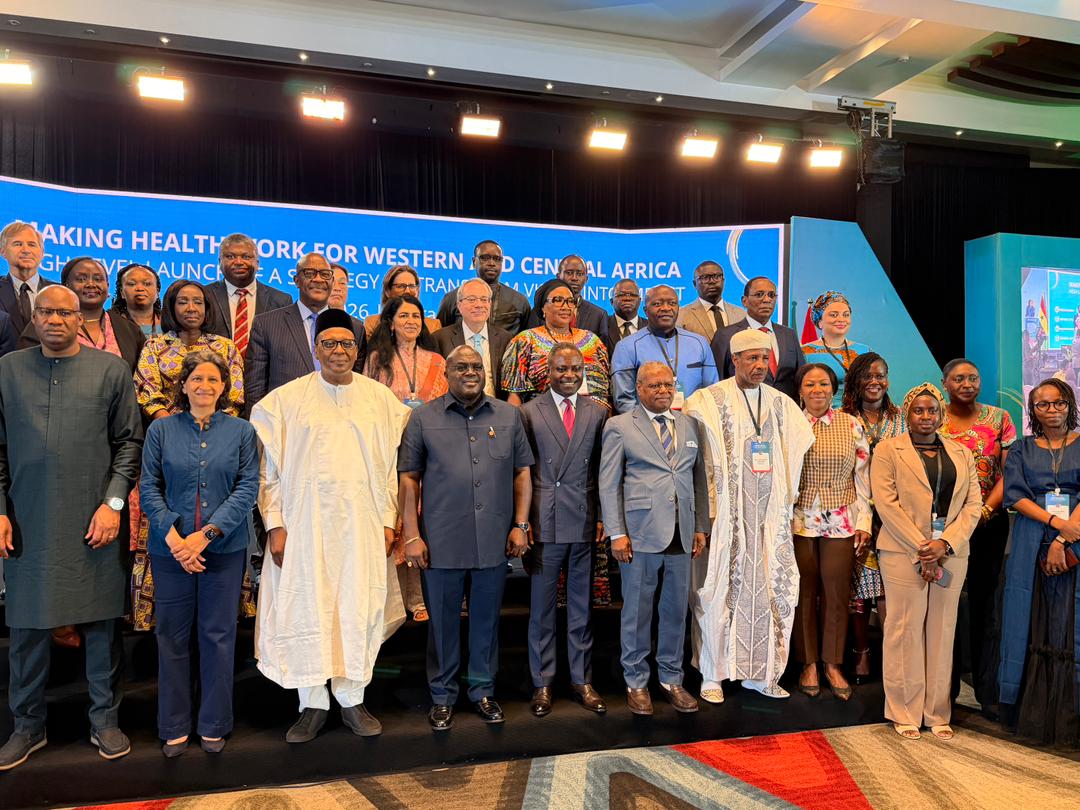
World Bank Launches ‘Fit to Prosper’ Health Strategy in Accra, Positions Health as Economic Driver Across West and Central Africa
The World Bank Group has launched a major regional health strategy in Accra aimed at expanding access to quality healthcare while unlocking economic growth across West and Central Africa, as countries grapple with rising health demands and tightening fiscal space.
The initiative, titled “Fit to Prosper: Investing in Health for Jobs and Development in Western and Central Africa,” responds to mounting pressure on health systems driven by rapid population growth, disease outbreaks, climate shocks, and a growing dual burden of communicable and non-communicable diseases.
Aligned with key frameworks such as the Accra Reset, the Lusaka Agenda, and the World Bank’s commitment to Universal Health Coverage (UHC), the strategy provides a roadmap for countries to prioritise investments, improve efficiency, and strengthen resilience. It also advances the Africa Initiative for Medical Access and Manufacturing (AIM2030), which seeks to boost local production of essential health commodities, enhance health security, and create jobs.
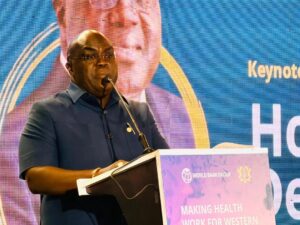
Chief of Staff Launches Strategy, Frames Health as Economic Imperative
Ghana’s Chief of Staff, Julius Debrah speaking on behalf of President John Dramani Mahama, urged African governments to reposition health as a central pillar of economic transformation.
However, he described the initiative as a shift from viewing healthcare as a social obligation to recognising it as a driver of productivity, job creation, and long-term prosperity.
“Health is an economic strategy,” he stated, stressing that a healthy population underpins innovation, resilience, and national growth.
Strong Backing from the World Bank
The Chief of Staff commended the World Bank’s sustained investments in the region, noting that its health portfolio spans more than 20 countries with 24 active operations valued at approximately $4.4 billion.
He highlighted measurable gains in maternal and child health, pandemic preparedness, and system strengthening, supported by an additional $340 million in co-financing from partners such as the Global Financing Facility, Gavi, the Global Fund, Japan, and Canada.
Ghana’s Reform Agenda Gains Momentum
He noted that the regional strategy aligns closely with Ghana’s ambition to achieve universal health coverage and build a resilient health system.
While acknowledging progress under the National Health Insurance Scheme (NHIS), he pointed to ongoing challenges including coverage gaps, quality concerns, and financial sustainability.
To address these, the government is implementing key reforms, including strengthening domestic health financing through the uncapping of the National Health Insurance Levy, rolling out a Free Primary Healthcare Initiative, and establishing the Ghana Medical Trust Fund (MahamaCares) to support treatment for critical illnesses.
“These are not isolated reforms,” he said. “They represent a deliberate shift from dependency to sustainability and from fragmentation to system-wide transformation.”
Ghana to Launch Country Compact
The Chief of Staff also announced plans for Ghana to launch a Country Compact with the World Bank Group, designed to align domestic resources, concessional financing, and partner support under a unified national vision.
The Compact will be jointly coordinated by the Ministries of Health and Finance, with clear priorities, measurable targets, and sustainable financing mechanisms.
Call for Regional Collaboration
Emphasising the transnational nature of health threats, the Chief of Staff underscored the need for stronger regional cooperation.
He highlighted priorities including disease surveillance, emergency response systems, local manufacturing of health products, and cross-country knowledge sharing.
“When one country is vulnerable, we are all vulnerable. And when one country succeeds, we all move forward,” he said. Stressing that, the true test of this strategy will not be in its design, but in its delivery.
“By investing in health, we are investing in jobs, stability, and the future of our region,” the Chief of Staff concluded.
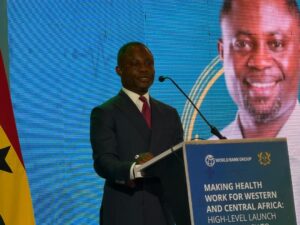
Health Minister: Strategy Timely and Critical
Ghana’s Minister for Health, Hon Kwabena Mintah Akandoh, described the initiative as both timely and essential in addressing evolving health challenges across the region.
He warned that no country can achieve sustainable development with a weak healthcare system. “No society can fully realise its potential if its children are malnourished, if mothers cannot access safe care, or if families are pushed into poverty because of the cost of illness,” he said.
Health at the Core of Development
Mr. Akandoh stressed that health is fundamental to human capital development and economic progress, noting that rapid population growth, urbanisation, and rising demand for services are intensifying pressure on health systems.
He reaffirmed Ghana’s commitment to UHC under its 2020–2030 roadmap, aimed at ensuring access to quality healthcare without financial hardship.
Key Government Interventions
The Minister outlined flagship interventions including the Free Primary Healthcare Initiative to remove financial barriers at the point of care, the Ghana Medical Trust Fund (MahamaCares) to support the treatment of non-communicable diseases such as cancer and cardiovascular conditions, and the continued strengthening of the National Health Insurance Scheme (NHIS) to expand coverage and improve financial protection. These measures, he said, are designed to create a continuum of care from prevention to specialised treatment.
Promoting “Health Sovereignty”
A central theme of his address was “health sovereignty,” defined as the ability of African countries to set their own priorities, strengthen local systems, and reduce long-term dependency on external aid. “Health sovereignty does not mean isolation. It means purposeful partnership,” he noted.
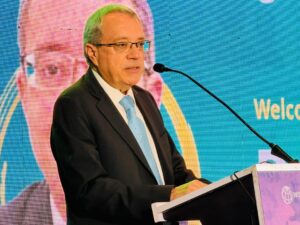
World Bank Applauds Ghana’s Leadership
Robert R. Taliercio, Division Director at the World Bank, commended Ghana’s leadership, calling the country a standout example of health reform in the region.
He noted significant progress, including reductions in childhood stunting and steady movement toward achieving a demographic dividend. “Ghana shows us how it can be done and what we can learn from its experience,” he said.
He also highlighted the long-standing partnership between Ghana and the World Bank, dating back to 1957, and revealed that a new Country Partnership Framework is being developed to guide collaboration over the next six years.
Strategy Anchored on Three Pillars
Presenting the strategy, World Bank Practice Manager for Health, Nutrition and Population, Rifat Hasan, described the region as being at a critical turning point.
He outlined three core pillars of the strategy: Frontline First, which focuses on strengthening primary healthcare systems; Fixing Finance, aimed at improving efficiency and increasing domestic investment; and Future Fit, which seeks to enhance preparedness for pandemics and climate-related risks.
He emphasised that the approach builds on existing progress while addressing persistent inequalities in access to care.
Economic Case for Health Investment
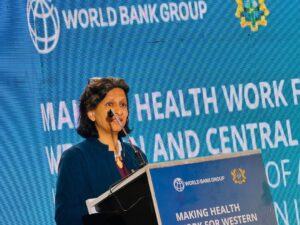
World Bank Vice President for People, Mamta Murthi, reinforced the economic rationale for investing in health, noting that the region’s youthful population presents both an opportunity and a responsibility.
She revealed that the World Bank aims to reach 1.5 billion people globally with improved healthcare services, including 200 million in West and Central Africa.
According to her, investments in health could generate returns of up to 15 times their value, while addressing workforce gaps could create up to two million jobs.
Focus on Local Manufacturing and Resilience
The strategy also prioritises strengthening local manufacturing of medicines and health supplies, reducing reliance on imports and addressing vulnerabilities exposed during the COVID-19 pandemic.
It further emphasises building resilient systems capable of responding to future health emergencies, including cross-border disease outbreaks and climate-related risks.
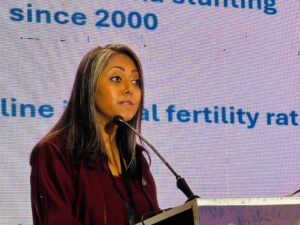
Dr. Rifat Hasan, World Bank Practice Manager for Health, Nutrition, and Population, presented the “Fit to Prosper: Investing in Health for Jobs and Development” strategy, describing it as a continuation of decades of progress in the region while tackling ongoing structural gaps in health systems.
Building on progress, addressing gaps
Dr. Hasan noted that West and Central Africa has recorded significant health improvements over the past 20 to 30 years, including a 23 percent reduction in child stunting, a 39 percent decline in maternal mortality, and a 55 percent reduction in under-five mortality.
Despite these gains, she said the region still carries a disproportionate burden of global maternal and child deaths, underscoring the urgent need for accelerated reforms.
Five strategic opportunities
The strategy identifies five major opportunities to transform health and development outcomes in the region.
These include harnessing a rapidly growing youth population to drive economic transformation, expanding access to quality healthcare services, creating millions of health-related jobs particularly for women and young people, strengthening resilience to pandemics, climate change and economic shocks, and reinforcing a stronger social contract where health becomes a top public priority.
Dr. Hasan stressed that investments in adolescent girls, nutrition, and maternal health are central to achieving long-term development gains.
Health as an economic driver
She further emphasized that health is not only a social service but also a critical economic investment, noting that stronger health systems could generate up to 1.4 million skilled jobs and 800,000 community health worker positions across the region.
Citing global evidence, she added that every one dollar invested in health can yield returns of more than 15 dollars, making the sector one of the most impactful areas of development financing.
Three pillars of the strategy
The “Fit to Prosper” framework is built on three main pillars. Frontlines First is about boosting primary healthcare systems, growing the number of community health workers, and making sure facilities are ready with essentials like water, electricity, and digital connectivity.
Fixing Finance focuses on using health funds more efficiently, raising more domestic resources, and aligning donor support with national goals. Future Fit is all about being ready for pandemics and climate-related challenges by improving surveillance systems and ensuring healthcare delivery can handle emergencies.
Strengthening primary healthcare
Dr. Hasan described primary healthcare as the backbone of the strategy, noting that most essential services, including maternal, child, and adolescent health, can be effectively delivered at this level.
She also highlighted the need to address barriers such as cultural norms, financial constraints, and lack of trust in health systems.
Financing and sustainability
She warned that low domestic health spending and weak budget execution remain major challenges to achieving universal health coverage in the region.
The strategy therefore calls for increased government investment in health, improved financial management, and stronger coordination of external funding to ensure efficiency and sustainability.
Resilience and preparedness
Dr. Hasan underscored the importance of strengthening preparedness for health emergencies, citing lessons from the COVID-19 pandemic and past Ebola outbreaks. She said resilient primary healthcare systems are essential not only for routine services but also for maintaining continuity during crises.
Multi-sector collaboration
The strategy promotes collaboration across sectors including education, energy, agriculture, water, and digital infrastructure to improve health outcomes. It also encourages investment in local pharmaceutical manufacturing and stronger supply chains to enhance regional health security.
Implementation support
The World Bank said implementation will be supported through financing, technical assistance, and knowledge sharing, including ongoing health compacts in countries such as Nigeria, Sierra Leone, and Côte d’Ivoire, with Ghana and Senegal finalising similar arrangements. Additional support will also come through partnerships with global health institutions and development agencies.
Conclusion
Dr. Hasan called on governments, development partners, and stakeholders to move beyond policy design and focus on effective implementation.
“This strategy is not just a document; it is a roadmap for real transformation,” she said, urging collective action to strengthen health systems and improve lives across the region.
Call for Action
Looking Ahead
The launch of the “Fit to Prosper” strategy marks a significant step in efforts to transform healthcare systems across West and Central Africa.

Source: Isaac Kofi Dzokpo
