
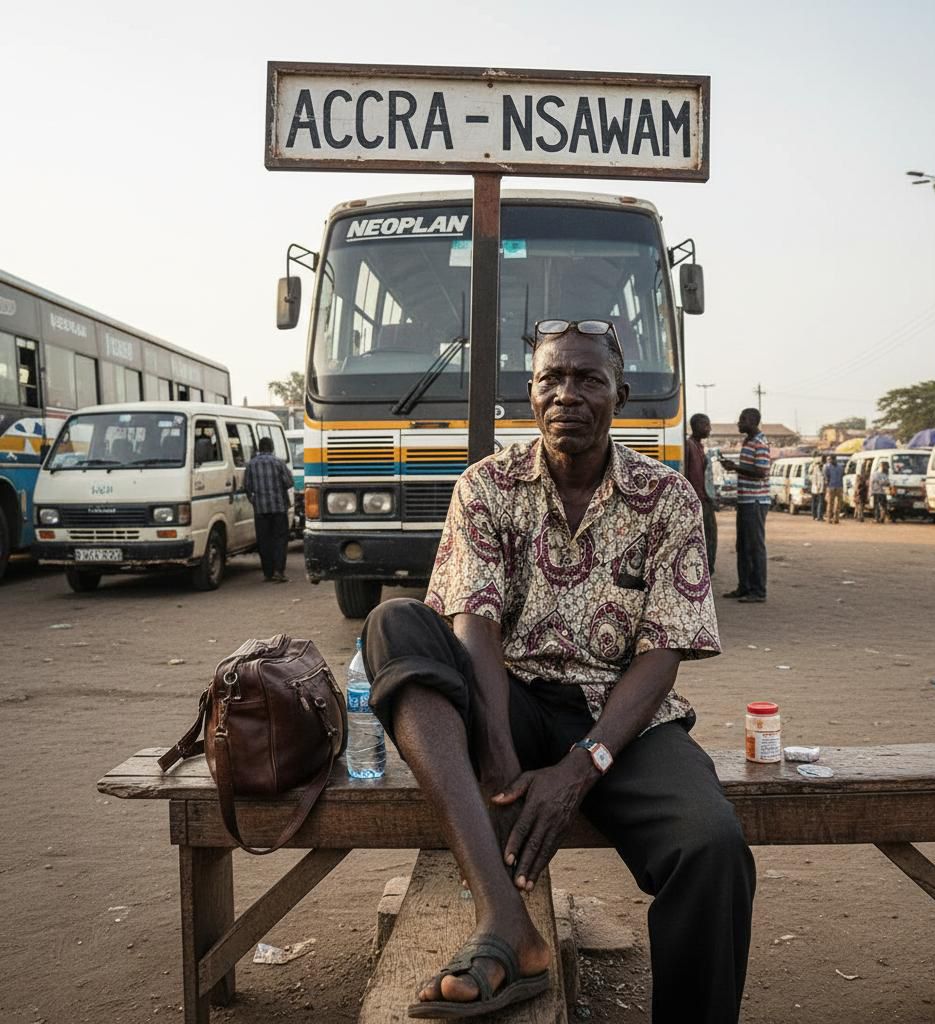
At Neoplan Station in Accra, 52-year-old trotro driver Kwame Asamoah sat on a wooden bench, massaging his legs before his next trip to Nsawam.
After more than three decades behind the wheel, Kwame’s biggest challenge is no longer potholes or reckless motorists—it is his health.
“I sometimes feel tingling in my legs when I step on the brake,” he admitted. “I get scared. What if I can’t stop in time with passengers inside?”
Kwame has diabetic peripheral neuropathy, a nerve complication from long-term, uncontrolled diabetes. Like many Ghanaian drivers, he must manage a chronic condition while carrying hundreds of passengers each week.
Diabetic Peripheral Neuropathy – A Silent Threat
Diabetic peripheral neuropathy is one of the most common complications of diabetes. It damages the nerves, especially in the hands and feet, leading to numbness, tingling, or weakness. Global studies suggest that up to 50 per cent of people with diabetes may develop some form of neuropathy.
“Loss of sensation in the feet can seriously compromise a driver’s ability to press the pedals accurately,’’ explained Dr. Samuela Amponsah, a diabetes nurse specialist Anton Medical Hospital. “This makes them more vulnerable to accidents. Unfortunately, this risk is often invisible to passengers and regulators.”
She added that conditions like hypertension and stroke, often linked to diabetes, can cause sudden incapacitation behind the wheel.
Road Safety in Numbers: The Bigger Picture
According to the Ghanaian Times from January to June 2025, the National Road Safety Authority (NRSA) recorded 7,289 crashes involving 12,354 vehicles. These claimed 1,504 lives—an average of eight every day—while injuring more than 8,300 people.
“Most reports cite speeding, fatigue, or bad roads,’’ noted Mrs Racheal Agyare , at the Communication department of NRSA “But rarely do we consider hidden health conditions as contributing factors. Yet, we know they play a role.”
For passengers, the thought is chilling. “I never imagined that a driver’s sickness could cause an accident,” said Mariam Fuseini, a trader who commutes from Nsawam daily.” We only worry about over-speeding, but now I’m thinking differently.”
Prevalence of Diabetes &Hypertension in Ghana
The Ghana Health Service and academic studies highlight how widespread these silent illnesses have become. For Diabetes it affects about 2.8 -3.9 per cent of adults, with rates rising to 6 per cent in urban areas with many remaining undiagnosed.
Hypertension affects about 30 per cent of adults nearly one in three Ghanaians. Yet, awareness, treatment, and control remain low.
For commercial drivers, who often work long hours with little time for check-ups, the risk is even higher.
What the Law Says
Ghana’s legal framework recognises medical fitness as a road safety issue. The Road Traffic Act, 2004 (Act 683) requires licence applicants to declare any disease or disability likely to endanger public safety. The law empowers the Driver and Vehicle Licensing Authority (DVLA) to revoke or suspend a licence if a driver is found medically unfit.
The Road Traffic Regulations, 2012 (L.I. 2180) make eye tests compulsory and give the DVLA power to demand further medical checks. Since 2022, all applicants must undergo certified eye tests at accredited centers.
But in practice, enforcement is patchy. “Our current system checks health only at the point of licensing,” explained Dr. Jacob Arthur, a public health and road safety advocate. “Chronic illnesses like diabetes or hypertension don’t show on the face. Without periodic monitoring, we leave gaps that can turn deadly.”
A DVLA official, who requested anonymity, admitted that outside of eye tests, other screenings are “largely left to the honesty of applicants” and medical certificates. “There is no structured follow-up system to ensure drivers remain fit over the years,” the official said.
By comparison, in the United Kingdom, drivers are legally required to notify the DVLA if they develop a medical condition that could affect driving, with fines of up to £1,000 for failure. Ghana lacks a similar self-reporting mechanism.
Voices from the Road
Kwame Danso, a 38-year-old driver described how untreated high blood pressure once made him dizzy behind the wheel. ‘I nearly lost control, ’’he recalled. ‘Now I take my tablets every day, but I wish we had regular check-ups at the station.
The GPRTU (Ghana Private Road Transport Union) acknowledges the growing health challenge. Its Industrial Relations Director, Alhaji Abass Imoro, said the union has begun partnering with health professionals to conduct periodic screenings at lorry parks.
“Diabetes and high blood pressure are no longer rare among members,’’ he told the Ghanaian Times. “We are encouraging our drivers to check their blood sugar and blood pressure regularly. We are also engaging DVLA and NRSA to explore how regular medical checks can be integrated into driver welfare.”
Medical and Policy Perspectives
Dr. Emmanuel Nyarko of Best Heart Medical Centre added that “a simple blood pressure and blood sugar test during licence renewal could save lives adding that it should be mandatory, not optional.
For him commercial drivers are a high-risk group. Their lifestyle—long hours, stress, poor diet—puts them at risk of diabetes and hypertension.
” Integrating NCD screening into DVLA processes is not just advisable, it’s urgent.” he stated
Global lessons
The World Health Organization (WHO) recommends integrating non-communicable disease (NCD) screening into occupational health systems, particularly for high-risk groups like transport workers. Countries such as South Africa and Kenya have already adopted stricter health assessments for long-distance drivers.
In Kenya, long-distance drivers must undergo periodic medical fitness checks, including for blood pressure and diabetes. In South Africa, professional drivers undergo more comprehensive health assessments, especially for long-haul journeys.
“Road safety is health safety,” said Dr. Prosper Tumusiime, WHO Ghana’s NCD focal person. “A driver with uncontrolled hypertension or diabetes is as dangerous as a vehicle with faulty brakes.”
A Driver’s Turning Point
For drivers like Kwame Asamoah, the stakes are high. Every trip is a balancing act between livelihood and health. His story underscores a simple but urgent truth: Ghana’s roads will only be safer when the health of drivers is treated with the same seriousness as the condition of their vehicles.
As WHO reminds: “Road safety is health safety. A sick driver is as dangerous as a faulty brake.”
For the millions of passengers boarding buses each morning, that reminder may be the thin line between life and tragedy.
By Benedicta Gyimaah Folley
