
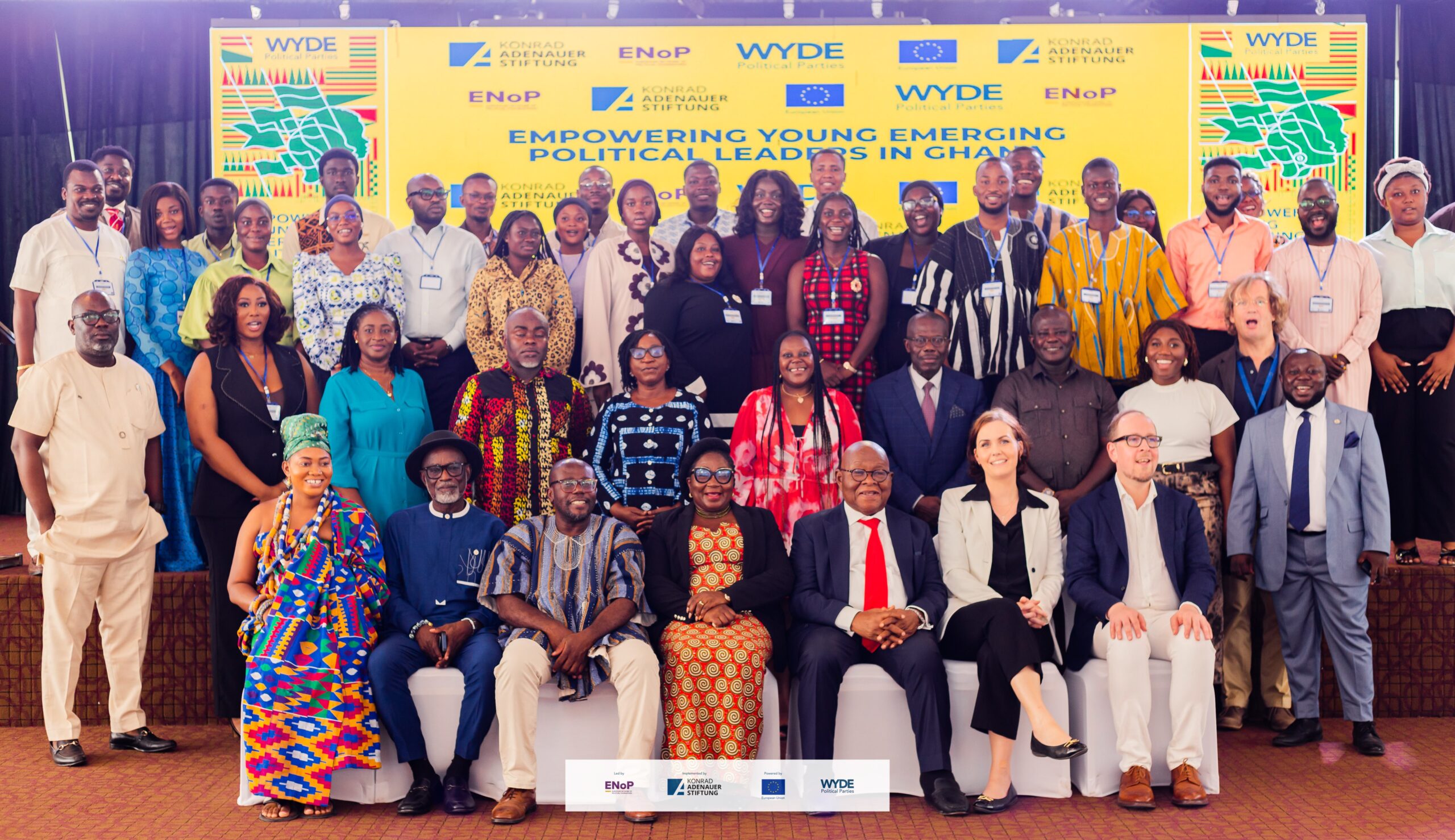
The Konrad Adenauer Stiftung (KAS) Ghana Office, in partnership with the European Network of Political Foundations (ENoP) and the European Union (EU), has launched the Ghana edition of the EU Women and Youth Democratic Engagement (WYDE) Political Parties Project, with a strong call for greater youth inclusion in political leadership.
The inception workshop, held in Accra was under the theme “Empowering Young Emerging Political Leaders in Ghana,”.
The workshop brought together political party representatives, civil society actors, diplomats, academics and young political leaders from across the country.

In her welcome address, Anna Lena Sabroso Wasserfall Country Representative of KAS Ghana described the project as timely, noting that it coincides with 60 years of the Foundation’s presence and engagement in Ghana.
The new WYDE Political Parties Project, she explained, builds on that legacy by introducing a structured, multiparty programme developed jointly with the European Union and embedded within a broader regional and continental framework.
“As we all know, young people and women constitute an ever-growing share of Ghana’s population. Yet they remain underrepresented in political leadership and decision-making.
Barriers such as limited access to leadership pathways within parties, financial constraints, and entrenched political norms continue to limit meaningful participation.
The WYDE Political Parties Project addresses these challenges in a very targeted and practical way. It combines capacity building, targeted mentoring, and networking, while at the same time working with political parties, institutions, and civil society to strengthen inclusive and transparent internal structures.
From our perspective, it is exactly this combination that is crucial: Sustainable political participation does not emerge from isolated trainings alone. It requires role models, institutional openness, cross-party exchange—and the opportunity to learn directly from experience”, she said.

EU Ambassador to Ghana, Rune Skinnebach, emphasized the need to move beyond symbolic youth
inclusion.
“If we want strong, inclusive democratic societies whether in Africa or Europe, young people must not just be invited to the table; they must be at the very centre of the action” he said.
The Ambassador noted that while young people in Ghana and around the world care deeply about
democracy and their communities, they are often excluded from decision-making processes.
“That has to change”‘ he stressed.
He referenced the EU Youth Action Plan adopted in 2022, which led to concrete investments including the Women and Youth Democratic Engagement Initiative (WYDE).
At a practical level, he explained, WYDE supports grassroots organisations and young activists working in areas such as anti-corruption advocacy, election observation, democratic reform and civic education.
“You are not just the future of this country; you are its present” Ambassador Skinnebach told participants.

The KAS Programme Manager and Project Lead of the EU WYDE Project in Ghana, Lawrencia Akosua Pomaa, highlighted on the project’s implementation
“The EU WYDE Project brings together young leaders, practitioners, and leaders in academia and politics to build strong, collaborative networks grounded in shared values, mutual learning, and collective responsibility.
The Project lays the foundation for a resilient and inclusive society—one where unity strengthens democracy, participation drives progress, and collective action secures a sustainable future for Ghana,” she added.
