
Story By: Nii Okpoti Odamtten & Muhammad Faisal Mustapha….
In a decisive escalation of Ghana’s anti illegal mining campaign, the National Anti Illegal Mining Operations Secretariat (NAIMOS) has arrested eighteen individuals in a meticulously executed operation within the ecologically critical .
The intelligence led raid, conducted on Monday, 27 April 2026, underscores the growing operational intensity of the government’s crackdown under the leadership of the Minister for Lands and Natural Resources, whose policy direction continues to redefine enforcement benchmarks in the fight against galamsey.
Carried out between 0830 and 1645 hours, the operation found suspects actively engaged in illegal gold extraction deep within the forest enclave an alarming incursion into one of Ghana’s most environmentally sensitive zones.
Preliminary environmental assessments revealed extensive degradation across the reserve. Sections of palm plantations had been cleared to create makeshift mining corridors, while large pits and improvised extraction systems scarred the once pristine landscape.
The Cape Three Points Forest Reserve, widely regarded as a vital component of Ghana’s coastal biodiversity belt, now bears the marks of sustained illegal exploitation raising urgent concerns about long term ecological damage and habitat loss.
“This operation is not just about arrests; it is about reclaiming Ghana’s environmental sovereignty,” a senior NAIMOS official stated.
“No protected area is beyond our reach, and no illegal operator is beyond accountability.”»
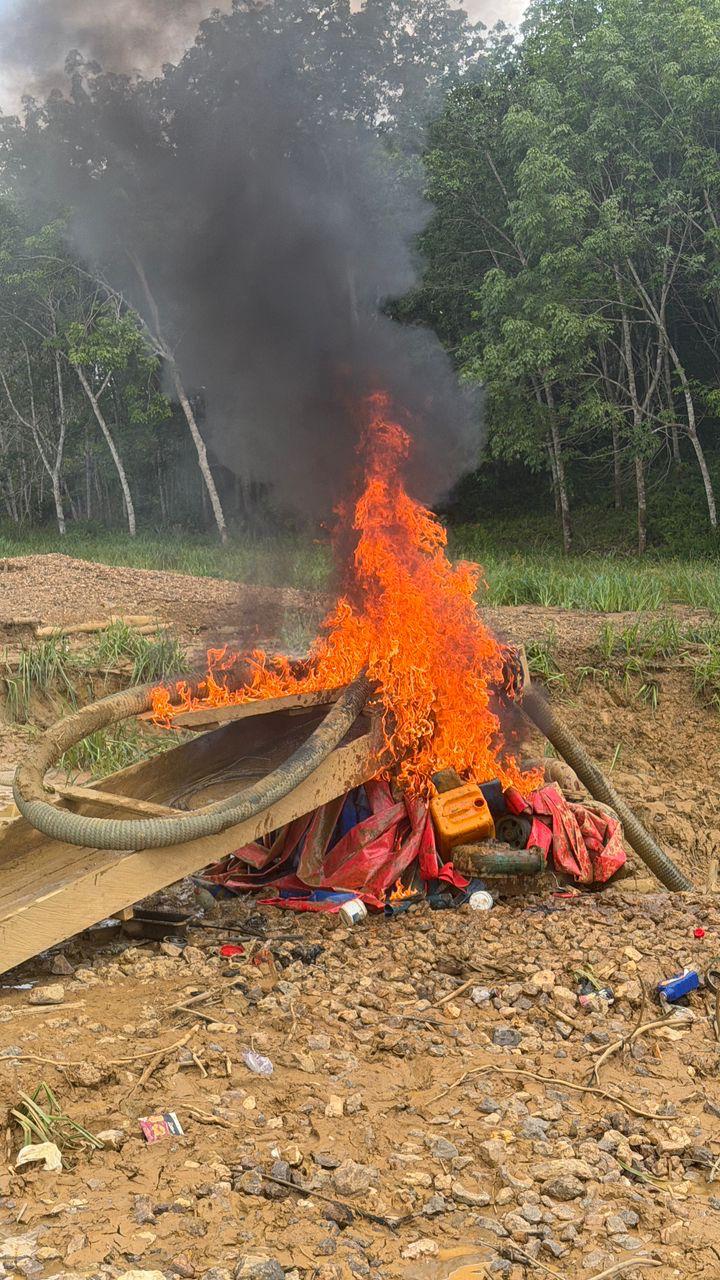
Upon entry into the enclave, operatives encountered a fully functional illegal mining setup. Eight Changfan machines industrial grade equipment typically used in alluvial mining were found in active operation. These were supported by twelve water pumping machines, extensive hose networks, and gold washing platforms.
* All eight Changfan machines were destroyed on site
* Seven water pumping machines were seized
* Remaining equipment was dismantled and rendered inoperable
This systematic disabling of infrastructure reflects NAIMOS’s evolving strategy: not merely disrupting operations, but eliminating the capacity for rapid re entry.
“We are shifting from reactive enforcement to strategic dismantling of illegal mining ecosystems,” another official emphasized.
“The objective is permanence ensuring these sites do not rebound.”
The eighteen suspects apprehended have been identified as:
David Kombat, Moses Kombat, Daniel Cobbinah, Sibi Nabi, Godfred Kojoe, Enoch Danquah, Eric Cobbinah, Henry Kwabena, Sumadu Patrick, David Ginib, Dorbaa Daniel, Simone Benibe, Abraham Waditey, Stephen Kojoe, Kwesi Donste, Bavari Naah, Abdul Rauf, and Paul Ganiue.
They have since been transferred to the Agona District Police Command to assist with investigations and to face due legal process.
Monday’s operation is widely seen as a direct outcome of the renewed strategic direction under Hon. Emmanuel Armah Kofi Buah, whose tenure has been marked by a more aggressive, intelligence driven, and enforcement heavy posture against illegal mining.
His leadership has re energized inter agency coordination and strengthened NAIMOS’s operational mandate, enabling deeper penetration into previously inaccessible illegal mining strongholds including protected forest reserves.
“Hon. Buah’s leadership has brought clarity, urgency, and resolve to this fight,” a source within the Ministry noted.
“What we are witnessing is a system that is no longer tolerating environmental crime but actively dismantling it.”
The NAIMOS Secretariat has reaffirmed its unwavering commitment to safeguarding Ghana’s natural resources, sending a strong signal that illegal mining particularly within protected zones will attract the full force of the law.
“Let this serve as a clear warning,” the Secretariat emphasized.
“Whether in river bodies, farmlands, or forest reserves, illegal mining will be confronted decisively and relentlessly.”
As Ghana intensifies its national response to galamsey, operations such as this signal a turning point where enforcement is no longer sporadic but sustained, strategic, and uncompromising.
For the Cape Three Points Forest Reserve, the intervention may represent a critical lifeline. For illegal operators, it marks the shrinking of safe havens. And for policymakers, it reinforces a growing narrative: that environmental protection is now firmly at the center of national security and sustainable development.
