
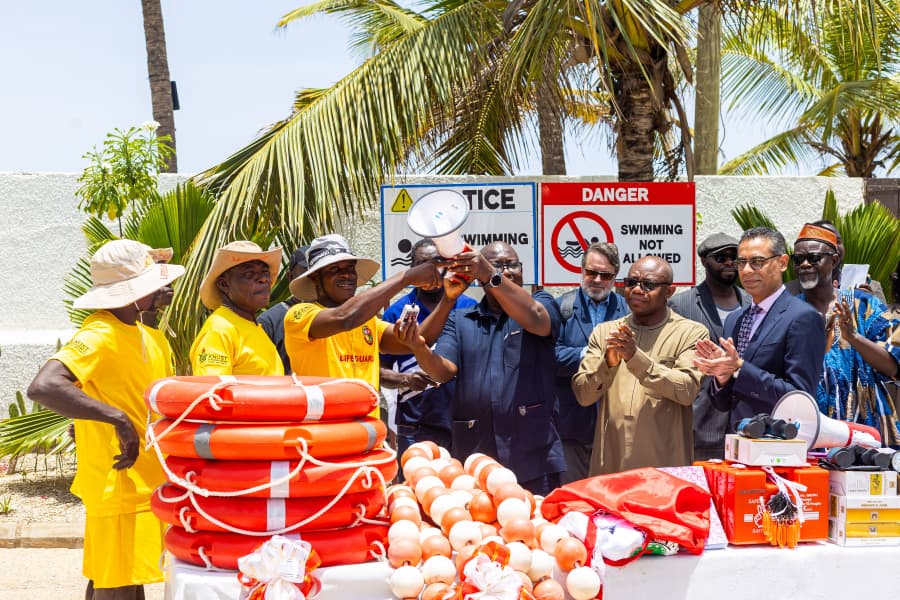
Ghana has taken a major step toward safeguarding lives with the successful launch of a national lifeguarding initiative aimed at preventing drowning and improving safety along the country’s beaches and other water bodies.
The initiative, officially launched on April 14, 2026, at the Labadi Beach Hotel in Accra, is the result of a collaborative effort led by the National Coordination Board for Drowning Prevention, with technical support from the Kwame Nkrumah University of Science and Technology (KNUST) and the Johns Hopkins International Injury Research Unit (JH-IIRU), and support from Bloomberg Philanthropies. The event brought together key stakeholders from national security agencies, emergency services, local government, development partners, and coastal communities, all united by a shared commitment to tackling one of Ghana’s most persistent yet preventable public safety challenges.
Speaking at the event, the Deputy Minister for the Interior, Hon. Ebenezer Okletey Terlabi, who served as Guest of Honour, underscored the urgency of addressing drowning as a national priority. He noted that the issue demands immediate and sustained attention, emphasizing that, “Drowning is not a distant or occasional problem, but it is a present and persistent threat.” He further highlighted the broader meaning of safety in everyday life, stating that, “For many Ghanaians, security is not abstract but is the confidence that daily activities, including work, travel, and recreation, are carried out safely.”
Drowning continues to claim an estimated 1,400 lives annually in Ghana, with children and young people among the most affected. Yet, stakeholders at the launch emphasized that these tragic losses are largely preventable through coordinated action, public awareness, and the deployment of trained personnel. The initiative is therefore focused on introducing practical and sustainable measures that will stop drowning before it occurs, including the deployment of trained lifeguards, improved safety systems at beaches, and stronger collaboration among institutions responsible for public safety.
Early implementation is already showing promising results in parts of the Greater Accra Region, particularly within the La Dade Kotopon Municipality, where 21 trained lifeguards have been deployed across Laboma, La Pleasure, and Acapulco beaches. Their presence is not only improving safety conditions but also restoring public confidence, as beachgoers are assured that trained responders are on hand in case of emergencies. These lifeguards have received professional training in water rescue, CPR, first aid, and risk assessment, and are employed and paid by the municipal assembly—an important step toward long-term sustainability.
The initiative is firmly grounded in multi-sector collaboration, bringing together institutions such as the Ghana Navy, Ghana National Fire Service, Ghana Police Service, National Ambulance Service, and the National Security Council Secretariat, alongside local government authorities and community stakeholders. Commodore Ben Baba Abdul of the Ghana Navy stressed the importance of this collective effort, stating, “We believe that drowning is not the responsibility of one institution, but a shared duty that calls for unity of purpose.”
A significant highlight of the event was the inauguration of the National Coordination Board for Drowning Prevention, which is expected to provide strategic leadership, ensure effective coordination among stakeholders, and guide the long-term expansion of drowning prevention efforts across the country. With support from international partners, the initiative is aligned with global best practices and positioned for sustainable growth.
The launch also underscored the importance of community involvement, with cultural performances and local participation reinforcing the message that preventing drowning requires both institutional commitment and public responsibility. Stakeholders collectively called on all Ghanaians to adopt safe practices around water bodies and to support ongoing efforts to protect lives.
As Ghana moves forward, the national lifeguarding initiative represents a critical milestone in the country’s journey toward reducing preventable deaths and strengthening public safety. With continued leadership, partnership, and community engagement, the initiative is expected to expand its reach and impact, ultimately ensuring that beaches and water bodies across the country become safer for all.
