
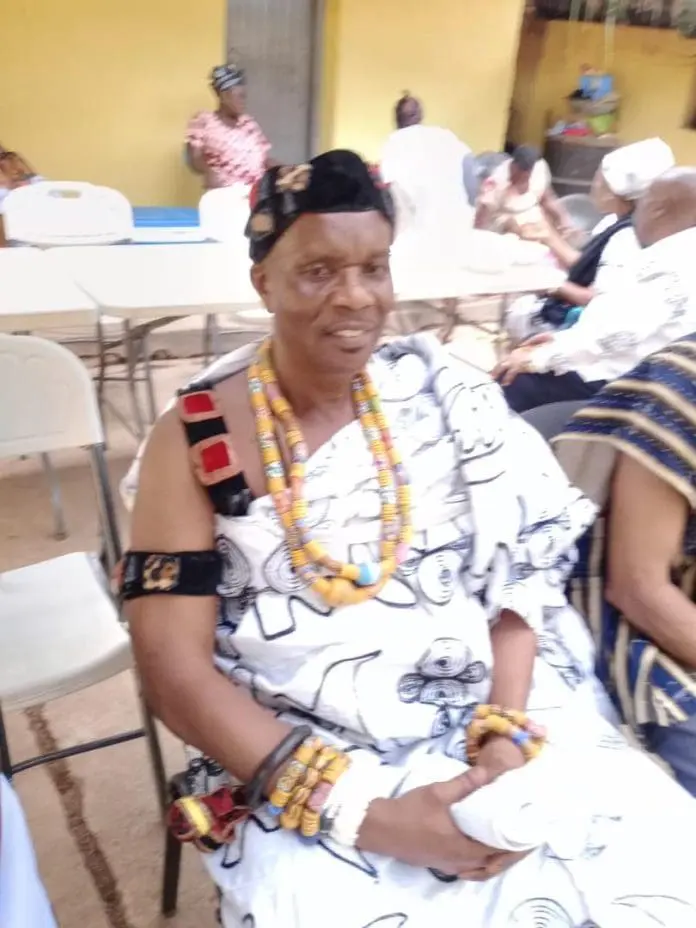
Elders of Hwakpo, led by the Head of the Ackweh Family, have strongly rejected a recent Tema High Court judgment in the long-running Hwakpo land dispute, arguing that customary land ownership cases should not be determined on the basis of information sourced from online encyclopedias such as Wikipedia.
The family’s criticism follows a judgment delivered by Justice Malike Awo Woanyah, which declared the Adibiawer Clan as allodial owners of the disputed land and affirmed the title of the Puplampu Family to 5,650.56 acres.
Addressing a press conference at Hwakpo, the Head of the Ackweh Family described the ruling as deeply troubling and fraught with legal and factual inconsistencies, particularly the court’s apparent reliance on information from Wikipedia while assessing the family’s customary history and land ownership claims.
“Customary land cases cannot be decided by Wikipedia,” the family head declared. “Questions involving centuries-old traditional land ownership, customary succession and indigenous history must be determined on the basis of credible evidence, customary law, judicial precedent and proven acts of possession, not generalized internet publications.”
According to the family, one of the most contentious aspects of the judgment relates to the court’s treatment of the historical account of Naana Adikuor, whom the Ackweh Family identifies as its ancestor and the original source of its claim to the disputed lands.
The family maintains that Naana Adikuor acquired rights over the land through customary arrangements recognized under Dangme tradition several centuries ago. However, portions of the judgment reportedly referenced information relating to the “Trokosi” system obtained from Wikipedia in evaluating that historical narrative.
The elders argued that applying generalized descriptions of cultural practices sourced from an online encyclopedia to determine specific customary land rights in Ada sets a dangerous precedent for the adjudication of traditional land disputes across Ghana.
“This case concerns the interpretation of local customary history and rights that predate colonial administration. Such matters require rigorous legal analysis and examination of evidence, not references from internet sources whose content can be altered by anyone,” one elder stated.
Acreage Discrepancies Raise Questions
Beyond the issue of Wikipedia, the family also pointed to what it described as significant inconsistencies in the acreage covered by the judgment.
According to the elders, the introductory portion of the ruling refers to approximately 67,594.27 acres of land. However, they contend that the writ of summons filed before the court covered about 32.4 acres, while another document referenced in the judgment reportedly concerns only 32.4 acres.
The family questioned how declarations affecting more than 67,000 acres could be made when the figures cited throughout the proceedings appear to differ substantially.
“The subject matter of a land dispute must be clearly identified and consistently defined,” the family head argued. “Where there are varying acreage figures running into tens of thousands of acres, it raises legitimate concerns about the scope of the determination.”
Contradictions in Historical Evidence
The elders also challenged the court’s handling of historical evidence presented by the opposing side.
According to the family, the judgment itself found that a document described as the “History of the Puplampu Family” was unsigned, undated and failed to identify its author. The court reportedly characterized the document as self-serving and not worthy of belief.
Despite that finding, the family contends that the court subsequently accepted key elements of the historical narrative advanced by the Puplampu Family and relied on them in reaching its final conclusions.
The Ackweh Family says this creates a contradiction that undermines confidence in the reasoning behind the judgment.
“If evidence is found to be unreliable, then conclusions drawn from that same evidence must naturally come under scrutiny,” the family head stated.
Previous Judgments and Possession
The family further argues that insufficient weight was given to previous court decisions and evidence of occupation on the disputed land.
The elders referenced earlier judgments, including a Tema High Court decision which they say recognized the Ackweh Family’s rights regarding portions of the land and affirmed its authority to undertake developments and protect the area from encroachment.
They also pointed to the existence of schools, churches, homes and other community infrastructure within Hwakpo as evidence of long-standing occupation and possession.
According to the family, testimony during the trial revealed that members of the Puplampu Family do not occupy significant portions of the disputed territory and have limited physical presence in the area.
The elders therefore expressed surprise that the court concluded the Ackweh Family had failed to establish sufficient acts of possession.
Appeal Under Review
The Head of the Ackweh Family disclosed that consultations with lawyers are ongoing to determine the next legal steps, including a possible appeal.
He said the family remains committed to pursuing the matter through lawful judicial processes and is confident that a higher court will closely examine the issues raised by the judgment.
“We have faith in the judicial system and believe that the appellate process exists precisely to address situations where parties believe significant errors have occurred,” he said.
The judgment has reignited debate over the ownership of extensive lands within the Ada Traditional Area, where competing claims by various families and clans have resulted in decades of litigation.
While the ruling currently remains in force, the Ackweh Family insists that important questions remain unanswered regarding the treatment of customary history, evidentiary standards, previous court decisions and the role of internet-based sources in determining traditional land rights.
