
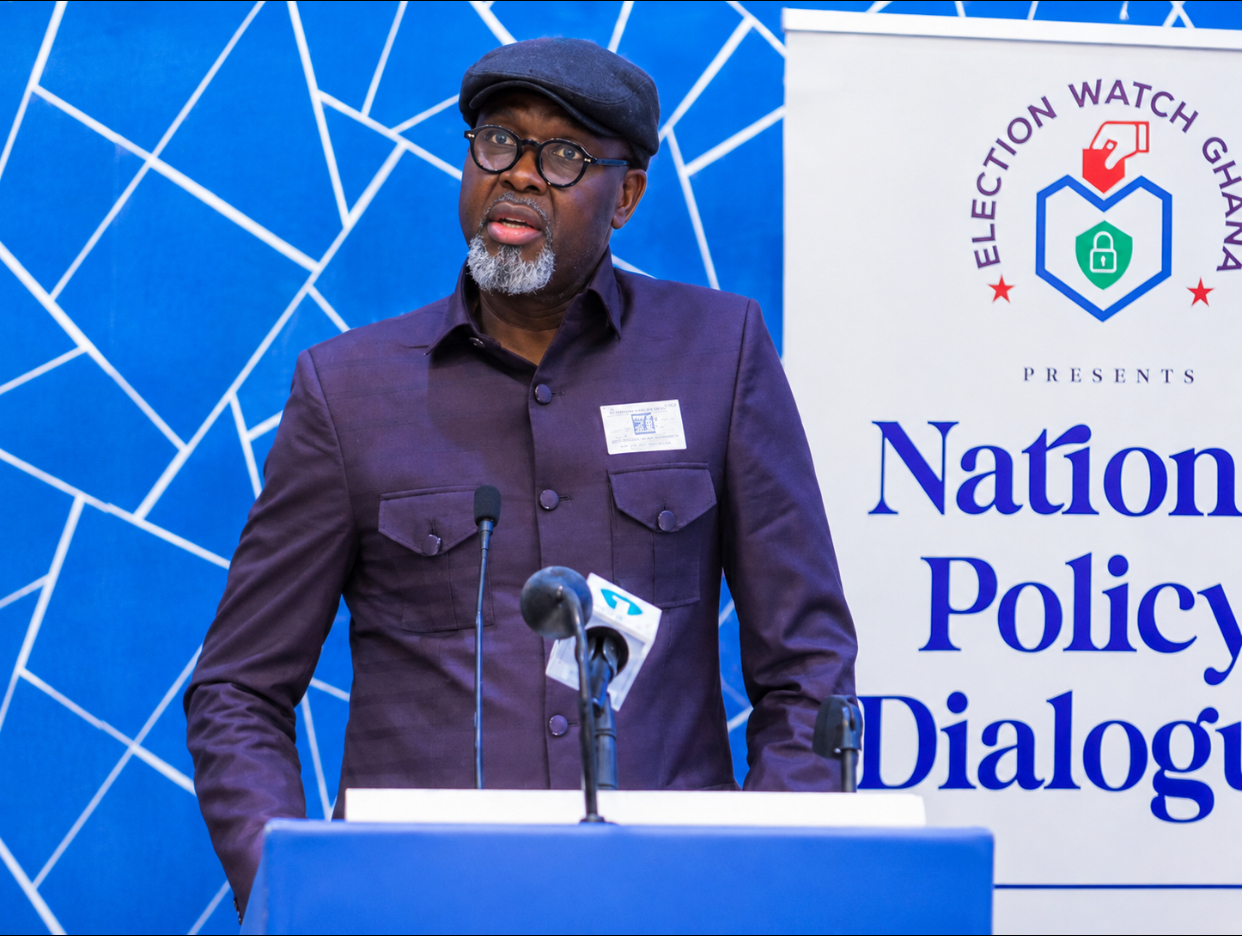
Ghana’s National Security Coordinator, COP Osman Abdul Razak, has warned that the apparent decline in the visibility of political vigilante groups does not necessarily mean the threat has been eliminated, saying some groups are adapting by operating through less visible networks, social media, and encrypted communication channels.
He said some groups that previously operated openly were now rebranding themselves as internal security teams, volunteer task forces, or community security initiatives, while others had dissolved into looser networks that are more difficult for security agencies to identify and track.
“A vigilante group is a vigilante group, regardless of its name, uniform or publicity,” COP Abdul Razak stressed.
He was speaking on Tuesday, August 25, 2026, at a National Policy Dialogue on the implementation of the Vigilantism and Related Offences Act, 2019 (Act 999), organised by Election Watch Ghana at the Kofi Annan International Peacekeeping Training Centre (KAIPTC) in Accra.
The dialogue brought together security officials, political party representatives, civil society organisations, traditional and religious leaders, academics and media practitioners to assess the effectiveness of Act 999 and its implications for Ghana’s national security and democratic governance.
‘Threat has not disappeared’
According to the National Security Coordinator, the passage of Act 999 has contributed to a decline in the open and organised display of political vigilantism, but emerging methods of mobilisation require security agencies and other stakeholders to remain vigilant.
He noted that some groups had shifted from openly identifiable structures to informal arrangements, while political mobilisation was increasingly taking place online.
“Mobilisation has moved online, on social media, encrypted chats, local disputes, targeted security arrangements, or other informal channels,” he said.
COP Abdul Razak said the changing nature of political vigilantism required a corresponding adjustment in intelligence gathering, monitoring and enforcement strategies.
He further acknowledged that prosecutions under Act 999 had been limited and that some legal processes had been slow.
“Let us know that the law exists, and it shall be enforced fairly without fear or favour,” he stated.
He cautioned that weak, selective or delayed enforcement could undermine public confidence in the law and weaken its deterrent effect.
Security enforcement must be impartial
COP Abdul Razak also stressed the need for the enforcement of Act 999 to be insulated from political considerations.
He said operational decisions must be guided by intelligence, evidence and professional assessments, while investigations should be evidence-based and enforcement protocols standardised.
According to him, security personnel responsible for politically sensitive investigations and decisions must be professionally protected from informal political interference.
He also urged stakeholders to shift from reacting to political violence during election periods to preventing it well ahead of elections.
He proposed intelligence monitoring and stakeholder engagement between 12 and 18 months before elections, youth engagement and civic education between nine and 12 months before elections, and intensified monitoring of political mobilisation at least six months before elections.
Election Watch Ghana demands accountability
In her welcome address, Executive Director of Election Watch Ghana, Rose Austin, said seven years after the passage of Act 999, Ghana must candidly examine whether the law has achieved the purpose for which Parliament enacted it.
She said the legislation represented an important national commitment that political competition must not degenerate into violence, intimidation, coercion or the creation of partisan structures operating outside the authority of the state.
However, Ms Austin expressed concern about perceptions of inconsistent or selective enforcement, particularly where political actors or politically affiliated groups are involved.
“Where citizens perceive the law to be applied selectively, the credibility of the rule of law is weakened. Where perpetrators believe that political affiliation can provide protection from accountability, impunity becomes entrenched,” she said.
She warned that entrenched impunity could create an environment in which political vigilantism becomes normalised or formalised.
According to her, political vigilantism should not be viewed merely as a partisan or electoral matter but as an issue involving national security, democratic governance, public order and the rule of law.
‘Fight is not against any political party’
Ms Austin emphasised that the campaign against vigilantism must not be interpreted as an attack on any particular political party.
“The fight against vigilantism is not a fight against any particular political party. It is a fight for the integrity of Ghana’s democratic system itself,” she said.
She urged political parties, regardless of whether they were in government or opposition, to support a political environment in which no party would require, tolerate, or benefit from organised political violence.
She also called on political parties to take responsibility for the conduct of their members and affiliated groups, while urging security agencies to enforce the law professionally, impartially, and without fear or favour.
Government, she said, must provide the necessary institutional and legal support for effective implementation of the law, while civil society must continue to monitor, educate, advocate, and hold institutions accountable.
Chief of Staff calls for ‘concrete, trackable commitments’
A speech delivered on behalf of the Chief of Staff, Dr Julius Debrah, by Special Envoy to the Sahel States, Lt. Gen. (Rtd.) Larry Gbevlo-Lartey, described the dialogue as a timely opportunity to examine the practical implementation of Act 999.
The Chief of Staff said the strength of a law depended not only on its enactment but also on its implementation, institutional enforcement and ability to inspire public confidence.
He urged participants to examine both the achievements recorded under Act 999 and the legal, operational and institutional bottlenecks that continue to undermine its effectiveness.
He further stressed that vigilantism was a threat to the entire public and should not be reduced to an issue involving one political party.
The dialogue, he said, should move beyond identifying problems to developing “concrete, trackable commitments” capable of strengthening Ghana’s democratic resilience.
Act 999
The Vigilantism and Related Offences Act, 2019 (Act 999), was assented to on August 23, 2019. The law was enacted to disband vigilante groups, including political party vigilante groups and land guards, and to proscribe acts of vigilantism in Ghana.
The law prohibits the formation, organisation or operation of vigilante groups and provides significant criminal penalties for violations.
The National Policy Dialogue therefore sought to assess how effectively the legislation has worked seven years after its enactment, identify gaps in its implementation, and develop practical measures to prevent political violence from undermining Ghana’s democratic stability.
Ms Austin said the outcome of the engagement should not end with speeches and expressions of concern but should translate into commitments that can be followed up and for which institutions and stakeholders can be held accountable.
“Our democracy is too precious to be surrounded by political violence. Our peace is too vulnerable to be taken for granted,” she said.
She urged all stakeholders to move “from rhetoric to accountability” and from commitments on paper to measurable implementation.
The organisers believe sustained collaboration among political parties, security agencies, civil society, traditional and religious leaders, the media, and citizens will be critical to closing the space for political vigilantism and safeguarding Ghana’s democratic future.
Source: Joseph Kobla Wemakor
