
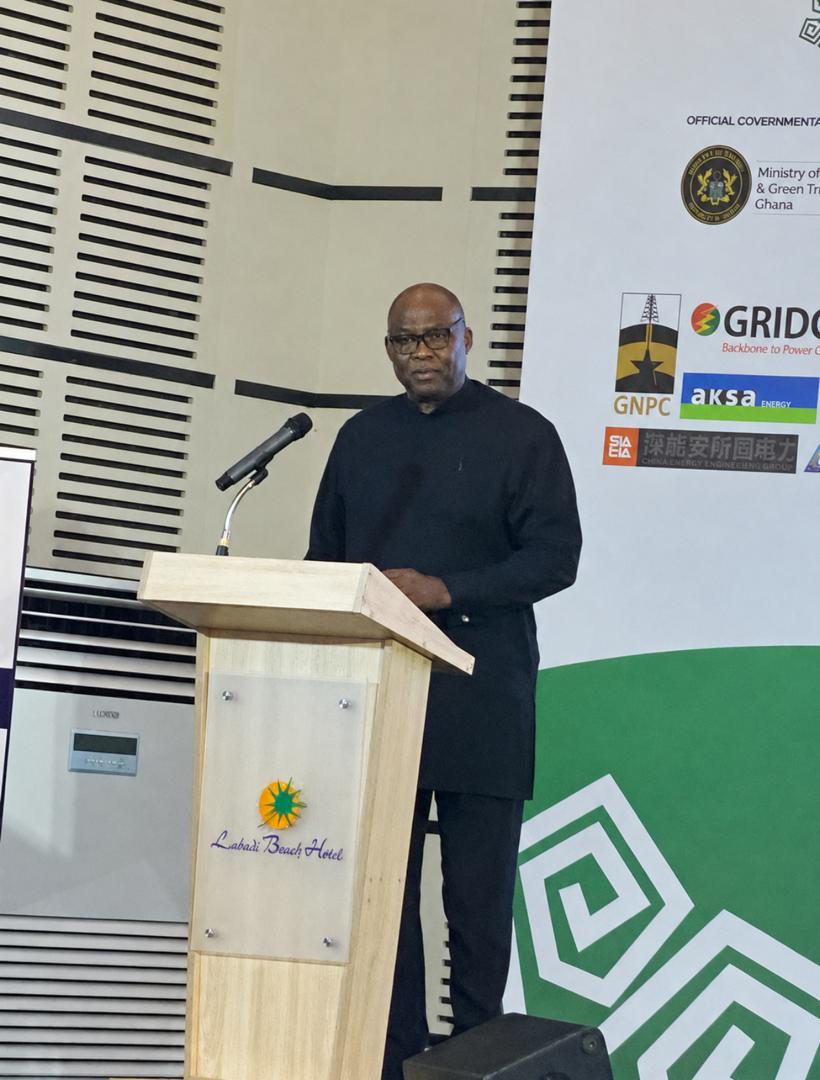
Former Minister of Mines and Energy and Presidential Special Envoy for Global Reparations, Ambassador Ekow Spio-Garbrah, has called for a fundamental rethink of Ghana’s approach to energy development, urging the country to pursue long-term policies, stronger national control, and innovative financing to achieve sustainable energy transformation.
He said Ghana’s ability to secure its economic future would depend largely on whether the country could exercise greater control over its energy resources, planning, and delivery while developing policies that extend beyond short-term political considerations.
Ambassador Spio-Garbrah made the call when he addressed the 3rd Energy Sustainability Conference 2026, organized by Safety Communication Consult in partnership with the Ministry of Energy and Green Transition at the Labadi Beach Hotel in Accra.
The conference, held on August 27, 2026, was themed “Public-Private Synergy: The Role of Corporate Ghana in National Energy Transformation.”
Drawing from his experience as a former Minister of Mines and Energy, Ambassador Spio-Garbrah stressed that courage, integrity, and a commitment to the national interest must remain at the heart of decisions concerning Ghana’s strategic resources.
He recalled that during his time in government, he was assigned responsibilities in the energy sector partly because of his willingness to stand up for what he considered the national interest.
According to him, Ghana has the human resources, technical expertise, and natural resources needed to transform its economy, but the country must develop the institutional courage and strategic vision to harness them effectively.
Ghana needs energy sovereignty
The former minister said Ghana must work towards achieving what he described as “energy sovereignty”—greater control over the country’s energy resources, energy planning, and energy delivery.
He noted that independent power producers currently contribute a significant proportion of Ghana’s electricity supply, making it necessary for the country to critically examine how its energy system is structured and how contracts and investments are managed.
“Getting that energy sovereignty is critical for us,” he said, arguing that greater control over energy would allow Ghana to align power generation and delivery with its industrial requirements and broader national development priorities.
He maintained that Ghana’s energy planning should not be dictated solely by immediate needs or short-term considerations but must be anchored in long-term national development objectives.
“We must think beyond 10 years.”
Ambassador Spio-Garbrah cited the construction of the Akosombo Dam under Ghana’s first President, Dr. Kwame Nkrumah, as an example of long-term thinking.
He noted that when the project was conceived, the electricity expected from the dam was considerably more than the country immediately required, demonstrating a willingness to invest for future generations.
He therefore advocated energy plans capable of lasting 10 years or more, stressing the importance of determining an appropriate energy mix involving oil and gas, solar, renewables, and other sources.
He said Ghana’s future energy strategy must be guided by sustainability rather than short-term political calculations.
Africa’s energy investment gap
Ambassador Spio-Garbrah also drew attention to the wider African energy crisis, noting that the continent continues to receive a disproportionately small share of global energy investment despite its enormous natural and renewable energy potential.
He cited figures presented at the conference indicating that Africa accounts for roughly a fifth of the world’s population but receives only about three percent of global energy investments.
He further noted that Africa accounts for only about 1.6 percent of installed renewable energy capacity globally, despite possessing some of the world’s richest solar and wind resources.
The continent also continues to face a massive electricity access deficit, with approximately 590 million Africans reportedly lacking access to electricity.
“These are the kinds of gaps that we hope that the Parisian finance can help many countries to resolve,” he said.
Reparations and Africa’s development
As Presidential Special Envoy for Global Reparations, Ambassador Spio-Garbrah linked the contemporary energy debate to Africa’s historical exploitation.
He argued that Africans themselves constituted a major source of labour and economic energy during the transatlantic slave trade, contributing to the development of economies outside the continent.
He said reparations should, therefore, not be viewed solely through the lens of historical compensation but also in terms of addressing structural disadvantages that continue to affect Africa’s economic development.
According to him, Africa must now convert its human, natural, and technological potential into what he described as a new form of “digital economic energy” capable of driving transformation across the continent.
Calls for retired experts to be tapped
Ambassador Spio-Garbrah also urged Ghana to make better use of the expertise of retired professionals, former ministers, chief executives, and other experienced specialists who have accumulated decades of knowledge in the energy and related sectors.
He described such professionals as a “fountain of knowledge” whose experience could be harnessed to help address contemporary national challenges.
He noted that many retired experts may not necessarily demand payment for offering their expertise, making their knowledge an underutilized national resource.
Stronger public-private collaboration needed
The former minister’s call comes against the backdrop of growing discussions about how government and corporate Ghana can work together to build a more resilient and sustainable energy sector.
He stressed that Ghana has considerable natural resources and technical expertise, but translating those advantages into sustainable development requires visionary leadership, sound policies, and institutions capable of defending the national interest.
He further cautioned that Ghana’s energy challenges cannot be understood purely from a domestic perspective, arguing that international institutions and global geopolitical forces continue to influence energy policy, financing, and resource development.
For Ghana, he said, understanding these international dynamics is essential to avoiding policy errors and ensuring that national energy decisions ultimately serve the country’s long-term developmental interests.
Source:Joseph Kobla Wemakor
