
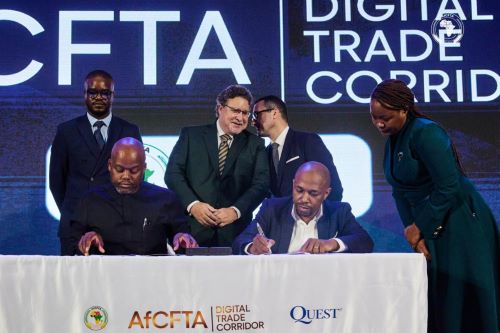
The African Continental Free Trade Area (AfCFTA) digital trade corridor will help reduce the cost and complexity of doing business across Africa by facilitating seamless cross-border payments, expanding market access and strengthening intra-African commerce, AfCFTA Secretary-General Wamkele Mene has said.
According to Mr Mene, the initiative is intended to complement the AfCFTA by providing the digital infrastructure required to turn the vision of a single African market into a practical reality for businesses and consumers.
He said the continent’s 1.4 billion people and 55 countries represented a significant market opportunity, but persistent barriers to trade continued to limit the ability of African businesses to fully benefit from that market.
Mr Mene questioned why African countries should continue to route payments through financial institutions outside the continent or depend on foreign currencies when trading among themselves.
He said the integration of digital payment systems, particularly the Pan-African Payment and Settlement System (PAPSS), offered an opportunity to change that situation by enabling businesses to transact in their respective local currencies.
“Why should two African nations route payments through a third country outside of the continent? Why should we rely on external foreign currencies to trade with one another as a continent?” he asked.
Mr Mene said a borderless continental payments infrastructure would help retain more of the value generated from African commerce within the continent and reduce the costs associated with cross-border transactions.
He noted that PAPSS had already demonstrated the potential for African businesses to make and receive payments using local currencies, reducing the need for third-party currencies and financial systems.
Digital platform to transform commodity trade
Beyond payments, Mr Mene said the digital trade initiative would also create opportunities to fundamentally change the way Africa participates in global commodity markets.
He said the continent had for decades remained a major source of raw materials, including minerals, while receiving limited value from the processing and trading of those resources.
The proposed digital minerals and commodities exchange is expected to provide a platform through which African commodities can be verified, valued, traded and delivered within a digital ecosystem tailored to the continent.
Mr Mene said the broader objective was to ensure that Africa moved beyond supplying raw materials to becoming a greater owner and beneficiary of the wealth generated from its resources.
“Africa stops being only the source of the wealth. Africa becomes the owner of the wealth,” he said.
He explained that greater participation in commodity valuation, price discovery and trade would strengthen Africa’s bargaining position and support efforts to retain more economic value on the continent.
One digital marketplace for Africa
Mr Mene further said the proposed digital marketplace would connect businesses across the continent and provide entrepreneurs with access to customers beyond their immediate geographical markets.
He said digital technology could allow a small business in one African country to reach customers thousands of kilometres away without being constrained by traditional physical barriers to trade.
“This is Africans trading with Africans, trading African prosperity, building African prosperity, and leveraging on African digital innovation,” he said.
He acknowledged that creating a single market across 55 countries was a major undertaking but stressed that the scale of the ambition should not discourage implementation.
“Creating a single market out of 55 countries requires ambition, vision, and more importantly, execution of that vision,” Mr Mene said.
He said the digital trade corridor should therefore be viewed not simply as a technology project but as an important instrument for implementing the AfCFTA, reducing trade costs and deepening economic integration.
The initiative is ultimately expected to strengthen the capacity of African businesses to trade across borders, facilitate digital payments, improve commodity markets and help retain a greater share of the value generated by African economic activity within the continent.
