
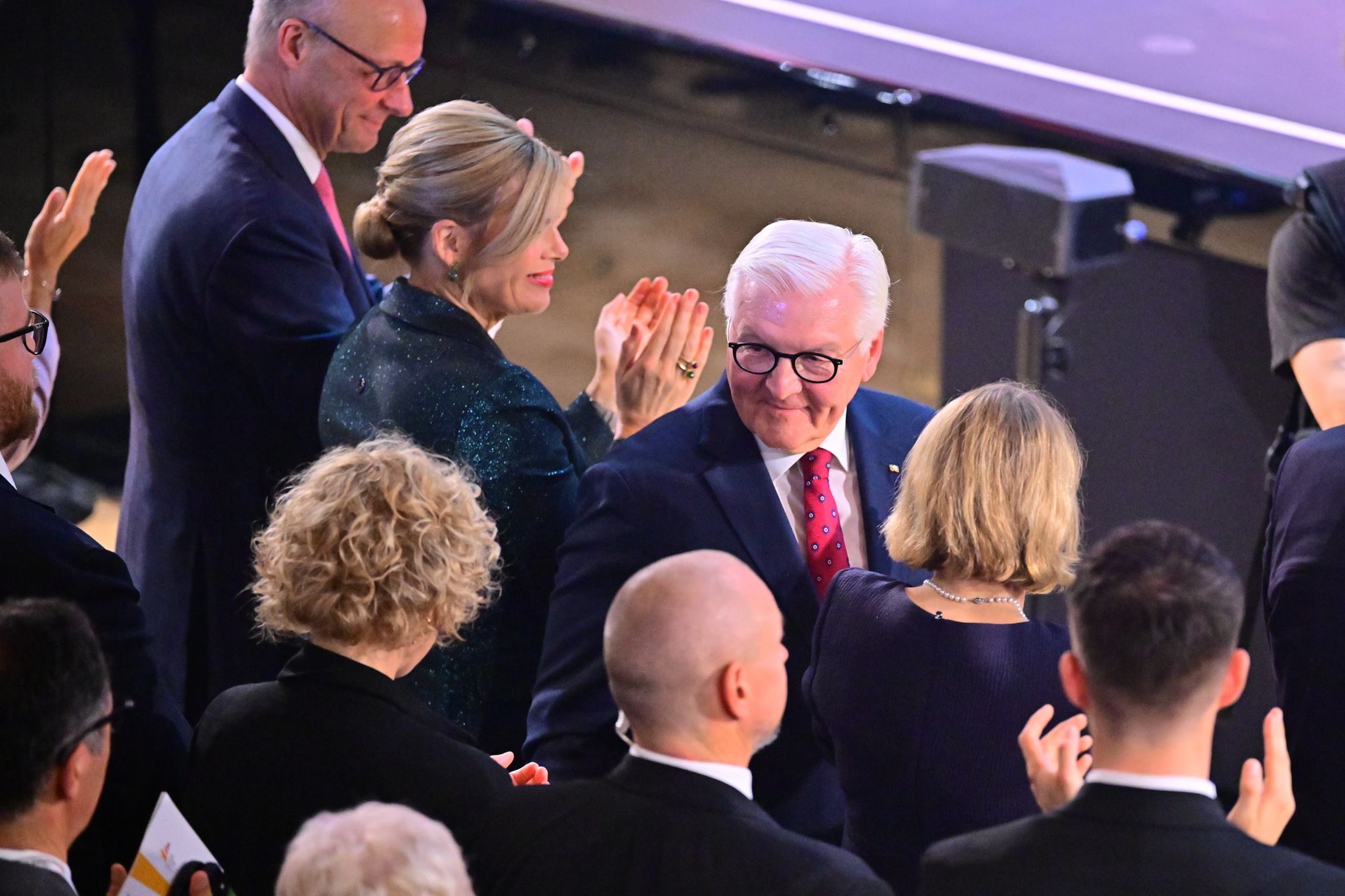
German President Frank-Walter Steinmeier called for a resolute defence of democracy as the nation marks Unity Day in numerous events staged on Saturday.
Steinmeier, speaking in Bremen where the national events are being held this year, also warned against the further rise of extremist forces in Germany, fuelled partly by lies and manipulation on social media.
“And all of this is accompanied by intolerable political demagoguery from extremist forces who revel in destruction, mock and threaten other people. And that endangers not only freedom and democracy,” said Steinmeier. “It also endangers our internal unity. And we must not allow that to happen.”
The country’s political leaders are gathering in Bremen to mark German Unity Day. The national holiday commemorates October 3, 1990, when the five states of the former East Germany joined the Federal Republic of Germany, formally ending the long division between East and West Germany following World War II.
The Bremen celebrations come just weeks after a series of state and local elections, with far-right and far leftist groups winning large sections of the vote.
Almost four decades after reunification, large sections of society have expressed their distrust in Germany’s political order, Steinmeier said.
Every vote counts and must be taken seriously, he said. “That is precisely why we cannot ignore the fact that a quarter or more of the electorate are signalling, through their voting decisions, that they are turning their backs on key fundamental decisions of the Republic.”
Steinmeier said people should see the discrediting of democratic processes, the radicalization of public opinion and vilification of compromise as a warning.
The president said he had thought that everyone had learnt the lesson from history, but was dismayed by the way far-right extremists seek to erase the memory of the victims of the Holocaust.
The main celebrations on Saturday began with an ecumenical church service, with some 1,000 guests of honour gathering in Bremen Cathedral. Among them were Steinmeier, Chancellor Friedrich Merz and President of the Bundestag, Germany’s lower house of parliament, Julia Klöckner.
The service focused on the theme of strength, in line with the motto of this year’s celebrations: “Many strengths – one country.”
The sermon focused on a fairy tale based in the town, about very different animals who nonetheless depend upon one another. Bernd Kuschnerus, president of the Bremen Evangelical Church said together, they discover their strengths. “We cannot get anywhere on our own.”
Bishop Dominicus Meier of Osnabrück also recalled the tale of the animals, called the “Town Musicians of Bremen.” They too lived at a time of change and had to find a new direction, he said.
In the fairy tale, all four elderly animals are threatened with being sold or facing a violent death, so they join forces. “We, too, are living in such times. Habits, structures and ways of life that previously gave us a sense of security are reaching their limits or are no longer sustainable,” he said.
Many people feel overwhelmed, powerless or are withdrawing from society. They must not be left alone, Meier said. “Let us realize that unity and cohesion only hold true where people live them out with conviction and integrity, and stand up against division and polarization.”
Andreas Bovenschulte, president of the upper house, or Bundesrat, also called for greater recognition of different life paths and a resolute commitment to democracy on German Unity Day.
German reunification was a joint decision, he said. “East Germans were not mere spectators of their own history. They made history.”
But, he said, good jobs, education and reliable public services should not be a matter of postcode.
His comments come amid concern about the consequences of reunification, more than three decades after the fall of the Berlin Wall. Disparities between eastern and western Germany persist, particularly in terms of pay and wealth, while the economic upheaval that followed reunification continues to shape the east.
Some eastern Germans also argue that they have had too little influence or recognition in national institutions.
More than 400,000 people are expected to attend the public festival in Bremen, which is hosting the central celebrations because it currently holds the presidency of the Bundesrat.
Numerous stalls and stages have been set up in the city centre for the festival which runs through Sunday. Some 800 events are planned including free concerts, discussions, guided tours and exhibitions.
By Helen Hoffmann, dpa
