
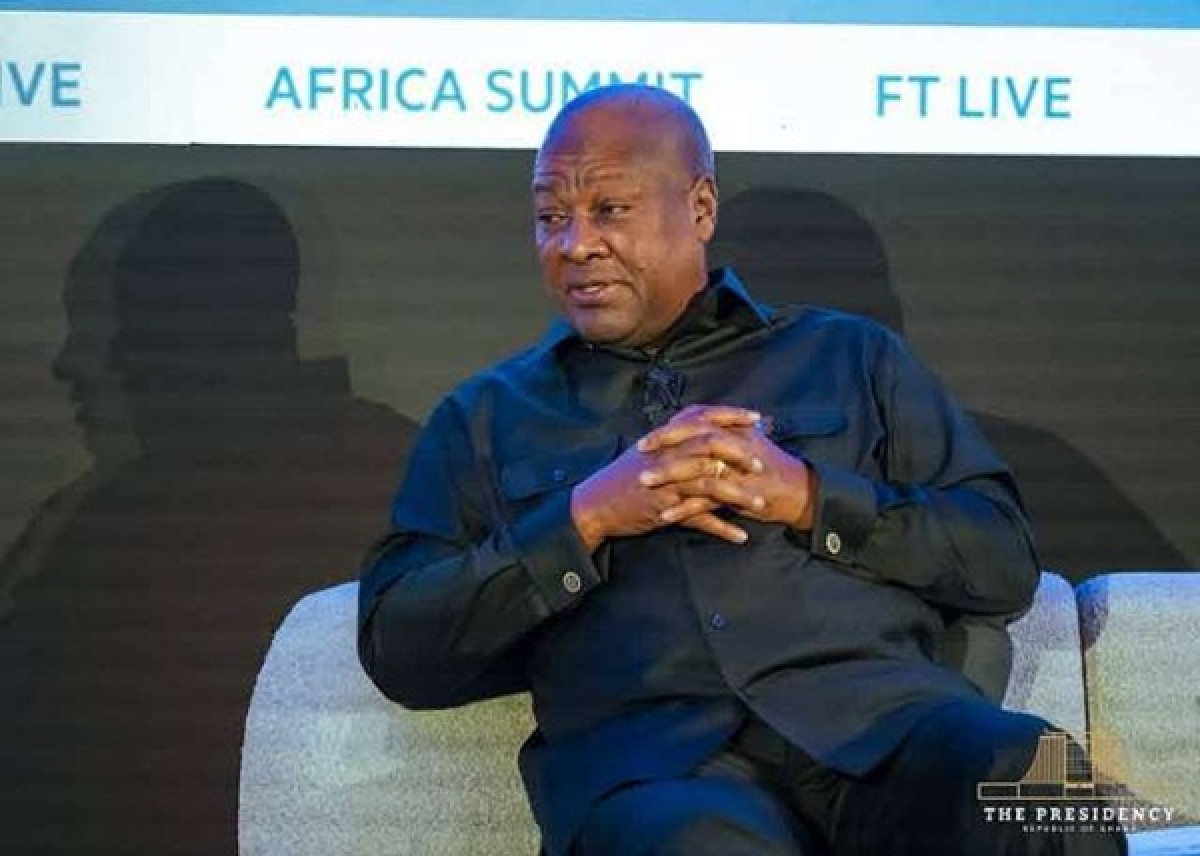
President John Dramani Mahama has called for a fundamental transformation of Africa’s economic structure, urging African countries to reduce their dependence on foreign aid and prioritise industrialisation, domestic resource mobilisation and economic self-reliance.
He said the continent must move away from its traditional role as an exporter of raw materials and a consumer of finished products by investing in local manufacturing, processing and value addition to create jobs and strengthen economic growth.
Speaking at the Financial Times Africa Summit in London, President Mahama challenged global financiers, institutional investors and policymakers to support a fairer international financial system that would enable African economies to access affordable capital for development.
He criticised the high borrowing costs imposed on African countries, describing the global financial architecture as unfair and a major obstacle to the continent’s development.
“The global order is rigged against Africa. I have always maintained that position,” he stated.
“We borrow at eight times the interest rates at which Western nations borrow. Sometimes, we borrow to ameliorate the effects of climate change, which we did not create.”
President Mahama stressed that declining international development assistance should serve as a wake-up call for African governments to strengthen their economies rather than deepen their reliance on external support.
“The response to dwindling aid is not to learn how to improve your begging skills,” he said.
“You need to respond differently by becoming more resilient and more sustainable.”
Citing Ghana’s experience, the President disclosed that the withdrawal of funding from the United States Agency for International Development (USAID) had created an annual financing gap of approximately US$154 million.
He explained that about US$74 million of the affected funding had previously supported critical healthcare interventions, including HIV testing and antiretroviral treatment.
According to him, the development underscored the urgency for African governments to mobilise domestic resources and assume greater responsibility for financing essential public services.
President Mahama said Ghana’s Accra Reset initiative, originally designed to protect social expenditure, had evolved into a broader strategy for strengthening economic governance, resilience and national ownership of development priorities.
“You cannot own the outcome when you are not part of the decision-making. We must have some control,” he emphasised.
He further called for increased investment in Africa’s industrial sector to reduce dependence on commodity exports and generate sustainable employment opportunities, particularly for the continent’s growing youth population.
“We cannot continue forever as exporters of raw materials to the rest of the world and consumers of finished products,” he said.
“We must bring part of that processing and value addition into Africa to create jobs for our young people.”
The President maintained that Africa’s pursuit of economic independence did not mean withdrawing from international partnerships but rather redefining them to ensure fairness, shared ownership and mutual benefits.
He urged international investors to embrace partnerships that promote local processing, technology transfer, joint ventures and greater African participation in economic decision-making.
President Mahama said such arrangements would attract long-term private investment, strengthen industrial development and enable African countries to retain a greater share of the wealth generated from their natural resources.
He reiterated that Africa’s economic future must be anchored in industrialisation, affordable financing and stronger ownership of its development agenda.
