
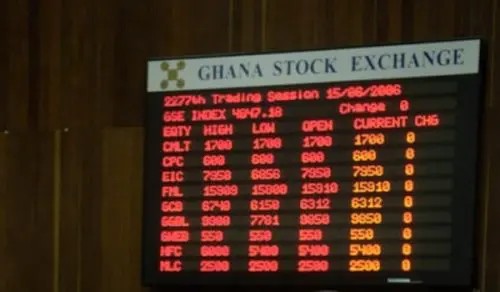
The Ghana Stock Exchange (GSE) maintained its strong performance in the week ending October 30, 2026, with its Composite Index closing at 14,302.27 points and recording an impressive year-to-date return of 63.08%, driven by gains in major listed stocks.
The rally came as the Ghana cedi strengthened against the US dollar, British pound and euro, despite declining trading activity on the equities and fixed-income markets.
According to the latest weekly market report by Tesah Capital Research, gains in banking and telecommunications stocks helped sustain the market’s upward momentum, while demand for Treasury bills moderated.
Banking, Telecom Stocks Drive Market Gains
The GSE Composite Index closed the review week at 14,302.27 points, bringing its year-to-date return to 63.08%, supported by strong performances from SCB PREF, GCB Bank, MTN Ghana and KASA.
SCB PREF led the gainers, advancing 10% to close at GH¢0.99, while GCB Bank rose 4.60% to GH¢42.08.
MTN Ghana recorded a 3.53% increase to GH¢6.75, with KASA gaining 2.21% to close at GH¢1.85.
GCB Bank emerged as one of the market’s strongest performers, posting a year-to-date return of 109.25%. MTN Ghana and KASA followed with returns of 60.71% and 54.17%, respectively. However, some listed equities recorded losses during the week.
Republic Bank Ghana (RBGH) declined 2.20% to GH¢4.00, while Enterprise Group (EGL) shed 1.18% to GH¢8.40.
Guinness Ghana Breweries (GGBL) fell 0.37% to GH¢10.66, with Fan Milk (FML) edging down 0.07% to GH¢13.99. Gold-backed security GLD remained unchanged at GH¢462.36.
Despite the market’s positive performance, trading activity slowed, with the volume of shares traded declining by 14.76% from 12.36 million to 10.53 million shares.
The total value of shares traded stood at approximately GH¢56.52 million.
Tesah Capital Research expects financial and information and communications technology stocks to remain major drivers of market performance in the coming week.
Treasury Bill Demand Drops
Meanwhile, investor demand for Treasury bills weakened significantly, with total bids declining to GH¢2.55 billion from GH¢4.23 billion in the previous week.
Despite the decline, the government’s latest auction recorded a marginal oversubscription.
The government targeted GH¢2.447 billion but received bids amounting to GH¢2.548 billion, representing an oversubscription of 4.13%.
Acceptance rates varied across the three Treasury bill tenors, with 81.43% of bids accepted for the 91-day bill, 93.39% for the 182-day bill and 47.59% for the 364-day bill.
Interest rates also declined across all three instruments.
The 91-day Treasury bill rate dropped by one basis point to 4.60%, while the 182-day rate fell by three basis points to 6.26%.
The 364-day instrument recorded the largest decline, shedding seven basis points to settle at 9.60%.
The government has set a target of GH¢3.543 billion for its next Treasury bill auction.
Fixed-Income Market Records Lower Trading Activity
Trading activity on the Ghana Fixed Income Market (GFIM) also declined during the review period, with total volumes falling by 2.8% to GH¢13.36 billion.
Treasury bills continued to dominate transactions, accounting for 61.30% of total trading volumes.
Bonds issued under the Domestic Debt Exchange Programme (DDEP) represented 37.55%, reinforcing the dominance of government securities in the secondary market.
Sell-buy-back transactions accounted for 0.92%, while new Government of Ghana notes represented 0.11%.
Corporate bonds and commercial paper contributed 0.08% and 0.04%, respectively.
The figures indicate that investor activity remained concentrated in Treasury bills and DDEP bonds, even as overall trading volumes declined.
Cedi Appreciates Against Dollar, Pound and Euro
On the foreign exchange market, the Ghana cedi recorded gains against all three major international currencies during the week.
Data from the Bank of Ghana’s interbank midrates showed that the local currency appreciated by 0.26% against the US dollar to close at GH¢11.62.
Despite the weekly improvement, the cedi remained 10.07% weaker against the dollar on a year-to-date basis.
Against the British pound, the local currency strengthened by 0.06% to GH¢15.56, although its year-to-date depreciation stood at 9.67%.
The cedi recorded its strongest weekly gain against the euro, appreciating by 0.61% to close at GH¢12.96. Its year-to-date depreciation against the European currency stood at 5.32%.
Meanwhile, indicative open-market midrates remained higher than the official interbank figures, with the dollar trading at GH¢11.73, the pound at GH¢15.70 and the euro at GH¢13.31.
Market Outlook
The week’s performance highlighted the continued strength of Ghana’s equities market, supported by gains in key banking and telecommunications stocks, despite reduced trading volumes.
The cedi’s appreciation against major international currencies also provided a positive development for the foreign exchange market, although the local currency remained weaker on a year-to-date basis.
In the fixed-income market, declining Treasury bill demand and lower secondary-market trading volumes pointed to more subdued investor activity.
Looking ahead, Tesah Capital Research expects banking and ICT stocks to remain important influences on the Ghana Stock Exchange’s performance, as investors monitor market conditions and developments in the broader economy.
