
Human Rights Reporters Ghana (HRRG), a vibrant media advocacy and human rights organisation has called on governments across West Africa to strengthen investment in early childhood education and development, warning that gaps in inclusive learning, child protection, healthcare, nutrition, and institutional accountability could undermine the developmental opportunities of millions of young children.
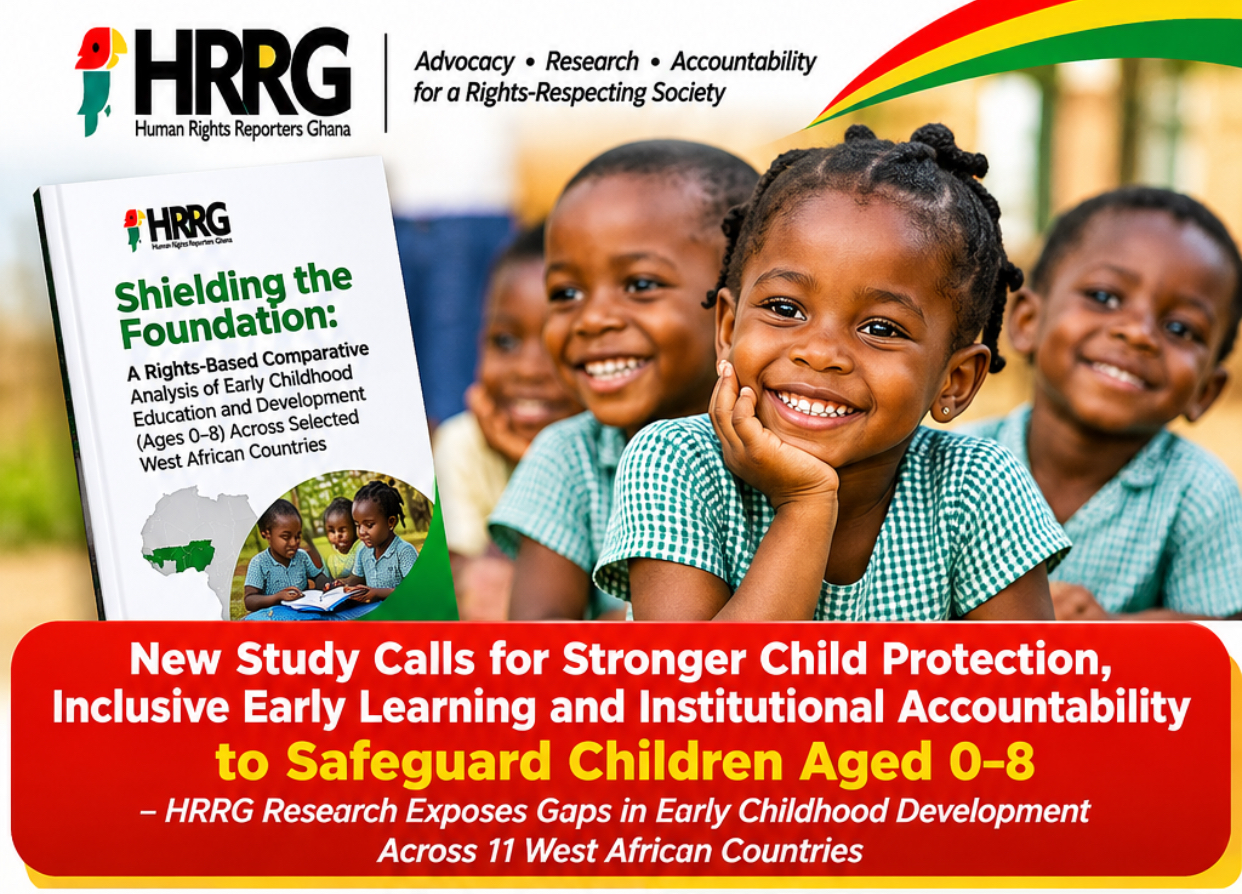
The call follows the publication of a new regional research report titled “Shielding the Foundation: A Rights-Based Comparative Analysis of Early Childhood Education and Development (Ages 0–8) Across Selected West African Countries.”
The study examines the policy environment, legal frameworks, institutional responsibilities, and available evidence relating to children aged zero to eight across 11 selected countries: Benin, Burkina Faso, The Gambia, Ghana, Guinea, Liberia, Mali, Niger, Nigeria, Senegal, and Sierra Leone.
Led by HRRG Founder and Executive Director, Dr. Joseph Kobla Wemakor, who served as Principal Investigator and Lead Research Consultant, the research argues that early childhood development must receive greater attention in national development planning and public investment priorities.
It emphasises that the early years are not simply a preparatory stage for formal schooling but a critical period in which children’s health, nutrition, safety, caregiving environment, and access to learning opportunities collectively shape their development.
Investment must go beyond classrooms
A central message of the report is that investment in early childhood development should not be restricted to constructing classrooms or expanding pre-primary education.
Instead, HRRG advocates an integrated approach that connects early learning with healthcare, adequate nutrition, responsive caregiving, child protection, and social support.
Drawing on the Nurturing Care Framework developed by the World Health Organisation, UNICEF and the World Bank, the report identifies five interconnected components essential to children’s development: good health, adequate nutrition, responsive caregiving, security and safety, and opportunities for early learning.
According to the research, these elements must be addressed together if governments are to create environments in which children can survive, thrive, learn, and reach their developmental potential.
The report also examines the implications of child labour, child marriage, female genital mutilation, disability-related exclusion, and weaknesses in institutional protection systems for children’s rights.
Research highlights gaps in policy implementation and evidence
Through a comparative documentary and policy analysis, the study reviews published secondary evidence, national policies, legal instruments, official statistics, and institutional research across the selected countries.
It identifies areas requiring sustained policy attention, including disparities in access to early learning, challenges in providing disability-inclusive services, weaknesses in child protection arrangements, and limitations in the availability and comparability of national data.
The report notes that differences in statistical definitions, age classifications, survey periods, and data collection methods can complicate comparisons between countries.
It therefore focuses on identifying shared policy concerns, institutional responsibilities, and opportunities for improvement rather than producing a ranking of the countries examined.
RightsShield Framework introduced
The research also proposes a conceptual monitoring approach known as the RightsShield Framework, intended to support the examination of early childhood rights, institutional responsiveness, and accountability.
The framework seeks to encourage a broader assessment of whether government commitments and institutional policies are translating into practical protection, inclusive services, and meaningful developmental opportunities for children.
HRRG clarifies that the framework remains conceptual and requires further technical development, stakeholder consultation, pilot testing, and independent validation before it can be adopted as a formal monitoring instrument.
HRRG urges governments to strengthen child-focused investment
The report recommends increased investment in inclusive early childhood education and development services, stronger coordination among public institutions, improved child protection systems, and more effective accountability mechanisms.
It also calls for better collection and use of reliable, age-disaggregated data to help governments identify children who are being excluded from essential services and design interventions that respond to their specific circumstances.
Particular attention is given to children with disabilities and those living in vulnerable situations, who may face additional barriers to accessing quality early learning, healthcare, protection, and social support.
The organisation maintains that protecting children’s developmental rights requires coordinated action involving governments, educational institutions, healthcare providers, social protection agencies, civil society organisations, development partners, families, and communities.
Early childhood development as a sustainable development priority
HRRG believes that stronger investment in the early years can contribute to broader development objectives, including educational equity, social inclusion, human dignity, and the protection of children’s fundamental rights.
The organisation is encouraging governments, policymakers, development partners, researchers, and civil society organisations to engage with the report’s findings and recommendations and translate relevant commitments into practical interventions.
The research was undertaken through documentary and comparative policy analysis, drawing on published secondary evidence, official data, national legislation, government policies, and institutional publications. It does not claim original household surveys, interviews, focus group discussions, or primary field investigations.
Published on November 16, 2026, the 23-page report is available through Zenodo, an open research repository.
Read the full report:
https://zenodo.org/records/24270448
