
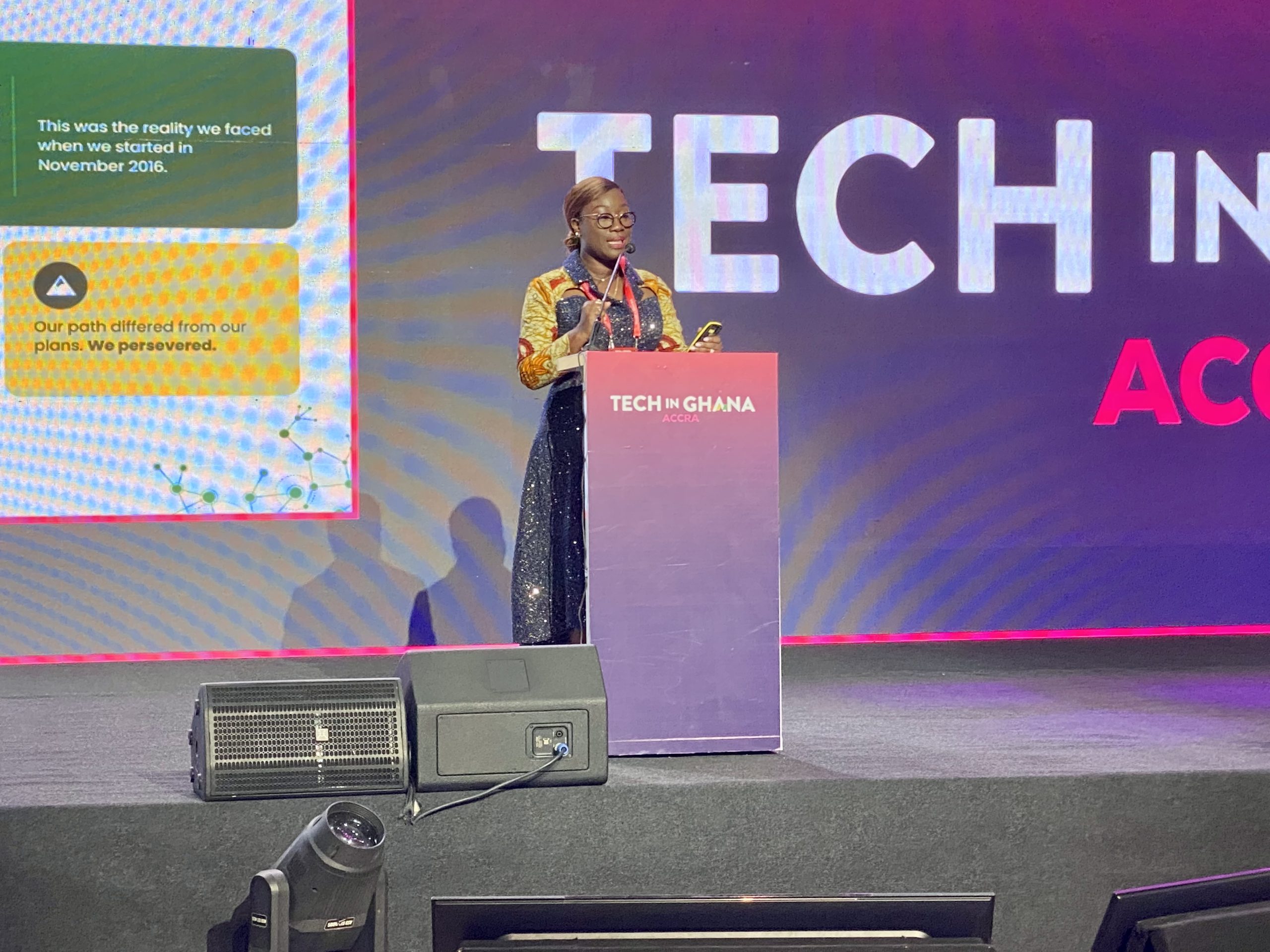
Ghanaian technology entrepreneur Deborah Asmah has highlighted the importance of building locally relevant digital solutions, strengthening business technology adoption and integrating trust into innovation, as she reflected on the decade-long journey of Npontu Technologies at the 18th edition of the Tech in Ghana Conference in Accra.
Asmah, Chief Marketing and Operations Officer of Npontu Technologies, used her address to offer an account of how the company evolved from a modest startup with limited resources and ambitious ideas into a technology business developing digital tools and artificial intelligence-powered solutions for organisations across Ghana and beyond.
Speaking at the two-day conference, held on November 24 and 25, 2026, at the Palms Convention Centre, Labadi Beach Hotel, under the theme “From Ecosystem to Economy: Building the Industries of the Future,” she described the company’s early years as a period marked by ambition, uncertainty, financial constraints, and the determination to demonstrate that Ghanaian businesses could develop and scale their own technology.
According to Asmah, Npontu began with a vision to help organisations analyse their data and use technology to improve their operations. However, the company soon discovered that many businesses lacked the basic digital infrastructure required to collect and manage the information needed for meaningful data analysis.
That realisation forced the company to rethink its initial strategy.
Rather than continue pushing advanced analytics solutions into a market where many businesses were not adequately prepared to use them, Npontu shifted its focus towards developing practical digital tools that addressed the immediate operational needs of Ghanaian businesses.
“We decided to build a platform that the local Ghanaian business needed,” she explained, recounting how the company redirected its efforts towards solutions that could help organisations collect information, manage operations, and make better use of their business data.
Building through challenges and strategic adaptation
Asmah recalled that the company’s early ambitions were not matched by the financial resources, established customer base, or business connections needed to compete effectively in the technology market.
She described an experience in which she approached a major bank with a proposal to improve its digital customer interaction systems, only to be turned down.
The experience, she suggested, reflected some of the barriers confronting young technology entrepreneurs seeking to introduce homegrown solutions into established institutions.
Yet, rather than abandon its ambitions, Npontu adapted.
The company began developing practical enterprise solutions, including Kedeba, its locally developed enterprise resource planning (ERP) platform, with functionalities covering areas such as finance, customer experience and project management.
The strategy was designed to help businesses move beyond fragmented records and disconnected systems towards more coordinated digital operations.
Asmah also highlighted the importance of data as a foundation for artificial intelligence, explaining that Npontu’s approach involved focusing on its models and data rather than attempting to compete directly in the expensive technology infrastructure space.
She disclosed that the company had benefited from early support, including the provision of three graphics processing units (GPUs) from NVIDIA to run its models.
She further noted that approximately 300 to 350 interns had contributed to the company’s work over the years, particularly in labeling datasets and supporting model development.
Integrating AI into practical business operations
A major highlight of Asmah’s presentation was the company’s integration of its artificial intelligence platform, Snowy, into its applications.
She explained that Snowy, a locally named platform whose name she associated with the expression “oil from Ensima”, was integrated into Npontu’s products to help businesses derive greater value from their data.
Through the integration, users of the Kedeba ERP platform do not simply access an enterprise management system; they also receive an AI-enabled assistant designed to support business operations.
Asmah said the platform can alert users to developments in their finances and draw attention to potentially fraudulent account interactions.
She also discussed the company’s customer experience solutions, which are designed to help businesses identify potential customer attrition risks and improve how they engage with clients.
Her presentation demonstrated how locally developed technology can move beyond abstract discussions about artificial intelligence to address everyday business challenges, including financial monitoring, customer retention, data management, and operational efficiency.
Technology must be built around people, trust and inclusion
Beyond the technical aspects of Npontu’s work, Asmah placed considerable emphasis on the human and governance dimensions of technology development.
Although her academic background was in English and Philosophy, followed by legal studies, an LLB, and a Master’s degree in Law, she explained that her professional background had become an important part of her contribution to the company’s technology development process.
She described her role as helping to ensure that innovation was accompanied by appropriate safeguards, ethical considerations, and trust.
According to her, developing a technology solution is not enough; businesses must also consider the frameworks and protections necessary to ensure that the technology is deployed responsibly.
She further reflected on the value of bringing different perspectives into technology development, noting that diversity and inclusion can help identify considerations that might otherwise be overlooked.
Her remarks offered an important message to young people and aspiring technology entrepreneurs: building a career or business in technology does not necessarily require a conventional computer science background. Skills and perspectives from other disciplines can also contribute meaningfully to innovation.
Ghana’s digital transformation requires stronger business adoption
Asmah’s observations also raised a wider question about Ghana’s digital transformation: whether the country’s expanding digital infrastructure is translating into meaningful technology adoption by businesses.
She cautioned that the availability of digital infrastructure does not automatically mean that organisations are using the right tools to improve productivity and scale their operations.
Drawing on Npontu’s experience working with businesses, she argued that many organisations still struggle to harness their internal data or deploy appropriate digital platforms for their operations.
She highlighted the need for accessible and affordable solutions that enable micro, small, and medium-sized enterprises, as well as larger organisations, to manage sales, inventory, invoicing, receipts, and basic accounting processes.
This, she suggested, is essential because inadequate business records and digital systems can also affect organisations’ ability to access financing and other forms of institutional support.
Her presentation reinforced the importance of developing technology that responds to the practical realities of local businesses rather than focusing exclusively on sophisticated innovations that may remain beyond the reach of many enterprises.
A wider conversation about Ghana’s technology future
Asmah’s contribution formed part of broader discussions at Tech in Ghana Conference 2026 on the country’s transition from a growing technology ecosystem into an economy capable of generating jobs, attracting investment, and building competitive industries.
Jake France of Ghana’s Cyber Security Authority highlighted the importance of cybersecurity standards, security-by-design principles, and stronger protection of digital systems as technology adoption expands.
Meanwhile, Kenechi Okeleke, Senior Director at GSMA Intelligence, discussed Ghana’s digital infrastructure progress and the need to address the gap between network coverage and actual internet usage. He also highlighted opportunities around 5G, artificial intelligence, digital finance, indigenous African language models, and the development of startups into sustainable businesses.
Rachel Kreissl, Commercial Counselor at the United States Embassy in Ghana, highlighted opportunities for stronger US-Ghana commercial and technology partnerships, including business engagement around international technology platforms.
Together, the contributions underscored the need for Ghana to combine infrastructure development, innovation, cybersecurity, investment, and practical business adoption to strengthen its digital economy.
From ecosystem to sustainable economic impact
For Npontu Technologies, the decade-long journey shared by Asmah offers an example of how local technology businesses can respond to market realities, adapt their strategies, and develop solutions around the needs of organisations.
Her account also highlights a broader lesson for Ghana’s innovation ecosystem: the future of technology will not be determined solely by the sophistication of the products developed but also by their relevance, affordability, accessibility, and ability to solve real problems.
As Ghana continues to pursue its digital transformation ambitions, the challenge will be to ensure that innovation translates into stronger businesses, improved productivity, decent employment opportunities, and inclusive economic growth.
The Tech in Ghana Conference, established in 2017 as a platform connecting Ghana’s technology ecosystem with international opportunities, continues to provide a space for entrepreneurs, investors, policymakers, regulators, and development partners to exchange ideas and shape the country’s digital future.
Asmah’s reflections at the 2026 edition offered a compelling reminder that building the industries of tomorrow requires more than bold ideas. It demands resilience, strategic adaptation, locally relevant solutions, and a commitment to ensuring that technology works for people and businesses.
Ultimately, Ghana’s digital future will depend not just on how much technology the country develops, but on how effectively that technology improves lives, strengthens enterprises and creates opportunities for all.
By Joseph Kobla Wemakor
