
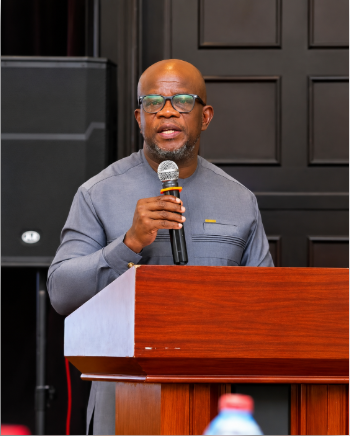
…Urges Public and Private Institutions to Prioritise Leadership Development
The Director-General of the State Interests and Governance Authority (SIGA), Professor Michael Kpessa-Whyte, has urged public and private institutions to make professional coaching a strategic investment in their efforts to improve leadership, enhance productivity and achieve sustainable organisational growth.
He said institutional transformation could not be achieved through policies and strategic frameworks alone without a corresponding change in the mindset, attitudes and behaviour of those entrusted with leadership responsibilities.
Prof. Kpessa-Whyte made the remarks on Sunday, November 29, 2026, when he addressed the Berkha Africa Coaching Soirée 2026 as the Special Guest of Honour at the Kempinski Hotel Gold Coast City, Accra.
Organised by Berkha Africa under the theme, “Leading Institutions That Learn,” the programme attracted directors of public and private institutions, chief executives, board chairs, professional coaches and leaders from various organisations.
The event provided a platform for participants to reflect on the importance of coaching, continuous learning and leadership development in achieving institutional excellence.
Beyond Policies and Strategies
Drawing on SIGA’s experience in overseeing state-owned enterprises, joint ventures and other specified entities, Prof. Kpessa-Whyte observed that many institutions had developed sound policies and strategies but struggled with their implementation.
“Policies set direction, but people determine destination,” he stated.
He explained that institutional transformation could only take root when leaders changed how they thought, exercised authority and related to others within their organisations.
“A reform without a change of mindset is merely a change of paperwork,” he said.
The SIGA Director-General maintained that the gap between institutional aspirations and actual performance was often attributable to leadership behaviour rather than a lack of knowledge.
He said professional coaching could address such challenges by helping leaders examine their assumptions, make informed decisions and take greater responsibility for organisational outcomes.
Coaching as a Strategic Investment
Prof. Kpessa-Whyte challenged the perception that coaching was a luxury or an intervention reserved for individuals experiencing professional difficulties.
He described coaching as a discipline of excellence that could improve decision-making, strengthen accountability and build leadership capabilities across institutions.
“The most expensive thing in any institution is a leader who has stopped learning,” he remarked.
He consequently urged organisations to place coaching at the centre of their leadership development programmes and make adequate resources available for its implementation.
“Coaching is a strategic driver of performance. It belongs at the centre of leadership investment, not at the margins of the training budget,” he emphasised.
Building a Culture of Continuous Learning
Prof. Kpessa-Whyte encouraged institutional leaders to make continuous learning an integral part of their organisational culture.
He said institutions that invested in the development of their people were better positioned to translate strategies into results and build resilient organisations.
“Strategy is written in the boardroom, but it is won or lost in the daily conduct of leaders,” he stated.
He also commended Berkha Africa and the International Coaching Federation for their contribution to the development of professional coaching in Ghana, particularly in promoting ethical standards and access to qualified coaching practitioners.
He urged organisations to establish partnerships with professional coaching institutions to strengthen their leadership capabilities.
Berkha Africa’s Leadership Development Drive
Through initiatives such as the Coaching Soirée, Berkha Africa seeks to promote professional coaching, leadership development, continuous learning and institutional excellence.
The initiative provides an opportunity for institutional leaders and coaching professionals to exchange perspectives on leadership development and organisational performance.
Prof. Kpessa-Whyte congratulated Berkha Africa on the initiative and encouraged participants to champion a culture of continuous learning within their respective institutions.
“Institutions that learn will outlast institutions that merely comply,” he stated.
He stressed that Ghana’s future would be shaped not only by the resources it possessed but also by the quality of the leaders it developed.
