
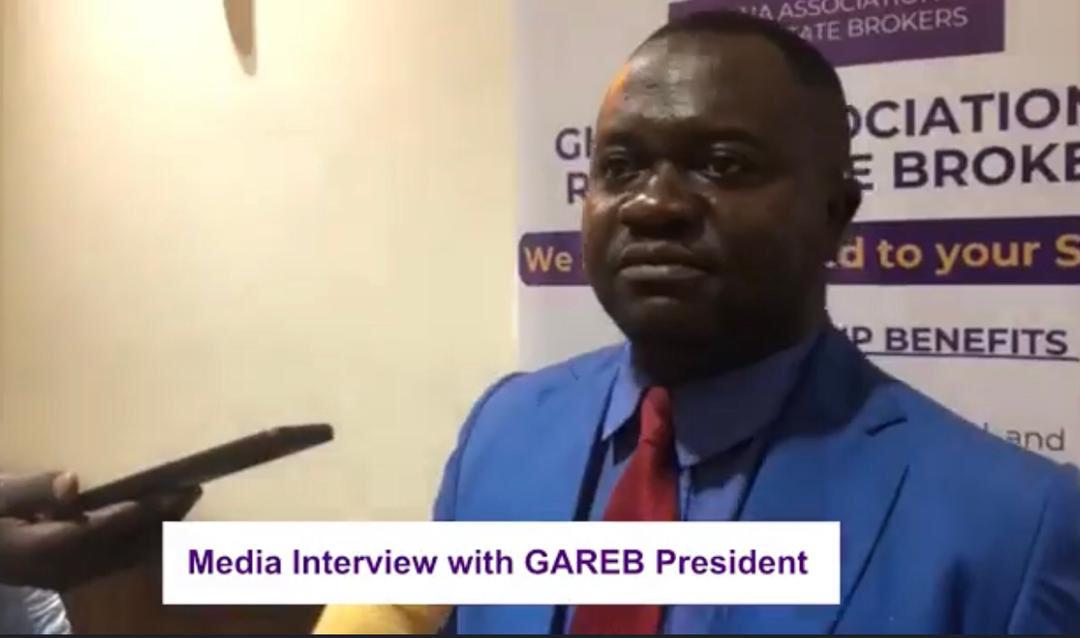
President of the Ghana Association of Real Estate Brokers and Board member of the Real Estate Agency Council (REAC), Engineer Jacob Adofo Ansong has placed on record that members of the public who engage the services of unlicensed agents or brokers are actually condoning an illegality against the Constitution of the Republic of Ghana.
Speaking in an exclusive interview with the Real Estate Market Show on the sidelines of Bank of Ghana’s Collateral Registry stakeholders engagement with the Ghana Association of Real Estate Brokers in Accra, Mr. Ansong stressed the need to collectively discourage quack agents and brokers who dishonestly dupe helpless unsuspecting Ghanaians in search of properties for rent or purchase.
According to him there are clear legal and professional standards and requirements set out by the Real Estate Agency Council as the regulator to ensure real estate agents or brokers operate under license and exhibit professional practices with a sense of accountability.
He lamented that just as you cannot operate a vehicle as a driver without a license or operate a health facility without a license it is equally a crime to engage in real estate agency or brokerage services without a license from the Real Estate Agency Council which is a statutory requirement for all agents and brokers in Ghana.
He advised that the legal system does not have enough grounds to protect citizens who are duped while engaging the services of unlicensed agents or brokers and equally so with agents and brokers who refuse to reach out to the Real Estate Agency Council for a license to formalize and legally protect their business transactions.
In a separate interaction with the press at the Bank of Ghana’s Collateral Registry Department’s engagement with the Ghana Association of Real Estate Brokers (GREB) however, Mr. Ansong went on to state that Ghana does not have a housing deficit. He said this is technically a fallacy. He clarified that in as much as the records show that many Ghanaians do not have proper system of accommodations or the financial muscle to rent or buy homes there are equally several houses lying vacant all around the country especially in the capital, Accra.
He stressed that the main problem has to do with unregulated pricing systems in the real estate business ecology. According to him most of the houses up for rent or sale are mostly built with foreigners being the target market hence prices associated to them are not affordable for the local market consumers.
He used the moment to call on government and all industry players to come to a common ground to regulate the pricing system in the real estate space in order to largely support both the low-income and middle-income housing communities in the country.
The Statistical Service of Ghana has a housing deficit ranging between 1.8 to 2 million from the 2021 to 2024 Population and Housing Census estimates in the residential real estate market. The housing deficit is indicative of high demand for housing needs.
Housing problems are becoming increasingly evident as the population continues to grow, particularly in urban areas though housing supply has not kept pace with the increasing demand for housing, resulting in a large deficit, in turn escalating costs of renting, and proliferating slums in informal settlements. It is estimated that a large percentage of Ghanaian urban residents live in slums, kiosks and sheds.
The World Bank estimates that Ghana’s annual housing need ranges between 70 000 and 133 000 units meanwhile only 33% of the country’s housing need is delivered annually. Statistics show an oversupply of luxury accommodation targeted at high income earners and a persistent shortage of low income housing.
By: Randy Sekyi Snr
