
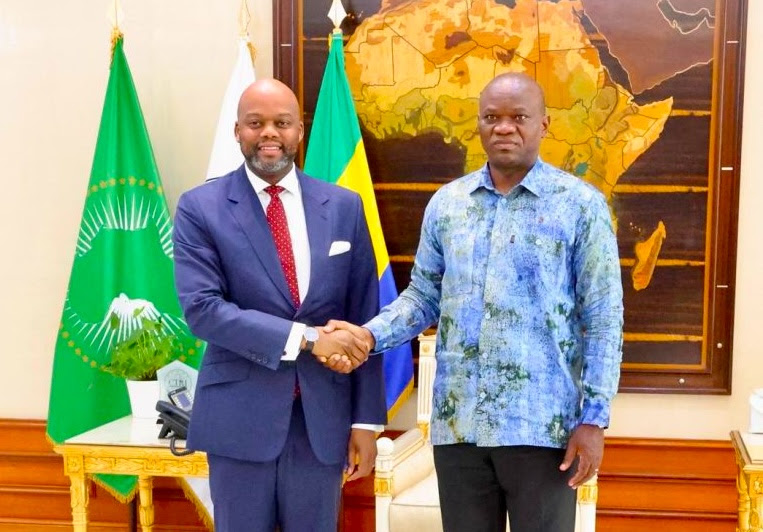
At the close of an official visit to Gabon, held on 18 and 19 June 2026, the Secretary-General of theAfrican Continental Free Trade Area (AfCFTA), H.E. Wamkele Mene, sealed an implementationpartnership with the Gabonese authorities and the private sector. Received at the highest level of the State, he set a clear course: to convert Gabon’s industrial and export potential into real access to the continental market.
Engagement at the highest level of the State
Over two days of meetings, the Secretary-General was received in audience by the President of the Republic, H.E. Brice Clotaire Oligui Nguema, as well as by both Vice-Presidents — the Vice-President of the Government, H.E. Hermann Immongault, and the Vice-President of the Republic, H.E. Hugues Alexandre Barro Chambrier. He also held discussions with the Minister of Trade, SMEs and Youth Entrepreneurship, H.E. Zenaba Gninga Channing. He set out the objectives of the mission: to strengthen the Secretariat’s engagement alongside Gabon in the implementation of the Agreement, to mobilise the private sector around the opportunities of the single market, and to advance concrete trade-facilitation initiatives.
The President of the Republic committed that Gabon would do everything possible to implement the AfCFTA and to take an active part in the shared continental ambition. The Secretary-General said he had been greatly encouraged by the President’s willingness to lead this implementation, and by Gabon’s ambition to play a leading role — within Central Africa and in advancing continental integration.
From potential to trade
The high-level public-private dialogue, held in Libreville, brought together Gabonese enterprises and the Secretariat’s experts. The exchanges placed ambitions and obstacles side by side — competitiveness, access to finance, logistics, command of the rules of origin. Drawing on Gabon’s strengths — its position in Central Africa, its resources and the Nkok special economic zone — the Secretariat presented the instruments that open the continental market to enterprises, and to women- and youth-led SMEs in particular: the Rules of Origin manual, the e-Tariff Book, the Pan-African Payment and Settlement System (PAPSS) and the AfCFTA Adjustment Fund.
The Secretary-General highlighted the potential of the Nkok industrial zone, particularly in timber and the pharmaceutical industry, and underscored that Gabonese products can reach markets well beyond Central Africa — in West, North and East Africa.
Minister Zenaba Gninga Channing set a converging course for Gabonese entrepreneurs: to move from spectators to actors in intra-African trade, by processing and exporting high-value-added goods.
A concrete undertaking: the Kye-Ossi border post
The Secretary-General carried forward a first concrete undertaking: the proposed one-stop border post at Kye-Ossi, at the junction between Gabon, Cameroon and Equatorial Guinea, for which he sought the support and endorsement of the authorities — a project intended to integrate digital facilitation tools and to increase commercial transactions, in service of connectivity within Central Africa. The Secretary-General welcomed the signing of an agreement between the three countries’ Chambers of Commerce and invited them to join the Secretariat’s Private Sector Dialogue.
The regional dimension: ECCAS
The visit also included a meeting with the Vice-President of the Commission of the Economic Community of Central African States (ECCAS), H.E. Ms Mariam Mahamat Nour [name to be confirmed]. The two institutions reaffirmed the role of the Regional Economic Communities as building blocks of the AfCFTA.
ECCAS noted that all of its Member States have ratified the Agreement and its Protocols — a significant milestone for the region — and the two parties agreed to develop a joint action plan to accelerate implementation.
A continental horizon
Looking ahead, the Intra-African Trade Fair (IATF) 2027 will be held in Lagos, Nigeria, from 5 to 11 November 2027 — a showcase where Gabonese enterprises can meet buyers from across the continent. The Agreement is estimated to have the potential to increase intra-African trade by 52.3 per cent.
“The Gabonese private sector can take full advantage of the market of 1.4 billion consumers that the AfCFTA offers, and diversify its production and its exports.”
— H.E. Wamkele Mene, Secretary-General of the AfCFTA
