
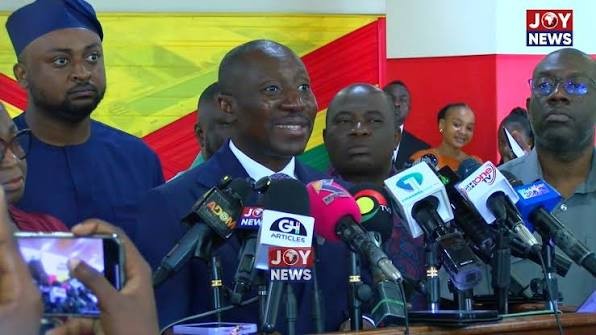
The Minority in Parliament has rejected suggestions that the New Patriotic Party (NPP) is opposed to the Ghana Gold Board (GoldBod), insisting that its concerns are rather about what it describes as the government’s poor, costly and opaque implementation of the initiative.
According to the Minority, the concept underpinning GoldBod was contained in the NPP’s 2024 election manifesto and championed by its presidential candidate, Dr Mahamudu Bawumia, as part of a broader strategy to strengthen Ghana’s foreign exchange reserves and stabilise the cedi.
Addressing a press briefing on Tuesday, August 18, 2026, the Minority said it could therefore not oppose an initiative that reflected a policy its own presidential candidate had proposed.
“The impression is being created that the Minority, or the NPP as a whole, is fundamentally opposed to GoldBod. Nothing could be further from the truth,” the Minority said.
It maintained that its disagreement with the governing National Democratic Congress (NDC) centred on how the policy had been implemented and the financial implications for the state.
“We welcome what we thought was the NDC’s brave and sincere decision to adopt and implement a policy they discovered in the NPP’s 2024 Manifesto… Our disappointment is that, having borrowed the policy, they failed to understand it and are now making an expensive mess of it,” the Minority stated.
Minority Claims NPP Had More Detailed Gold Plan
The Minority sought to draw a distinction between the gold-related proposals contained in the NPP and NDC manifestos ahead of the 2024 general election.
According to the group, the NDC’s manifesto contained a pledge to establish GoldBod to regulate and restructure the small-scale mining sector.
It argued, however, that Dr Bawumia had outlined a more comprehensive proposal in his August 18, 2024 manifesto launch address under a plan dubbed “Stabilising the Cedi Through Gold Purchase Programme.”
The Minority said the proposal sought to consolidate Ghana’s gold purchasing arrangements, increase foreign exchange reserves and use the country’s gold resources to support currency and macroeconomic stability.
It further claimed that Dr Bawumia had stressed the need for the programme to operate on a commercially sustainable basis and avoid becoming a loss-making venture.
“So, let us be clear: we cannot oppose a policy conceived and championed by our own presidential candidate as a solution to Ghana’s chronic macroeconomic instability,” the Minority said.
“Indeed, imitation is said to be the sincerest form of flattery. But when imitation is combined with incompetence, shadiness, secrecy and at a high cost to the state, we have a responsibility to ensure it is fixed.”
Minority Questions Cost of Gold Programme
The Minority said it was also not opposed to Ghana accumulating gold reserves, acknowledging that the Domestic Gold Purchase Programme had contributed to reserve accumulation and improvements in the country’s external buffers.
It argued that the controversy should instead focus on the cost of achieving those benefits, the governance arrangements surrounding the programme and the level of financial risk borne by the state.
According to the Minority, building foreign reserves should not provide justification for avoidable trading losses or prevent scrutiny of the programme’s financial performance.
“The question, therefore, is not whether Ghana should purchase gold,” the group said.
It said attention should rather be placed on “at what cost, under what governance arrangements, with whose money, under whose risk, and with what accountability?”
“No serious policymaker should argue that because a policy produces benefits, its costs no longer matter. Foreign reserves are important. That does not provide a blank cheque for avoidable trading losses,” it added.
The Minority maintained that GoldBod should ultimately be assessed on whether its objectives were achieved efficiently, prudently and at an acceptable level of risk to the Ghanaian taxpayer.
Citing an IMF assessment, the group claimed losses associated with the programme amounted to GH¢22 billion, arguing that the figure required greater scrutiny and accountability.
