
Ghana’s economy has made significant progress in restoring macroeconomic stability, but sustaining the recovery and translating it into more jobs and better livelihoods will require continued fiscal discipline, stronger revenue mobilization, and reforms to unlock the country’s transport sector.
This is according to the World Bank’s 10th Ghana Economic Update titled “Reset for Growth: Sustaining Macroeconomic Recovery and Unlocking Transport for Transformation,” launched at the Alisa Hotel in Accra.
The report finds that Ghana’s recovery deepened in 2025, with real GDP growth reaching 6.0 percent, the fastest pace since 2019, supported by services and agriculture. Growth accelerated further to 6.4 percent in the first quarter of 2026.
Inflation, which stood at 23.8 percent in December 2024, fell sharply to 4.6 percent by the end of July 2026, within the Bank of Ghana’s target band. The lowest point was 3.2 percent in March 2026, the lowest since 1999.
The fiscal position improved, with a primary surplus of 2.5 percent of GDP in 2025 exceeding the 1.5 percent target. Public debt declined from 70.3 percent of GDP in 2024 to 49.0 percent at end-2025, three years ahead of the IMF programme timeline.
Gross international reserves strengthened to cover 5.0 months of imports on the back of record gold export receipts, and Ghana successfully concluded its IMF Extended Credit Facility programme.
The IMF-World Bank Debt Sustainability Analysis has upgraded Ghana’s debt risk rating to moderate, the first time since April 2014 that the external debt distress rating has moved out of the high category.
Despite these gains, the report cautions that the recovery remains incomplete. Growth has not yet generated enough quality jobs to absorb Ghana’s expanding working-age population, 56.4 percent of Ghanaians remain in poverty, and external risks including commodity price volatility and higher energy costs could test durability.
Recovery Real But Not Built to Last Yet – Taliercio
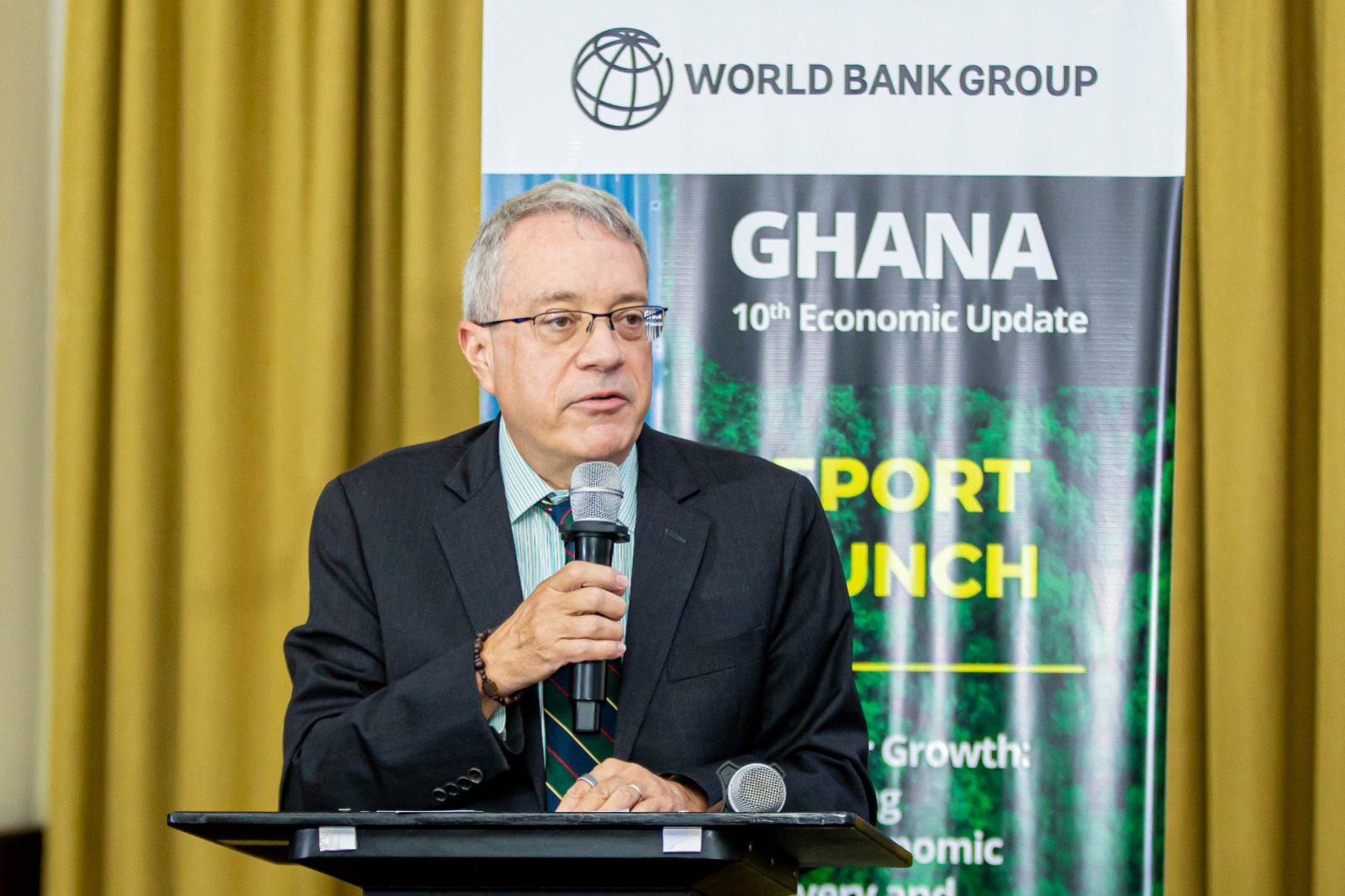
Launching the report, World Bank Division Director for Ghana, Liberia and Sierra Leone, Robert Taliercio, said Ghana stands at a genuine inflection point.
“Ghana stands at a genuine inflection point. The recovery from the 2022 crisis is real and measurable — but it also raises a harder question: is it built to last?” he said.
“Ghana has made important progress in restoring stability after a difficult period, but the next phase must be about making the recovery durable and more inclusive.
Maintaining fiscal and monetary discipline, strengthening revenue mobilization, and protecting priority social and infrastructure spending will be essential to ensure that macroeconomic gains translate into better jobs and improved welfare,” he said.
Mr. Taliercio warned that the fiscal surplus was achieved largely through expenditure compression, with capital spending 38 percent below budget, which is not sustainable.
“Sustained fiscal consolidation over the medium term will require strengthening revenue mobilization,” he said.
He flagged SOE pressures where delays in the Energy Sector Recovery Program cost about US$1 billion annually, and COCOBOD’s inefficiencies are taking a toll on farmers. He welcomed amendments to the COCOBOD Act approved by Parliament and called for swift implementation.
The report projects growth to moderate to 4.8 percent in 2026 as post-crisis gains taper off, before converging toward medium-term potential of around 5 percent.
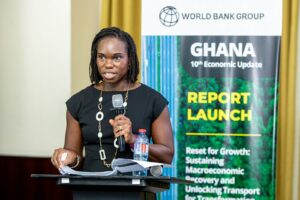
According to the co-author and Senior Economist at the World Bank, Tamoya Annika Lois Christie, the current gains offer a window for deeper reforms.
“The policy window is open. Ghana can use the current stabilization gains to build a more diversified and employment-intensive economy, but doing so will require sustained reforms that protect fiscal stability while removing structural bottlenecks to private investment and market access,” Mrs. Christie said.
Mrs. Christie has led the Bank’s macro-fiscal analysis on Ghana in recent years, including work on poverty, debt and domestic revenue mobilization.
Transport is Growth, Jobs Agenda – Timpabi
The special focus of the report examines Ghana’s transport sector, identifying chronic under-maintenance, fragmented governance, weak multimodal integration, and limited climate resilience as binding constraints.
Roads carry more than 95 percent of passenger and freight traffic, yet of Ghana’s 94,200-kilometre network, only 27 percent is paved and more than half is in fair to poor condition, particularly feeder roads. Rail freight has collapsed from 947 kilometres in 1960 to 160 by 2020.
Road safety incidents alone cost an estimated 2.1 percent of GDP annually, about US$4.55 billion, more than the education budget.
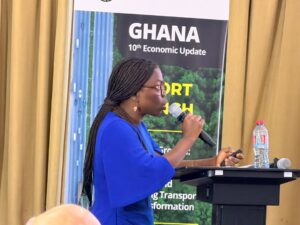
Presenting the transport findings, World Bank Transport Specialist and co-author, Akua Pokuaa Timpabi, said transport must be seen beyond infrastructure.
“Transport is not only an infrastructure issue; it is central to Ghana’s growth, jobs, and inclusion agenda. Better-maintained roads, stronger rail and port linkages, safer urban mobility, and climate-resilient infrastructure can reduce the cost of doing business, connect farmers and firms to markets, and expand access to jobs,” she said.
Ms. Timpabi, a Ghanaian civil engineer and former senior engineer with the Ghana Highway Authority, highlighted six priority reforms: sustainably funding road maintenance through the Road Maintenance Trust Fund, developing a unified National Transport Sector Strategy, revitalizing rail freight along the Western and Eastern Corridors, treating road safety as a fiscal and public health emergency, integrating climate resilience into transport planning, and expanding digital logistics systems beyond Tema to Takoradi and inland terminals.
The Bank announced it is investing US$500 million through the Ghana Market Access and Connectivity Project to rehabilitate about 1,050 kilometres of feeder roads under performance-based maintenance contracts.
Mr. Taliercio added: “Building roads without maintaining them simply accelerates the cycle of degradation we are trying to break.”
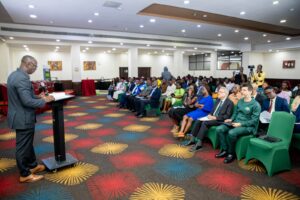
Govt: Stability is Foundation, Not Destination
Speaking on behalf of the Minister for Finance, Coordinating Director Samuel Arkhurst said that “Reset for Growth” is the government’s guiding philosophy, in line with the 2026 Budget theme, “Resetting for Growth, Jobs, and Economic Transformation.”
“Stability is the foundation. It is not the destination. Growth has to translate into jobs,” he said.
He said government’s Big Push Infrastructure Programme is underway in all 16 regions, with 13 projects at least halfway complete. He cited the 176-kilometre six-lane Accra-Kumasi Expressway where 122 kilometres of right of way have been cleared, and the Adawso-Ekye Amanfrom Bridge and Dambai Bridge.
On partnership, he said the US$500 million World Bank financing will rehabilitate 1,050 kilometres of feeder roads across four agricultural corridors in 13 regions under Phase One of the Agricultural Enclave Roads Programme, cutting travel times by up to 40 percent and creating about 25,000 jobs, at least 7,500 for women.
“When a farmer in the Afram Plains or along the Northern Corridor can get her produce to market without losing a third of it to a damaged road, that is not just an infrastructure achievement. It is a food security story,” he said.
Source: Isaac Kofi Dzokpo
