
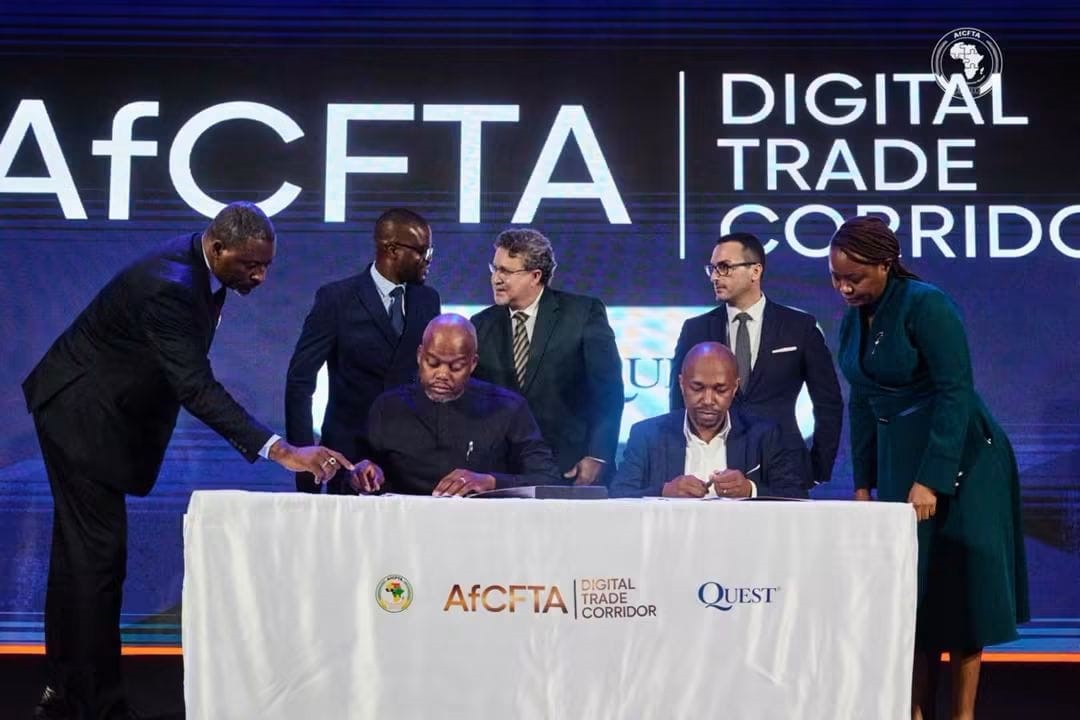
Africa’s drive towards a more connected, digitally enabled single market has taken another significant step forward with the launch establishment of the AfCFTA Digital Trade Corridor.
Signed in Accra on 31 August 2026, the initiative is intended to provide digital infrastructure and services that can help businesses trade, make payments, move goods and undertake transactions more efficiently across African borders.
From a continental digital marketplace and interoperable payments to logistics and commodity trading infrastructure, the initiative has significant ambitions. But what exactly has been agreed, where does it fit within the African Continental Free Trade Area, and what does it mean for Africa’s rapidly evolving digital trade landscape?
Here are five key things to know about the AfCFTA Digital Trade Corridor.
- What was signed and by whom?
On 31 August 2026 in Accra, the AfCFTA Secretariat and Quest Ghana Limited signed a Joint Venture Agreement establishing the AfCFTA Digital Trade Corridor.
The agreement represents the culmination of a process that included the signing of a Memorandum of Understanding in March 2026 and subsequent approval by the Cabinet of the Republic of Seychelles in July 2026.
Seychelles is providing sovereign support for the venture and will host its headquarters in Victoria, positioning the island nation as an important institutional base for the initiative.
The Joint Venture Agreement moves the initiative beyond the earlier framework of cooperation and establishes the formal arrangement through which the parties intend to develop and operate the Corridor.
- What is the Digital Trade Corridor meant to build?
At its heart, the AfCFTA Digital Trade Corridor is about developing infrastructure to make cross-border trade in Africa more digitally connected.
The joint venture is expected to design, develop and operate four principal capabilities: a digital marketplace; cross-border interoperable payments; logistics services; and trading, tracking and settlement services for minerals and commodities across the continent.
Two particularly significant components highlighted under the initiative are the proposed Digital African Minerals and Commodities Exchange and a continental cross-border interoperable payment system.
Together, these capabilities are intended to address some of the practical infrastructure requirements of conducting trade across multiple African markets.
For businesses, particularly those seeking to expand beyond their domestic markets, the significance lies in the possibility of bringing different elements of the trading process into an increasingly interconnected digital environment.
- Where does the Corridor sit within the AfCFTA Agreement?
The Digital Trade Corridor is not being developed in isolation from the wider AfCFTA legal framework.
Speaking at the signing ceremony in Accra, the Secretary-General of the AfCFTA Secretariat, H.E. Wamkele Mene, described the agreement as establishing a formal legal relationship for the operationalisation of the Protocol on Digital Trade.
That connection is important.
The Agreement Establishing the African Continental Free Trade Area entered into force on 30 May 2019, creating the framework for a single African market bringing together the 55 Member States of the African Union.
Collectively, the market represents approximately 1.4 billion people and a combined Gross Domestic Product of about US$3.4 trillion, making the AfCFTA the world’s largest free trade area by number of participating countries.
As implementation advances, digital trade is increasingly becoming an important part of the effort to ensure that businesses can take practical advantage of the continental market.
The Corridor therefore represents an infrastructure-focused initiative intended to support the broader implementation of Africa’s digital trade ambitions under the AfCFTA.
- The US$5 billion figures and why the distinction matters
One potentially confusing aspect of the announcement is the appearance of two figures of roughly US$5 billion. Although similar in size, they refer to two very different things.
Quest Ghana Limited values the Digital Trade Corridor project at US$5.17 billion.
At the signing ceremony, the Secretary-General also referred to more than US$5.1 billion in private-sector investment mobilised with the support of government organisations.
That investment figure relates to resources being mobilised to develop the infrastructure and capabilities envisioned under the initiative.
But there is another US$5 billion figure.
The Secretary-General separately estimated that the cost of payments associated with intra-African trade exceeds US$5 billion every year.
The distinction is therefore important: one figure concerns investment mobilised for the project, while the other represents an estimated recurring annual cost associated with payments for intra-African trade.
The scale of investment also reflects the wider infrastructure challenge facing Africa.
As the Secretary-General stressed in Accra, the continent will require “billions and billions of dollars” from both the private and public sectors to build the digital infrastructure necessary to support Africa’s trade transformation.
Reducing the cost and complexity of cross-border payments could consequently have significant implications for businesses trading under the AfCFTA.
- What the Corridor does not change
While the Digital Trade Corridor seeks to improve cross-border digital infrastructure, it does not remove the authority of national central banks over exchange-rate determination.
That responsibility remains firmly with the respective central banks.
“We have not taken away the authority of the central banks to undertake that very important task,” the Secretary-General explained during the signing ceremony.
He noted that 21 central banks already operate on the continental payment system, with each central bank determining its own exchange rate.
The distinction is significant because the Digital Trade Corridor is intended to provide infrastructure that facilitates transactions rather than replace the monetary-policy responsibilities of African states and their central banks.
The joint venture will therefore design, develop and operate the relevant infrastructure, while existing national mandates over exchange-rate determination remain intact.
Nor is the Digital Trade Corridor being presented as Africa’s only solution to the challenges surrounding cross-border payments.
As the Secretary-General emphasised, the AfCFTA supports “a multiplicity of solutions” to address the cost of payments associated with intra-African trade.
Building the Digital Foundations of One African Market
The establishment of the AfCFTA Digital Trade Corridor comes as Africa moves from negotiating the rules of its continental free trade area towards building the systems and infrastructure required to make those rules work in practice.
The ambition is substantial: connect marketplaces, payments, logistics and commodity trading through digital infrastructure capable of operating across borders.
Its ultimate significance, however, will be measured by implementation and by whether the infrastructure being developed translates into lower transaction costs, more efficient cross-border trade and greater opportunities for African businesses to participate in the continental market.
For Africa’s entrepreneurs, SMEs, established businesses and investors, that is where the promise of the Digital Trade Corridor could ultimately matter most.
