
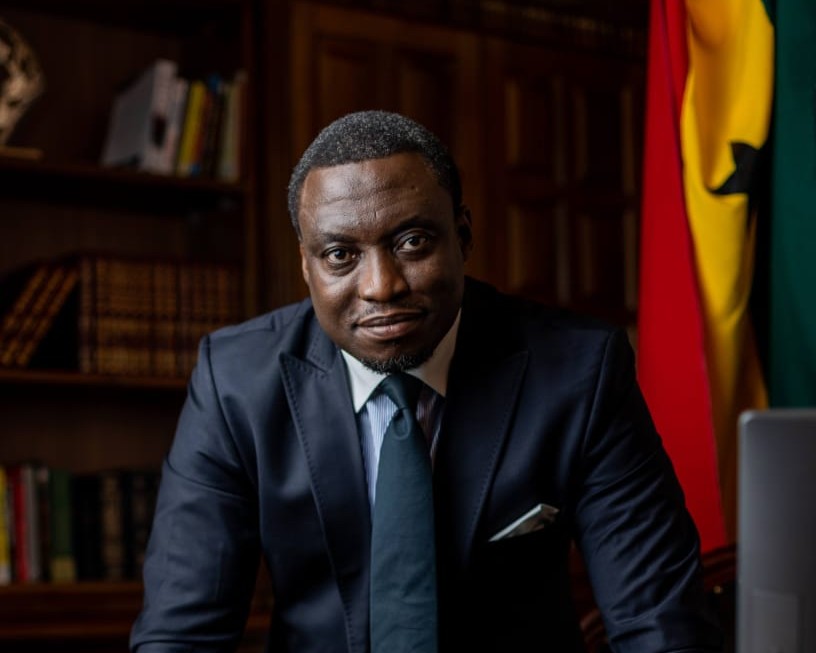
A commentary by Dr. Sam Ankrah
There is a particular kind of confidence that settles over a government when the numbers are moving in the right direction. Press statements get bolder. Ministers speak with the authority of men who have solved things. And somewhere in the middle of all that, the harder questions get buried beneath the weight of the celebration.
Ghana is in that moment right now.
Inflation is at 3.4%. The cedi has strengthened. GDP grew at 6% in 2025. The IMF has given its approvals, the credit rating agencies have upgraded their assessments, and the political communication machine has worked tirelessly to make sure that every Ghanaian knows what the headline figures say. And yet, drive through Nima. Walk through Agbogbloshie. Take a tro-tro to Madina and ask the people sitting in traffic what they bought at the market this week and how much it cost them. Then come back and tell me with a straight face that Ghana’s economy has turned a corner.
What has turned is the measurement. The economy itself is still largely where it was.
Stabilisation Is Not a Policy. It Is a Starting Point.
The government inherited a crisis. That is not a matter of dispute. The debt had ballooned to 92.4% of GDP. Inflation had hit 54%. The cedi was in freefall. The IMF was the only institution still willing to stand in the room with Ghana. All of that is true, and the stabilisation work that followed deserves fair acknowledgement.
But here is what also needs to be said plainly: stabilising an economy that had collapsed is not the same as building one that works. Any government with access to US$3 billion in IMF support, relief from external debt payments through restructuring, and a commodity export sector buoyed by high gold prices would show improving numbers. The conditions were set up for the metrics to improve. The question that political leadership must be held to is what they did with the breathing room those conditions created.
The answer, so far, is not very much.
Ghana’s manufacturing sector contributes approximately 11% of GDP. That figure has not meaningfully shifted in a decade. A country of 34 million people, with agricultural land, a coastline, a young population, and half a century of independence, is still importing toothpaste, furniture, garments, processed food, and construction materials at scale. The import bill continues to drain foreign exchange. The cedi’s stability is therefore not an achievement of structural strength. It is an achievement of suppressed demand, gold windfalls, and suspended debt obligations. When the IMF programme ends and full debt service resumes, the pressure on the currency will return unless the productive base of the economy has fundamentally changed. It has not fundamentally changed.
President Mahama, to his credit, said as much himself. Standing before business leaders in February 2026, he acknowledged that macroeconomic stabilisation alone would not deliver long-term prosperity and set a target to raise manufacturing’s share of GDP from 10% to 15% by 2030. He announced plans for 500,000 industrial jobs. He spoke of energy reform, industrial financing, and infrastructure. These are the right things to say. But Ghanaians have been hearing the right things said for thirty years. The gap between what is promised in conference rooms and what materialises in factory floors and family incomes is the defining political failure of the post-independence era, and it belongs to no single party.
The People Paid for This Recovery. They Have Not Yet Benefited From It.
This is the part that gets left out of the stabilisation story, and it is the part that matters most.
Inflation did not fall because goods became cheaper to produce. It did not fall because farmers got better inputs, or because energy costs for manufacturers dropped, or because a new wave of local production reduced import dependency. Inflation fell in large part because Ghanaians stopped buying. When people cannot afford to purchase, prices stabilise. That is not a monetary policy success story. That is a population absorbing pain until the numbers look better.
The World Bank’s own poverty assessment projected that 53.3% of Ghanaians were still living below the Lower Middle Income poverty line of US$4.20 per day in 2025. More than half the country. And the same assessment warned explicitly that the IMF programme’s adjustment measures, including electricity tariff increases and expenditure controls, risked delaying poverty reduction if the impact on the poorest was not carefully managed.
Read that again. The international institution that designed and approved Ghana’s recovery programme warned that the recovery programme itself could make poor people poorer if not managed carefully. That is not a criticism from the political opposition. That is a note of caution from the architects of the plan.
Youth unemployment is at 36.6% for Ghanaians aged 20 to 24. More than 750,000 young people between 15 and 24 are unemployed and searching. Another 1.25 million are not in employment, education, or training at all. They are simply idle. In a country where the population is young and growing, that number is not a statistic. It is a crisis with a slow fuse. Conflicts do not emerge from nowhere. Desperation does not stay polite indefinitely. The Ghana Catholic Bishops Conference said as much in a national forum last year, linking youth unemployment directly to security risks and social instability. You do not need to be an economist to understand what happens to a society when its young people have nothing to do and nothing to lose.
The Political Class Has Gotten Very Comfortable With the Long Game
There is a phrase that Ghanaian politicians of every party have mastered: “it will take time.” Every administration says it. Every manifesto promises transformation. Every budget speech speaks of industrialisation, agricultural value addition, and job creation. And every year, the informal sector absorbs another generation of workers into low-wage, unprotected, and economically fragile livelihoods because the formal productive economy has not grown fast enough, or in the right direction, to reach them.
Ghana Statistical Service’s Productivity Report, published in February 2025, found that 68.5% of Ghanaians in employment were in vulnerable work, meaning employment without job security, income stability, or social protection of any kind. Nearly seven in ten working Ghanaians are one bad season, one illness, or one market downturn away from genuine destitution. And this is the same economy that is now being described in press releases as a recovery success story.
The political class has also gotten comfortable with a particular sleight of hand: the substitution of IMF approval for democratic accountability. When the Fund completes a review positively, it is presented as a verdict on the government’s competence. When a credit rating agency upgrades Ghana’s outlook, it is offered as evidence that the country is on the right path. But IMF reviews measure compliance with a fiscal programme designed to protect creditors and restore macroeconomic balance. They do not measure whether a carpenter in Sunyani can now afford to send his children to secondary school. They do not measure whether the woman selling waakye in Labadi has seen her real income improve. They do not measure whether Ghana is producing more of what it consumes or consuming more of what it produces. Those are the measures of a genuinely working economy, and no international institution is issuing a quarterly report on them.
The Energy Sector Is the Country’s Most Expensive Unresolved Problem
Buried in the fiscal accounts, largely invisible in the political conversation, is a drain that has cost Ghana dearly for years and continues to do so. The energy sector, with its legacy of excess capacity agreements, take-or-pay contracts with Independent Power Producers, and accumulated arrears, consumes public resources that have no other name but lost opportunity.
The IMF itself, in its fifth review, was pointed about this: resolving energy sector challenges, it said, is “critical to contain fiscal risks.” The World Bank went further, noting that rising electricity tariffs are among the domestic headwinds continuing to “weigh on macro-fiscal stability and household welfare.” Businesses that should be expanding are instead managing unpredictable power costs. Manufacturers who might be processing agricultural goods into exportable products are instead running generators that eat into whatever margins they have left.
This is not new information. The energy sector’s structural problems have been documented, debated, and diagnosed across multiple administrations. The diagnosis has never been wrong. The treatment has never been sustained long enough to work. And the political will to tell Ghanaians the full cost of the problem, and present a credible exit plan, has never quite materialised.
What Honest Leadership Would Sound Like
It would say this: Ghana has been stabilised on the outside. The foundations, the manufacturing capacity, the agricultural value chains, the employment architecture, the energy infrastructure, are still not where they need to be. The next five years will determine whether the breathing room bought by the IMF programme is used to build something durable or simply to arrive at the next election cycle with the headline numbers intact.
It would say that the people who bore the cost of the crisis, ordinary Ghanaians who watched their savings erode, their purchasing power collapse, and their livelihoods shrink, deserve more than stabilisation. They deserve a concrete, time-bound plan for how economic growth becomes economic participation. Not 6% GDP growth that mostly shows up in services and gold exports. Growth that shows up in wages. In jobs that did not exist before. In tomato paste processed in Ghana instead of imported from Italy. In furniture made by Ghanaian hands from Ghanaian timber.
And it would say, honestly, that none of this is guaranteed. That the debt remains at high risk of distress in the IMF’s own assessment. That when full debt service resumes, the fiscal space that currently allows for modest social protection will narrow again. That the 2026 growth projection of 4.8% represents a deceleration, not an acceleration. That the structural work has barely begun.
READ ALSO:African Integration Will Fail Without Youth Inclusion, Gnassingbé Warns
Ghanaians are not asking for perfection. They are asking for honesty. They are asking to be told the truth about where the country actually is, not where the press release says it is.
The numbers look better. The people have not caught up with the numbers yet. That is not cynicism. That is the data.
Data references: IMF Fifth ECF Review, December 2025; World Bank Ghana Country Overview, 2026; World Bank Macro Poverty Outlook, 2025; Ghana Statistical Service Productivity Report, February 2025; Ghana Statistical Service Q4 2025 GDP Report; IMF Fourth Review Statement, April 2025; Ghana Broadcasting Corporation national forum coverage, July 2025.
