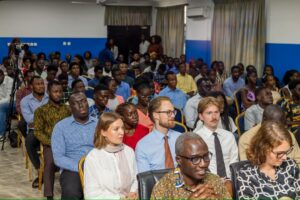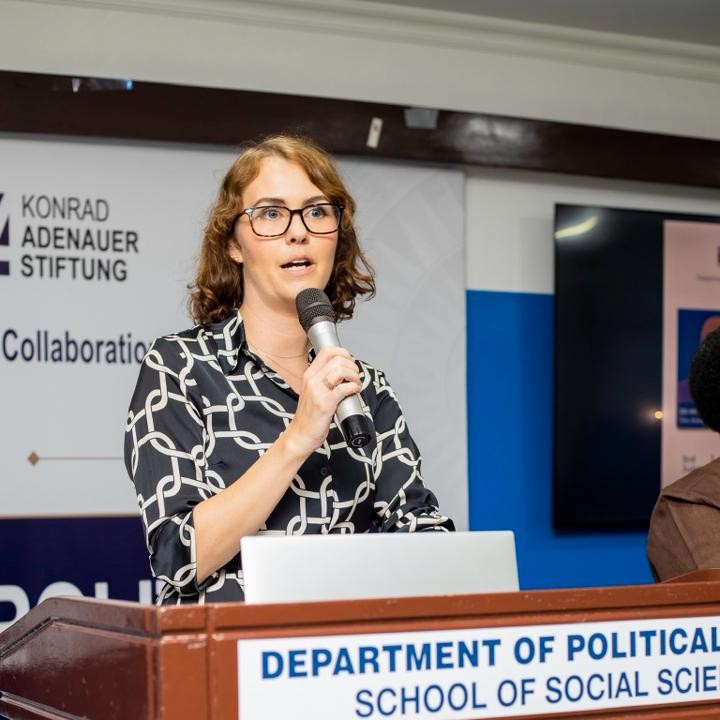
The second edition of the Time with a Politician series, organised by the Konrad-Adenauer-Stiftung (KAS) Ghana Office in partnership with the Department of Political Science at the University of Ghana, has been held under the theme “Governance and Leadership: Vision to Delivery.”
The event was aimed at bridging the gap between academic theory and practical political experience by giving students direct access to political leaders and policymakers, while promoting civic education, democratic participation and leadership development.
The Country Representative of KAS Ghana, Ms. Anna Lena Sabroso-Wasserfall, underscored the importance of linking academic learning with practical political experience.
She explained that while Political Science equips students with concepts, frameworks and analytical tools, politics is ultimately shaped by real-life decisions, negotiations, successes, setbacks and leadership experiences.
According to her, the Time with a Politician series was created to give students the opportunity to complement classroom learning with firsthand insights from individuals who have occupied key positions in public service and political leadership.
“This series was created to give students the opportunity to complement theoretical knowledge with real-life experience and to learn directly from people who have operated at the centre of political decision-making,” she said.
Ms. Sabroso-Wasserfall noted that such engagements help students better understand not only the decisions made by political leaders, but also the processes, challenges, and trade-offs involved in governance.
She encouraged participants to actively engage in discussions, ask questions, challenge ideas, and share their perspectives, stressing that the value of such forums depends largely on the quality of dialogue generated.
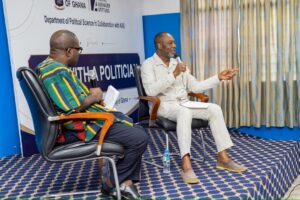 The former Education Minister and 2024 New Patriotic Party (NPP) vice-presidential candidate, Dr. Matthew Opoku Prempeh, used the occasion to outline his views on higher education reform, technical university development and political participation.
Addressing students and faculty members, Dr. Opoku Prempeh proposed a restructuring of Ghana’s technical university system, arguing that at least 70 per cent of academic programmes offered should be technical in nature.
He stressed that such reforms should not only focus on curriculum adjustments but also on strengthening the human resource capacity of the institutions.
“So, I’m of the opinion that G-Tech should come up with a proposal. If we are a technical university, 70 per cent of the courses there must be technical. The 70 per cent will involve human beings as well, lecturers as well. We have to do it,” he stated.
Dr. Opoku Prempeh cautioned that poorly managed reforms could undermine academic institutions, citing past restructuring exercises where resources and personnel were redistributed in ways that created challenges for affected institutions.
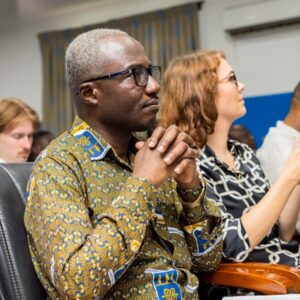
READ ALSO:Dr. Opoku- Prempeh Calls for Integrity in Political Leadership
He also reflected on reforms undertaken during his tenure as Education Minister, including the extension of the retirement age for professors from 60 to 70 years.
According to him, retaining experienced academics strengthens universities by preserving institutional memory and expertise, adding that senior professors should continue contributing to teaching, research and mentorship.
He further warned against the politicisation of academic reforms, arguing that excessive political interference in university administration and education policy could negatively affect institutional quality.