
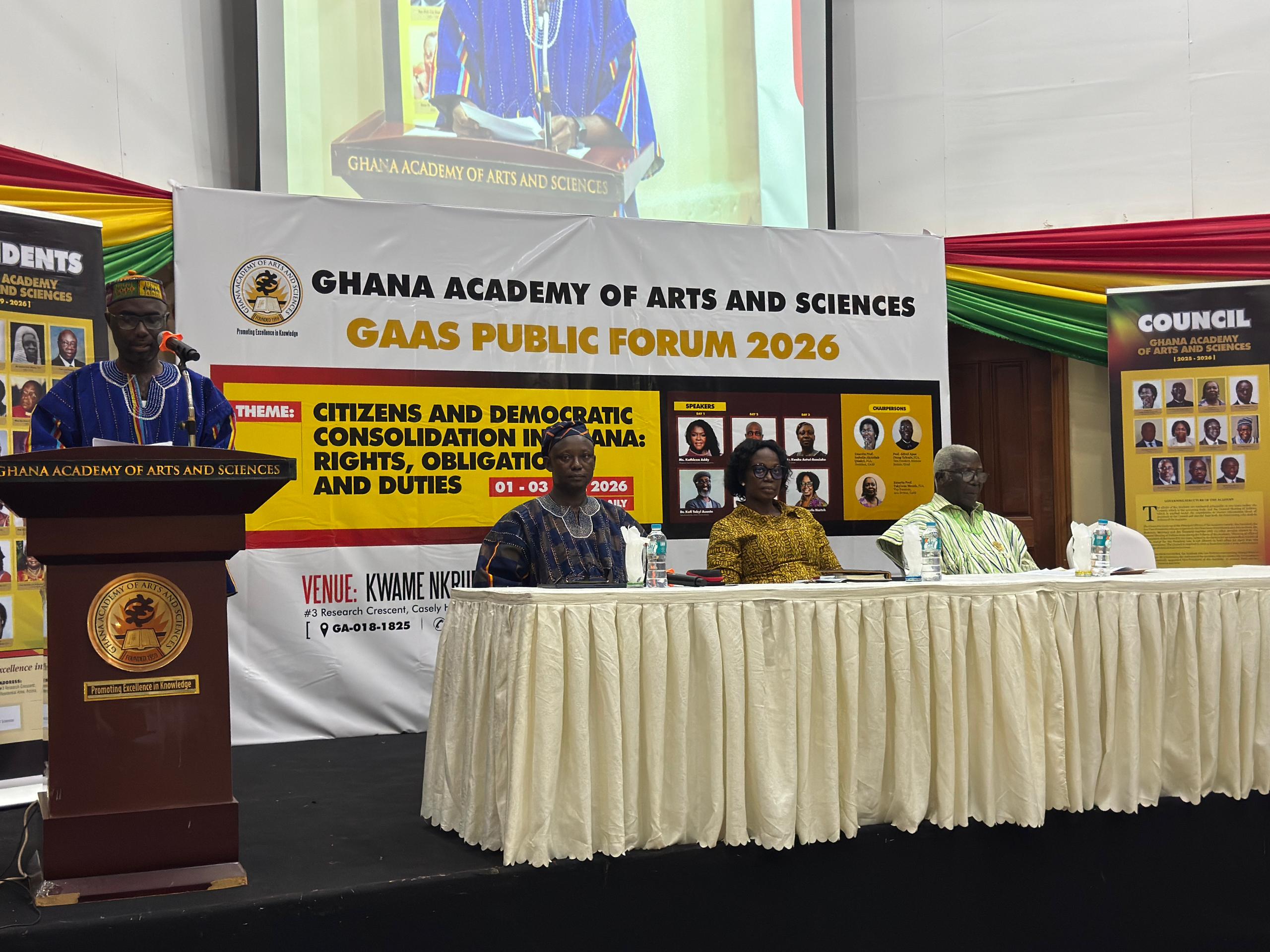
Ghana’s democracy, though procedurally sound, is being quietly hollowed out not only by the failures of political leaders but increasingly by the disengagement, partisan loyalties, and institutional apathy of its own citizens, two speakers told a national forum on democratic governance.
The warning came on Tuesday at a public forum organised by the Ghana Academy of Arts and Sciences (GAAS) on the theme, “Citizens and Democratic Consolidation in Ghana: Rights, Obligations and Duties,” which attracted Fellows of the Academy, civil society representatives, academics, and students.
Mrs Beauty Emefa Narteh, Executive Secretary of the Ghana Anti-Corruption Coalition (GACC), and Mr Kwaku Antwi-Boasiako, a governance and accountability researcher, both argued that while democracy remains the most desirable form of governance for Ghana, its foundations are under strain from forces that citizens themselves must urgently confront.
Mrs Beauty Emefa Narteh, posits that despite the real achievements of Ghana’s Fourth Republic with nine successive multi-party elections, four peaceful transfers of power, and a constitutional architecture that many African countries would envy, there is a widening and dangerous gap between the formal stability of Ghana’s democratic institutions and their practical delivery of accountability and improved living standards for ordinary citizens.
Democracy’s silent saboteurs
Presenting a paper co-authored with Mr Ebenezer Otu Okley, Programmes Officer of the Economic Governance Platform (EGP), Mrs Narteh argued that the conventional focus on elite corruption and institutional failure, while valid, tells only part of the story.
“Ghana’s democratic challenges are not driven solely by the actions of political elites,” she said. “They are also shaped, and in many ways enabled by citizen inaction.”
Drawing on Afrobarometer data showing that 74% of Ghanaians believe corruption increased over the past year and World Bank figures showing that approximately 850,000 Ghanaians were pushed below the poverty line between 2022 and 2024, Mrs Narteh identified three distinct forms of citizen disengagement that are structurally undermining democratic accountability.
The first, she said, is electoral passivity; the tendency of many Ghanaians to limit civic participation to voting every four years while remaining disengaged from governance processes between elections. The second is the systematic underuse of accountability institutions that already exist: the Right to Information Act, the Whistleblower Act, CHRAJ, and the Public Interest and Accountability Committee.
The third, and in her assessment the most structurally damaging, is what she described as the reproduction of partisan double standards. The widespread practice of condemning corruption in political opponents while defending or minimising the same behaviour when it involves one’s own party.
“This double standard does not merely reveal inconsistency,” she said. “It actively insulates corrupt actors from accountability by turning every demand for accountability into a partisan attack.”
The structural roots of passivity
Mrs Narteh was careful to distinguish between citizen inaction as a moral failing and citizen inaction as the predictable outcome of structural conditions. She argued that democracies rarely collapse through dramatic coups, they are more commonly hollowed out gradually through the slow erosion of norms, the weakening of institutions, and the quiet acquiescence of citizens who have been given repeated reasons to believe that engagement is futile.
She cited three concrete cases to illustrate the point. Auditor-General reports in Ghana have for years documented procurement irregularities running into billions of cedis, yet prosecutions rarely follow. The Right to Information Act, passed in 2019 after more than two decades of advocacy, remains significantly underutilised six years later. And the election petitions of 2012 and 2020, whatever one’s view of their legal outcomes, demonstrated that the integrity of electoral processes ultimately depends not on institutions alone but on organised, active citizen oversight.
“Where citizens are passive, institutions are more vulnerable,” she said. “The evidence is clear: where citizens are active, institutions respond. Where citizens are silent, impunity thrives.”
Addressing the forum, Mrs Narteh also commended the GAAS for bridging the gap between scholarly inquiry and practical governance concerns, describing the forum as “itself an act of democratic accountability” one that modelled the kind of sustained, evidence-based engagement that the country urgently needs.
Cash, corruption and democratic risk
Mr Antwi-Boasiako, presenting on the theme “Democracy Without Dividends: Why Citizen Apathy Threatens Ghana’s Democratic Future,” reinforced many of Mrs Narteh’s conclusions while offering a complementary analysis of the structural and economic factors driving democratic decline.
He argued that despite the challenges, democracy remains the superior form of governance but only if its quality is actively defended and its dividends made real for citizens.
Mr Antwi-Boasiako drew particular attention to a dimension of corruption that he said was insufficiently discussed in public discourse: the role of cash-based transactions in enabling and sustaining corruption in Ghana’s public sector. He argued that the high reliance on cash in public service delivery creates opacity, reduces traceability, and provides the conditions in which corrupt practices can flourish with limited accountability.
He further warned that the combination of factors currently converging in Ghana mirrors patterns that have historically weakened democracies elsewhere in the world. Economic frustration among the general population, growing youth disillusionment and disengagement from formal political processes, deepening inequality, entrenched corruption, and what he described as a creeping erosion of public trust. Each individually manageable, but collectively capable of undermining democratic legitimacy if left unaddressed.
“What weakens democracy elsewhere is emerging in Ghana,” he cautioned.
A call for organised citizen action
Both speakers converged on the conclusion that the path forward lies not in waiting for better political leaders but in the deliberate, organised activation of citizens as accountability actors.
Mrs Narteh called for a reframing of civic education away from constitutional recitation and towards practical skills – teaching citizens how to file RTI requests, how to read budget documents, how to engage with procurement records, and how to use the institutions that exist to hold the state accountable.
She also highlighted the role of civil society coalitions including the work of GACC itself over its 25 years of operation in demonstrating that organised, cross-partisan, sustained advocacy can produce measurable accountability outcomes, including the recovery of public funds and improvements in audit recommendation implementation.
“Individual citizens acting alone are rarely effective against entrenched interests,” she said. “What makes the difference is collective, organised and sustained pressure.”
Both speakers also made pointed recommendations to the state: fully operationalise the RTI Act, ensure the genuine independence of the Fiscal Council, and enforce visible, consistent consequences for procurement and financial irregularities consequences that citizens can see and that change political calculations.
Forum context
The GAAS forum was the third in a series of the year’s public lectures and discussions organised by the Academy as part of its engagement with pressing national governance questions. It attracted a broad cross-section of participants from academia, civil society, religious bodies, and student, reflecting the Academy’s mandate to foster rigorous intellectual engagement with the challenges of Ghana’s development.
READ ALSO: Wontumi Defends Decision to Pursue Legal Resolution in EXIM Bank Case
The forum’s theme; Citizens and Democratic Consolidation in Ghana: Rights, Obligations and Duties carries particular resonance at a moment when Ghana is recovering from a severe economic crisis that pushed hundreds of thousands into poverty and sparked unprecedented public interest in questions of fiscal governance and accountability. Both speakers argued that this moment of heightened public awareness represents not only a risk but also an opportunity: if properly channelled into organised civic demand, it could catalyse a genuine shift in Ghana’s accountability culture.
“Democratic consolidation is not a destination Ghana has reached,” Mrs Narteh said in closing. “It is a practice that must be renewed every day, in every institution, in every community, and by every citizen.”
