
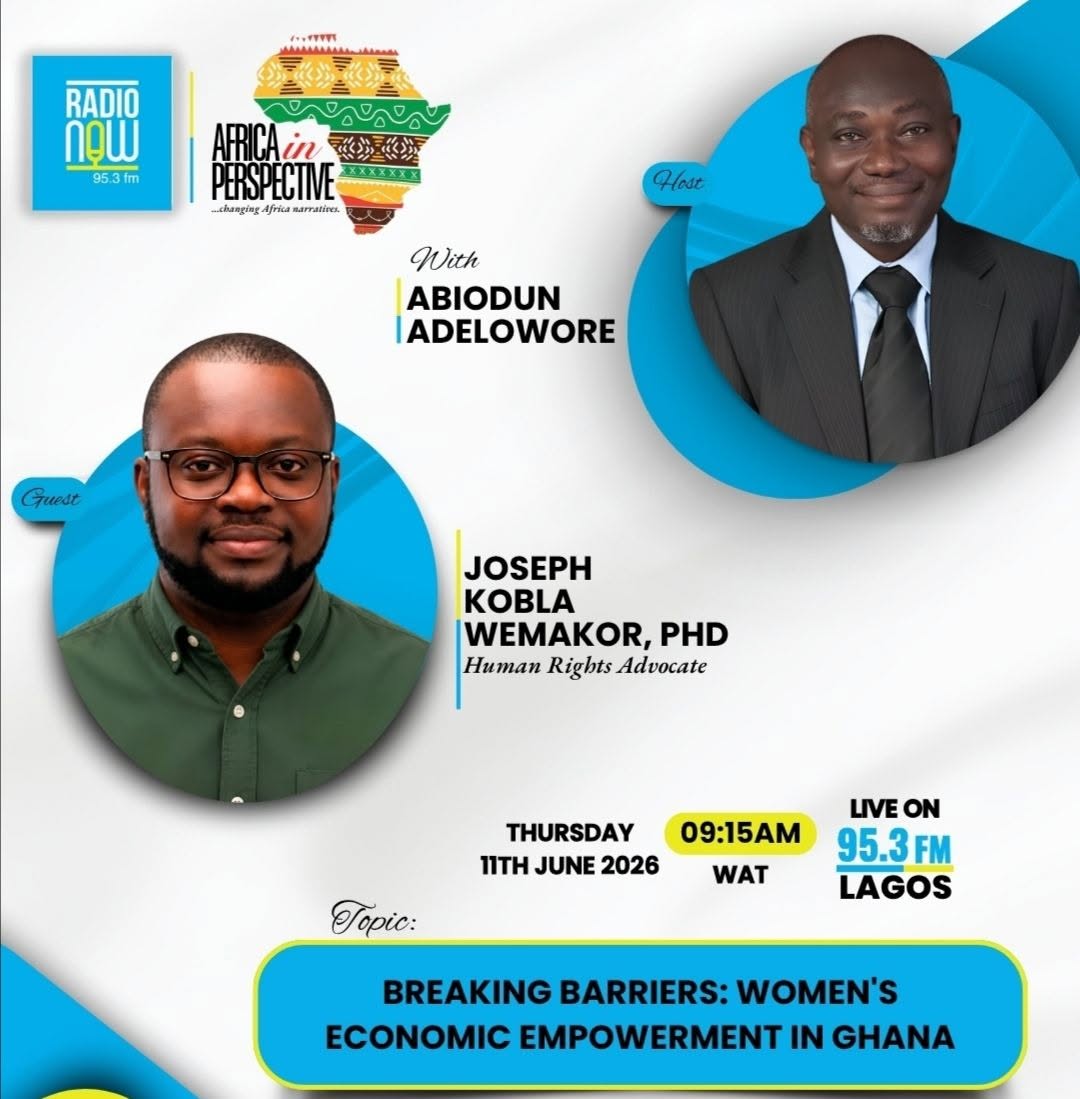
Executive Director of Human Rights Reporters Ghana (HRRG), Dr Joseph Kobla Wemakor has called for sustained investments and deliberate policies to promote women’s economic empowerment, describing it as critical to building resilient communities and accelerating Africa’s development.
He said empowering women economically required ensuring equal access to education, finance, land, markets, technology, leadership opportunities and decision-making processes that influenced their economic future.
Dr Wemakor made the call during an interview on Africa In Perspective, a programme aired on Radio Now 95.3 FM, a Lagos-based radio station in Nigeria.
Speaking on the theme, “Breaking Barriers: Women’s Economic Empowerment in Ghana,” he noted that although Ghana had made significant progress over the past decade, many challenges continued to hinder women’s full participation in the economy.
He said more women were pursuing higher education, establishing businesses and assuming leadership positions across various sectors, while government interventions, private sector initiatives and digital technologies had improved financial inclusion.
Despite these gains, he said women continued to dominate the informal sector, where earnings were often unstable and access to social protection remained limited.
“Access to finance remains unequal, and many women still face cultural expectations that restrict their economic choices,” he stated.
Dr Wemakor observed that women in rural communities faced greater challenges than their counterparts in urban centres due to limited access to financial institutions, markets, business training opportunities, internet connectivity and transportation infrastructure.
He said while women in cities such as Accra and Kumasi generally had better access to services, financing constraints and societal expectations continued to affect their economic advancement.
On access to credit, Dr Wemakor noted that although microfinance schemes and digital lending platforms had expanded financing options, many women entrepreneurs still struggled with high-interest rates, inadequate funding and collateral requirements.
“Many women-led enterprises operate informally and may lack the documentation and collateral required by financial institutions,” he explained.
He identified financial literacy, business management, bookkeeping, digital marketing, customer service, negotiation and leadership training as some of the key areas where women entrepreneurs required additional support.
Dr Wemakor also highlighted the growing role of technology in advancing women’s economic participation.
According to him, mobile money services had enabled women to save, receive payments and conduct business transactions more efficiently, while e-commerce platforms had opened new markets for entrepreneurs.
He said emerging technologies, including artificial intelligence, offered opportunities for business planning, marketing and productivity enhancement but stressed the need for digital inclusion.
“Digital inclusion efforts must ensure that women are not left behind,” he said.
Dr Wemakor commended Ghanaian women for their contributions to sectors such as agribusiness, food processing, manufacturing, fashion, renewable energy, education, healthcare and technology.
He said women were not only participating in these sectors but were also driving innovation and transformation through creativity and resilience.
The prominent human rights advocate also announced his participation as a guest speaker at the Women Entrepreneurship Empowerment Programme (WEEP) workshop scheduled for June 20, 2026, in Accra.
The programme, organised by Eminence Lead International with support from the National Entrepreneurship and Innovation Programme (NEIP) and the Ghana Export Promotion Authority (GEPA), aims to equip women entrepreneurs with practical skills, mentorship, financial literacy and leadership development opportunities.
Dr Wemakor said initiatives such as WEEP demonstrated the importance of moving beyond discussions to practical interventions that empowered women to succeed.
He urged governments, development partners, civil society organisations and the private sector to intensify efforts to remove barriers that limited women’s participation in economic activities.
“When women rise economically, communities rise with them. Investing in women’s enterprises means investing in stronger families, resilient communities and a more prosperous Africa,” he said.
