
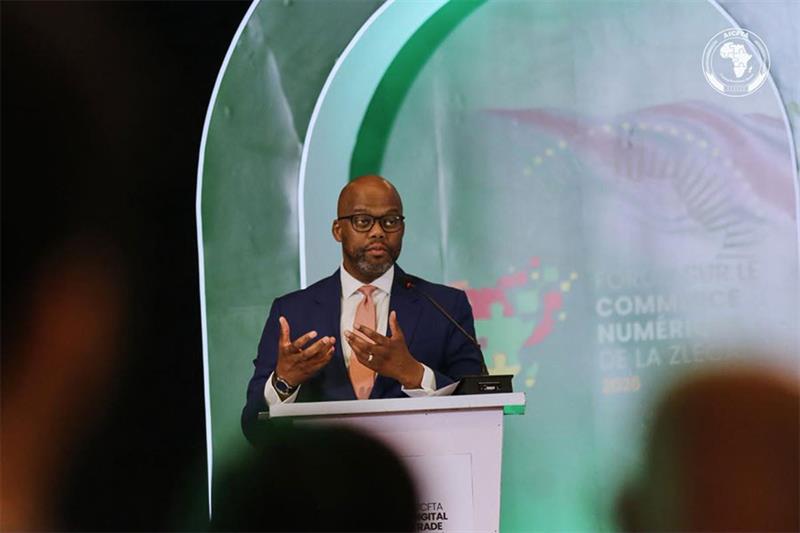
Secretary-General of the African Continental Free Trade Area (AfCFTA) Secretariat, Wamkele Mene, called on African governments to accelerate the implementation and ratification of the AfCFTA Protocol on Digital Trade, stating that it is essential to unlocking Africa’s projected $712 billion digital economy by 2050.
Speaking at the opening of the second AfCFTA Digital Trade Forum in Lagos on Wednesday, Mene said the protocol would remove long-standing barriers to intra-African trade by enabling integrated digital payments, harmonized regulations and secure cross-border digital commerce.
“The work is not finished. It has barely begun. But for the first time in a long time, Africa is not just participating in global digital trade; we are shaping what digital trade in Africa will become on our own terms,” he said.
Mene praised Nigeria’s leadership in advancing the digital trade agenda, noting that the country serves as an AfCFTA Co-Champion for Digital Trade alongside Kenya and South Africa and became the first African country to secure parliamentary approval for ratifying the Protocol on Digital Trade.
He highlighted the rapid expansion of Africa’s digital economy, which is currently valued at $180 billion, representing 5.2 percent of the continent’s GDP, and is expected to grow to $712 billion, or 8.5 percent of GDP, by 2050.
According to Mene, Africa already accounts for about 70 percent of the world’s total mobile money transaction value, while digital payment platforms such as the Pan-African Payment and Settlement System (PAPSS) are making cross-border trade faster and more efficient by reducing dependence on foreign currencies.
He said an integrated continental payments system would boost investor confidence and stimulate investment in transport, logistics and digital infrastructure across Africa.
Despite the progress, Mene acknowledged persistent challenges, including limited internet access, fragmented regulations, high data costs, cybersecurity concerns, and gaps in digital skills, particularly among women, youth, rural communities, and micro, small, and medium-sized enterprises (MSMEs).
He urged African governments to harmonize digital trade regulations, invest in broadband connectivity, improve digital infrastructure, and develop the skills needed to support a continent-wide digital economy.
Highlighting Africa’s competitive advantages, Mene said the continent possesses significant reserves of strategic minerals essential for the digital economy, including copper, cobalt and around 90 percent of global platinum reserves. He added that Africa also has 60 percent of the world’s best solar energy potential, delivers the world’s highest average return on foreign investment at 11 percent compared with the global average of 7.4 percent, and is home to six of the world’s ten fastest-growing economies.
He also noted that Africa is expected to have 900 million smartphones by 2030—more than America and Europe combined—and that by 2050, 40 percent of the world’s youth will live on the continent.
Mene said Africa’s growing digital economy will require up to 700 new data centres and an additional 1,000 megawatts of capacity, creating substantial investment opportunities in data storage, cloud services and digital infrastructure.
To support implementation of the Digital Trade Protocol, he announced that the AfCFTA Secretariat has launched several initiatives, including the Africa Digital Access and Public Infrastructure for Trade (ADAPT), which is being piloted in Kenya, Morocco, and Nigeria. The platform integrates digital identities, payments, data transfers, and electronic trade documentation to facilitate secure cross-border commerce.
He also highlighted the AfCFTA Digital Inclusion and Entrepreneurship Programme (ADIEP), launched in partnership with Google in October 2025, to provide free digital trade and artificial intelligence training for 7,500 African SMEs across 19 countries.
Mene concluded by calling on governments, businesses and development partners to strengthen public-private partnerships and embrace digital platforms and artificial intelligence to simplify trade, improve transparency and reduce transaction costs, saying such cooperation is essential to achieving Africa’s vision of an integrated digital economy.
