
The Weija Gbawe Municipal Assembly (WGMA) has admitted that an illegal landfill site at Mallam contributed significantly to the flooding that submerged parts of Mallam and surrounding communities following the heavy rains on Monday, June 29.
Residents have for years blamed the recurring floods on poor waste management practices, saying indiscriminate dumping at the site has blocked major drainage channels and impeded the free flow of stormwater.
The officials of the Weija Gbawe Municipal Assembly acknowledged that the landfill has become a major environmental concern and played a key role in the recent flooding.
The revelation follows an on-the-ground investigation by AmaGhana Online investigative journalist Daniel Benin Ohim, which linked the illegal landfill to the perennial flooding in the area.
The Assembly alleged that the landfill originated from a contract approved during the tenure of a former Municipal Chief Executive (MCE) under the previous New Patriotic Party (NPP) administration. It claimed documents bearing the former MCE’s signature support the assertion, although the former official reportedly denied authorising the agreement when confronted.
According to the Assembly, waste disposal activities at the site obstructed the natural drainage system, contributing to flooding at Mallam Junction and adjoining communities.
Investigations by AmaGhana Online further indicate that several attempts to bring together Assembly engineers, relevant stakeholders and the Chinese-owned company, CAITECH, to discuss a permanent solution have failed to yield results under both previous and current administrations.
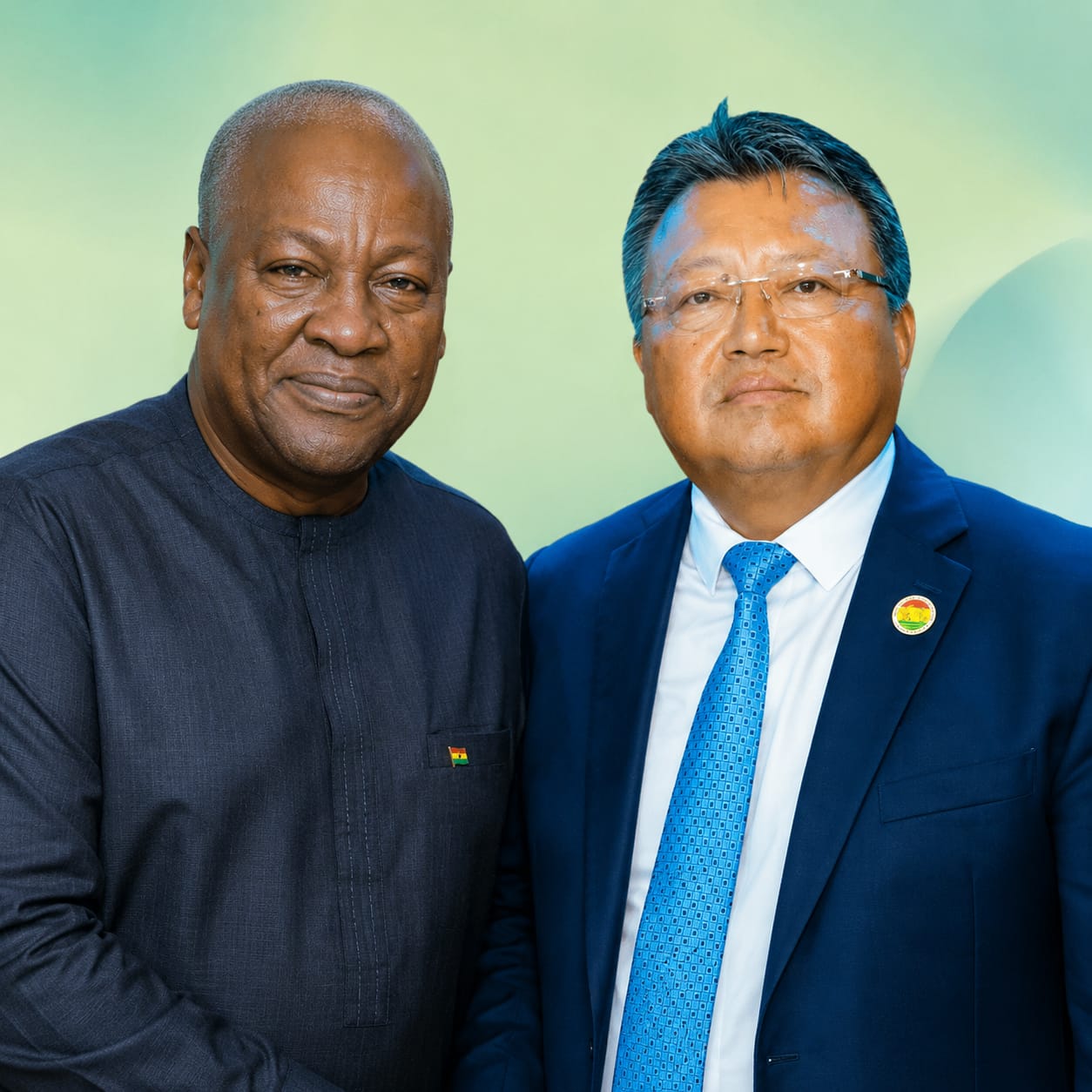
Meanwhile, Chairman of CAITECH, Tang Hong, has pledged the company’s readiness to finance a permanent solution to the flooding problem.
Mr. Tang said CAITECH was prepared to provide funding, logistics and heavy equipment to permanently resolve the challenge.
“I am prepared to finance, provide logistics and equipment to stop this problem once and permanently,” he said.
He, however, stressed that the initiative would require the cooperation of the Weija Gbawe Municipal Assembly and other relevant government agencies.
Mr. Tang said previous efforts by CAITECH to collaborate with the Assembly and other stakeholders did not receive the necessary support to implement a lasting solution.
He therefore appealed to President John Dramani Mahama, the Weija Gbawe Municipal Assembly and other relevant state institutions to engage the company in addressing the flooding challenge.
According to him, CAITECH is prepared to finance the entire operation, including dredging works, logistics, equipment and, where necessary, the relocation of the illegal landfill site.
He said clearing the accumulated solid waste obstructing drainage channels would significantly reduce flooding around Mallam Junction and neighbouring communities.
Mr. Tang further claimed that flooding in the area was less severe during much of CAITECH’s more than 30 years of operation and attributed the worsening situation to activities by other companies that later acquired adjoining lands.
He alleged that attempts by CAITECH to work with neighbouring companies and the Municipal Assembly to improve waste management had received little commitment.
Mr. Tang also noted that CAITECH is not the only company operating in the area, mentioning VVIP Transport Group as another business located around Mallam Junction, but argued that environmental concerns are often directed solely at CAITECH.
He reiterated that the company only seeks government engagement, the necessary approvals and collaboration to implement a permanent solution.
Despite his concerns, Mr. Tang commended the current Municipal Chief Executive for efforts made so far and urged him to engage CAITECH to address the flooding problem.
“We are ready to do whatever it takes. We only need the government and the Assembly to sit with us so we can permanently solve this problem,” he said.
The flooding that affected Mallam, Gbawe and adjoining communities after Monday’s downpour has renewed concerns over poor urban planning, weak enforcement of environmental regulations and blocked drainage systems.
Residents and environmental observers maintain that while the heavy rainfall triggered the flooding, years of illegal dumping and poor waste management created conditions that turned the downpour into a major disaster.
Many residents say the illegal landfill has for years clogged key drainage channels with refuse, plastics and silt, reducing their capacity to carry stormwater and causing floodwaters to overflow into homes, businesses and major roads.
READ ALSO: GWJN Demands Action to End Accra Flooding Crisis
Environmental groups and community members have repeatedly called for decisive action, arguing that official responses have largely been limited to emergency desilting exercises after flooding instead of implementing permanent preventive measures.
Stakeholders are now calling for stricter enforcement of sanitation laws, the closure of illegal landfill sites, rehabilitation of drainage infrastructure and stronger collaboration among government agencies to prevent future flooding in the Greater Accra Region.
They believe CAITECH’s renewed offer to partner with government authorities presents an opportunity to implement a lasting solution to the recurring flooding at Mallam.
By : Investigative Journalist Daniel Benin Ohim
