
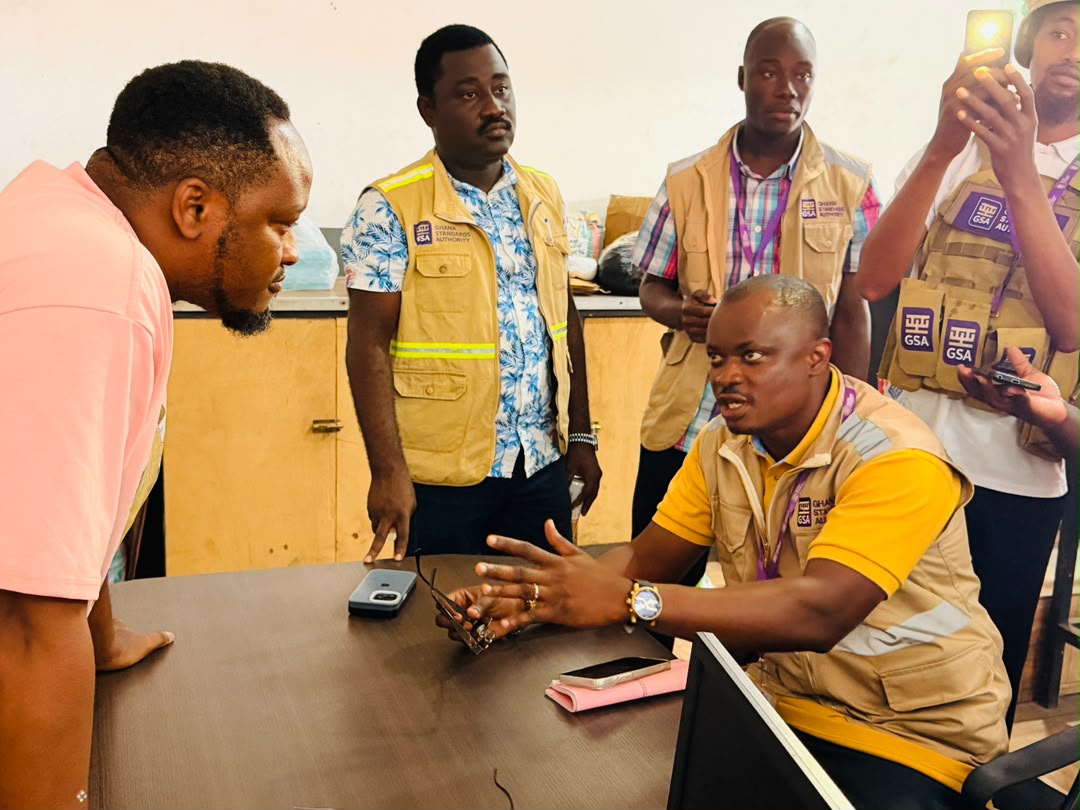
The Ghana Standards Authority (GSA) has commenced a nationwide inspection and verification exercise targeting weighing scales used by commercial transport operators to ensure compliance with national standards, promote fair trade and protect passengers from unfair luggage charges.
The exercise, which began in the Greater Accra Region on Thursday, forms part of the Authority’s renewed enforcement of the Ghana Standards Authority Act, 2022 (Act 1078), which mandates the verification and certification of weighing and measuring instruments used for commercial transactions. Operators found using unverified weighing equipment risk a minimum fine of GH¢12,000.
As part of the first phase of the exercise, GSA inspection teams visited about eight major transport terminals, including cross-country transport stations around the Ring Road area, O.A. Travel and Tours, VIP Jeoun Transport and the Intercity STC Coaches terminal, where officials assessed the accuracy and certification status of weighing scales used to determine passengers’ luggage charges.
Speaking to journalists after the inspection, the Greater Accra Regional Manager of the GSA, Mr. Clement Kubati, said the exercise had exposed widespread non-compliance among transport operators.

According to him, although many operators possessed weighing scales, a significant number were either not using them as the basis for determining luggage charges or were operating equipment that had not been inspected, verified and certified by the Authority as required by law.
He noted that the practice undermines transparency in commercial transactions and frequently leads to disagreements between transport operators and passengers over luggage fees.
“Our inspection has shown that most transport operators are not using weighing scales as the basis for charging passengers for luggage. This creates room for disputes, arbitrary pricing and unfair treatment of customers,” Mr. Kubati said.
He, however, commended the Intercity STC Coaches terminal for complying with the regulations after its weighing scale successfully passed the Authority’s verification tests, describing it as an example other transport operators should emulate.
Mr. Kubati urged all transport companies to submit their weighing equipment for inspection and certification to ensure accurate measurements, improve transparency and build public confidence in the transport sector.

Fair Trade
Mr. Kubati explained that the GSA, as Ghana’s National Metrology Institute, is legally mandated to inspect, verify and certify all weighing and measuring instruments used for commercial purposes to guarantee accuracy in trade.
He said weighing equipment used for commercial transactions is required to undergo verification every six months to ensure it continues to meet approved measurement standards.
“This exercise is backed by law. Measurement is the foundation of fair trade, and it is our responsibility to ensure that every weighing instrument used for commercial purposes is accurate and verified,” he stated.
He acknowledged concerns raised by some transport operators who questioned why the regulations had not been consistently enforced over the years but said the Authority had adopted a renewed compliance strategy aimed at strengthening nationwide enforcement.
“GSA is on a reset. We are determined to enforce the laws governing standards and measurement. Businesses should not become complacent because inspections will continue across all sectors where weighing instruments are used,” he added.
Consumer Protection
Mr. Kubati said the inspection exercise was designed to protect both businesses and consumers by ensuring that commercial transactions are based on accurate and verifiable measurements.
He explained that inaccurate weighing scales could either deprive transport operators of legitimate revenue or cause passengers to pay more than the actual weight of their luggage warrants.
“If a weighing scale records less than the actual weight, the operator loses revenue. If it records more than the actual weight, the customer is overcharged. Our responsibility is to ensure that neither party is cheated,” he said.
He stressed that ignorance of the law would not excuse operators from complying with the legal requirement to have their weighing equipment verified and certified.

Compliance Period
Mr. Kubati disclosed that transport operators whose weighing scales had not been verified had been issued notices and given a period to regularise their equipment before enforcement measures begin.
He explained that weighing scales which successfully pass the inspection would receive official GSA certification stickers as proof that they meet the required standards.
According to him, the Authority is currently prioritising public education and voluntary compliance before embarking on full-scale enforcement.
“For now, we are educating operators and giving them the opportunity to comply. But once the compliance period expires, enforcement will begin and those who fail to meet the requirements will face sanctions,” he warned.
He reiterated that the minimum penalty for operating unverified weighing equipment is GH¢12,000 and assured that the Authority would strictly enforce the law against offenders.

Stakeholder Engagement
Mr. Kubati announced that the GSA would soon engage transport unions, transport companies and other industry stakeholders to discuss concerns raised during the inspection exercise and provide further clarification on the implementation of the regulations.
He said the engagements would help address operational challenges while ensuring full compliance with national standards.
READ ALSO: DVLA Expands Service Access with Commissioning of Dome Ultra Center
“We have listened to some of the concerns raised by transport operators, and many of them are legitimate. We will engage them to discuss practical solutions while ensuring compliance with the law,” he said.
Mr. Kubati added that the nationwide inspection exercise would gradually be extended to other regions and sectors where weighing and measuring instruments are used for commercial activities.
He expressed confidence that the initiative would strengthen consumer protection, promote transparency in commercial transactions and enhance public confidence in Ghana’s national measurement system.
“We have a responsibility to ensure fairness in business, and accurate measurement remains key to achieving that objective,” he added.

Source: Isaac Kofi Dzokpo
