
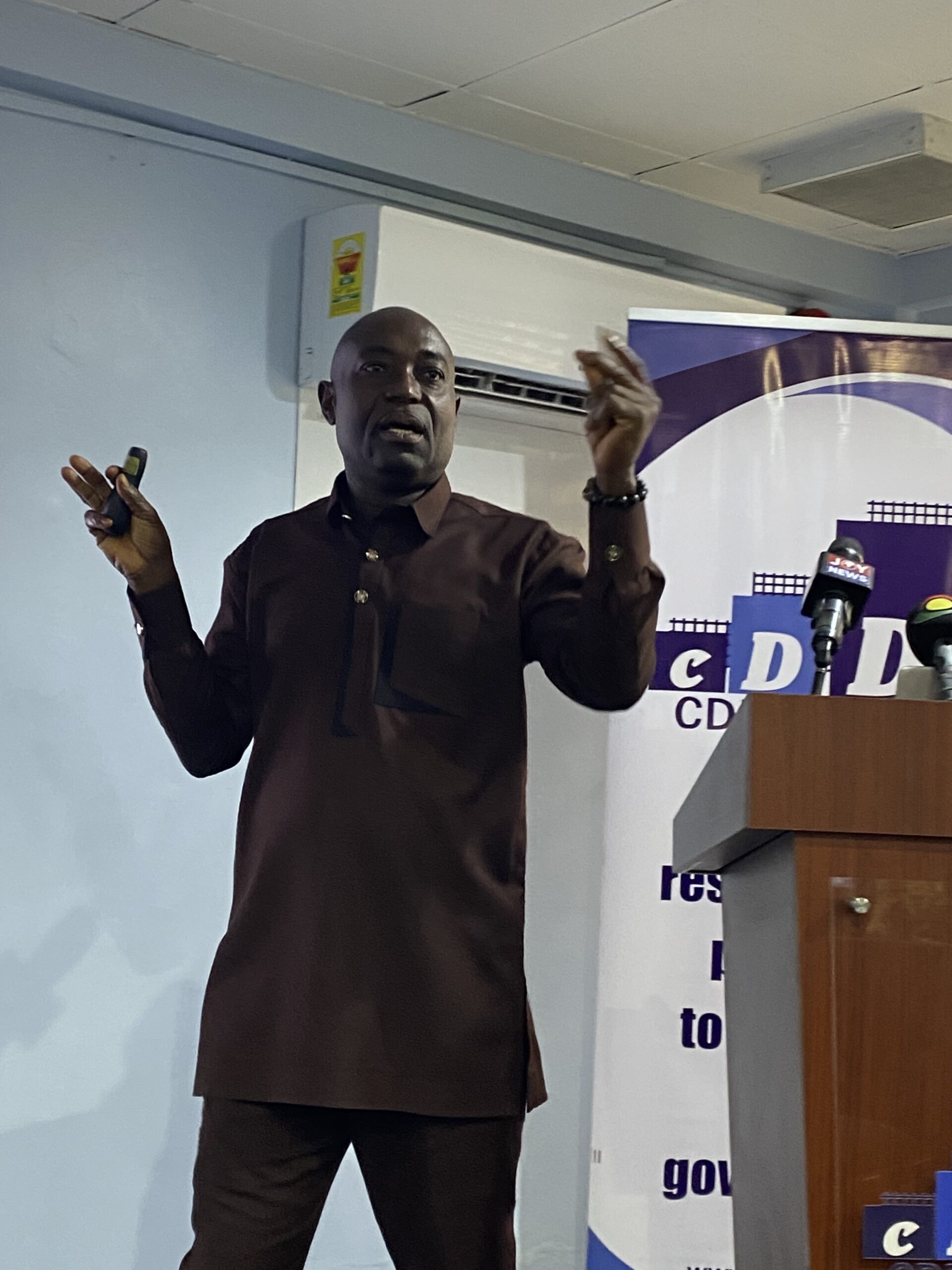
Mr. William Nyarko, Executive Director of the Africa Centre for International Law and Accountability (ACILA), has called for stronger regulation of campaign financing in Ghana, particularly measures requiring individual political candidates to account for donations received and money spent during elections.
He said the absence of effective candidate-level campaign finance regulations created a major transparency and accountability gap, allowing substantial amounts of money to move through political campaigns without adequate public disclosure.
Mr. Nyarko made the call at a media workshop on “Regulating Political Party Financing in Ghana” organised by the Ghana Center for Democratic Development (CDD-Ghana) in Accra.
He said while political parties were subject to some financial reporting requirements, individual candidates who received campaign financing were not adequately covered by the existing regulatory framework.
“The current framework states how political parties are funded but not candidates of the parties,” Mr. Nyarko said.
He said the distinction was important because much of the money used to influence electoral outcomes could be channelled directly to candidates rather than through political parties.
Mr. Nyarko said political financiers could provide resources to candidates with expectations of favourable treatment, contracts, appointments, or other benefits if those candidates eventually gained access to state power.
He therefore called for reforms to require candidates to disclose campaign donations, report expenditures, and submit financial returns for independent scrutiny.
His position is consistent with previous calls he has made for Ghana to develop comprehensive campaign finance regulations covering candidates. He has argued that Ghana’s existing framework, largely centered on political parties, is not sufficient to address electoral campaign financing by individual candidates.
The workshop formed part of CDD-Ghana’s efforts to build public understanding and support for reforms to Ghana’s political and campaign financing regime. The programme is supported by the British High Commission and focuses on the proposed Draft Model Political Finance Law.
Mr. Nyarko also drew attention to the increasing cost of political competition, including nomination and filing fees, internal party elections, delegate mobilisation and other campaign-related activities.
He said the rising cost of seeking political office could prevent capable citizens without significant financial resources from participating meaningfully in democratic processes.
Women, young people, and persons with disabilities, he noted, could be particularly affected by the financial barriers associated with political participation.
The concerns were reinforced by Mr. George Sarpong, a legal practitioner and journalist, who warned that Ghana risked allowing money to determine who gained political power.
“We will develop this nation by decent character and good ideas,” Mr. Sarpong said.
He warned that if money was allowed to drive Ghana’s democratic process unchecked, the country could “end up having criminal gangsters control the state.”
Mr Sarpong urged journalists to investigate who financed political campaigns, how much was spent, where the money came from and what expectations could accompany financial support.
He said the media had a responsibility to move beyond reporting political rallies, personalities, and election results and scrutinise the financial interests behind political campaigns.
Mr. Frederick Adu-Gyamfi, Director of Programmes and Operations at CDD-Ghana, said Ghana’s three decades of peaceful democratic transitions and competitive elections were important achievements that needed to be protected.
He, however, warned that the increasing cost of political competition and weaknesses in campaign finance regulation were emerging threats to the integrity and sustainability of the country’s democracy.
Mr. Adu-Gyamfi said the growing monetisation of politics was creating barriers for capable but less-resourced citizens while fueling opacity, weakening accountability, and increasing the risk of corruption.
He said although Ghana’s constitutional and legal framework provided a basis for regulating political financing, weaknesses in enforcement, disclosure requirements, donation limits, and expenditure controls had limited the effectiveness of the existing system.
He said CDD-Ghana’s proposed Draft Model Political Finance Law sought to strengthen transparency, regulate donations and expenditure, improve disclosure requirements, and introduce stronger enforcement mechanisms.
Representing the British High Commission, Mr. Duke Mensah Opoku, Senior Political Officer, said the United Kingdom remained committed to supporting Ghana’s democratic development and strengthening transparency and accountability.
He noted that Ghana had achieved eight consecutive peaceful elections and three transfers of power, describing those achievements as significant democratic milestones.
Mr. Opoku, however, cautioned that the rising cost of political campaigns and opaque campaign funding could undermine those democratic gains.
He said the increasing cost of political contests was creating barriers for women, young people, and persons with disabilities seeking to participate in political leadership.
He further warned that weakly regulated political financing could open the door to illicit funds and undue influence, distort policy priorities, drain public resources, and weaken the social contract between citizens and the state.
“Together we can ensure that political parties serve the public interest, not private pockets,” he said.
Dr. Kojo Pumpuni Asante, Director of Policy Engagement and Partnerships at CDD-Ghana, said Ghana could not afford to continue postponing reforms to political financing.
“If you don’t do it, the consequences for the state and the citizens are dire,” he said.
Dr. Asante explained that politicians who incurred substantial financial obligations to win elections could face pressure to recover those costs after assuming public office.
That, he warned, could create incentives for the diversion of public resources, inflated contracts, and decisions driven by private financial interests rather than the public good.
“The state must regulate it,” he said, adding that Ghana should consider supporting aspects of internal party elections and political participation to reduce the financial burden placed on candidates.
CDD-Ghana has been consulting political parties, civil society organisations, media practitioners, governance experts, and citizens as part of efforts to build consensus around comprehensive reforms.
The proposed Draft Model Political Finance Law includes measures on campaign expenditure ceilings, disclosure requirements, regulation of candidate financing, and stronger institutional oversight.
CDD-Ghana has also proposed an independent regulatory mechanism dedicated to monitoring political finance activities, enforcing compliance, and improving transparency.
The workshop urged journalists to broaden political reporting by examining not only candidates, political parties, and campaign promises, but also the financial arrangements behind political campaigns.
Participants said questions about the sources of campaign funds, the amounts spent, and possible expectations attached to political donations were essential to strengthening public accountability.
They said effective regulation of political financing was necessary to ensure that money did not become the principal determinant of who could participate in Ghana’s democratic process and ultimately gain political power.
Source: Joseph Kobla Wemakor
