

MTN Ghana and the University of Ghana (UG) have signed a Memorandum of Understanding (MoU) to deepen collaboration in Artificial Intelligence (AI), digital innovation and talent development.
The partnership will facilitate the implementation of the MTN Digital Excellence Award and the MTN DigiTech AI Hackathon 2026, providing students with opportunities to develop practical technology solutions to address local challenges.
The agreement was signed at MTN House in Accra as part of MTN Ghana’s 30th anniversary celebrations, themed “30 Years of Progress, Power to You.”
The initiative is expected to strengthen industry-academia collaboration by connecting university research and talent with practical industry experience, mentorship, incubation and opportunities to deploy innovative solutions.

Ghana Must Develop Local AI Solutions — MTN CEO
Chief Executive Officer of MTN Ghana, Stephen Blewett, said Ghana must take advantage of its growing pool of talent to develop homegrown AI solutions rather than depend solely on technologies developed elsewhere.
According to him, the partnership, which began as a discussion, has evolved into a strategic collaboration aimed at contributing to Ghana’s digital transformation.
“We have amazing talent here in Ghana and across the world. We need to focus on digital transformation not only in the tech space but across agriculture, infrastructure and other sectors,” he said.
Mr Blewett said AI had already become an integral part of everyday life and urged Ghana to position itself to determine how the technology is developed and deployed locally.
“AI is upon us. It cannot be ignored. It is already part of our lives. We need to embrace AI and, as a country, lead our own destiny when it comes to AI,” he said.
He explained that the hackathon would help bridge the gap between theory and practice by providing participants with mentorship, incubation, pilot opportunities and pathways to real-world deployment.

Young Ghanaians Must Move from AI Consumers to Innovators — MTN
Chief Digital Officer of MTN Ghana, Ibrahim Misto, has urged young Ghanaians to move beyond being consumers of emerging technologies and position themselves as developers, innovators and creators of solutions that address the country’s challenges.
He said the partnership between MTN Ghana and the University of Ghana provides an opportunity to equip students with the practical skills, industry exposure and support needed to participate meaningfully in the rapidly evolving Artificial Intelligence ecosystem.
According to him, Ghana must make a deliberate choice between depending largely on AI technologies developed elsewhere and investing in homegrown solutions that reflect the country’s unique social and economic realities.
“Ghana now faces a defining question: Will we wait for AI solutions to be built elsewhere, or will we build AI boldly, responsibly and locally to solve local problems?” he asked.
Mr Misto said Ghana has the talent and potential to develop AI solutions capable of addressing challenges across key sectors of the economy, but stressed that young innovators must be given opportunities to translate their ideas into practical applications.
He said the collaboration with the University of Ghana would help bridge the gap between academic knowledge and industry application by exposing students to real-world problems and emerging technologies.
Through the University’s Human-Computer Interaction (HCI) Lab, he said, students would gain hands-on experience in AI development and receive support to move their ideas beyond the conceptual stage into functional prototypes.
According to him, promising solutions could subsequently be tested, refined and scaled for deployment beyond the university environment, creating opportunities for innovation with wider social and economic impact.
Mr Misto stressed that the ultimate value of technological innovation should be measured by its ability to solve problems and improve lives rather than merely attract recognition. “Don’t build for applause. Build for impact,” he urged participants.
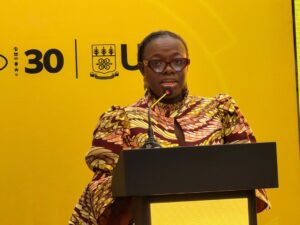
UG Pushes Industry Collaboration to Prepare Students for Jobs
Vice-Chancellor of the University of Ghana, Prof. Nana Aba Appiah Amfo, said closer collaboration between universities and industry had become necessary to prepare students for the rapidly changing world of work.
She said the partnership demonstrated how institutions responsible for developing knowledge and talent could work with companies operating at the forefront of technology to address national challenges.
Prof. Amfo said the initiative went beyond the signing of an MoU and reflected the type of industry relationship the University wanted to develop.
She noted that digital technologies, including AI, data analytics and cloud computing, were transforming jobs and business models, making it necessary for universities to continuously adapt their curricula.
“The world is changing rapidly as Artificial Intelligence, data analytics, cloud technologies and digital platforms are changing jobs and business models. The skills employers require are evolving as quickly as the technologies themselves,” she said.
She disclosed that the University, as part of a review of its required courses, was introducing compulsory modules in digital literacy and applied Artificial Intelligence, alongside gender equality, disability and inclusion.
According to her, technological development must be inclusive and ensure that people are not disadvantaged because of gender, disability or language.
“The future of work will require digital competence, but it must also be a future in which people are not excluded because of gender, disability or language,” she said.
Prof. Amfo stressed that classroom instruction alone was insufficient to adequately prepare students for the workplace.
She explained that while a Computer Science student might understand algorithms, exposure to issues such as large-scale data management, cybersecurity, customer expectations and the operational demands of companies such as MTN was equally important.
She said the partnership would provide opportunities for internships, national service placements, industry visits, masterclasses and direct engagement with industry practitioners.
AI Project Targets Speech and Language Barriers
Prof. Amfo also highlighted Tɛkyerɛma Pa, an AI and speech-recognition project designed to reduce communication barriers for persons with speech impairments while increasing the representation of Ghanaian languages in digital technologies.
She warned that the rapid growth of AI could leave some languages and vulnerable groups behind if inclusion was not deliberately incorporated into technology development.
“As a linguist, I have often spoken about the danger of languages being left behind as AI grows. Even where technology recognizes a language, who is it designed to hear?” she asked.
She said such initiatives demonstrated the importance of multidisciplinary research in developing technological solutions that address real societal challenges.
Prof. Amfo also welcomed MTN Ghana’s investment in the Digital Excellence Awards, which will recognise the Best Graduating Computer Science Student, Best Graduating Female Computer Science Student and Best AI-Related Project.
She particularly welcomed the recognition of female students, saying women remained underrepresented in the technology sector.
She stressed that the success of the partnership would ultimately be determined by the number of students who gain meaningful industry exposure, the quality of joint research undertaken and the technology businesses that emerge from the collaboration.

Government Backs Industry-Academia Partnership
Deputy Minister of Education, Dr. Clement Abas Apaak, who endorsed the partnership on behalf of the Minister of Education, described closer collaboration between academia and industry as essential to Ghana’s development.
He said successful economies depend on educational institutions capable of preparing people for the future and industries willing to invest in talent development.
Dr. Apaak identified three major benefits of the partnership: recognition and development of talent through the Digital Excellence Award, practical problem-solving through the AI hackathon, and improved national digital competitiveness.
He cited Rwanda’s Kigali Innovation City, anchored by Carnegie Mellon University Africa, as an example of how deliberate collaboration between academia, industry and government could contribute to job creation and productivity.
He assured MTN Ghana and the University of Ghana of the Ministry’s commitment to creating an enabling policy environment for similar partnerships.
Dr. Apaak also welcomed the initiative’s focus on inclusion, noting that persons with disabilities were frequently overlooked in the development of technology programmes.
He urged students participating in the initiative to develop applications, products and enterprises capable of addressing Ghana’s pressing challenges. “We cannot be left behind,” he said.

In a related development, Tɛkyerɛma Pa, an AI and speech-recognition project, was launched as part of the Tɛkyerɛma Pa AI Hackathon 2026, an initiative aimed at developing AI solutions that recognise Ghanaian languages and improve accessibility for persons with speech impairments.
Professor Isaac Wiafe of the Department of Computer Science at the University of Ghana and Lead of the Human-Computer Interaction (HCI) Lab said the Lab had developed what he described as Ghana’s largest local dataset for Automatic Speech Recognition and Text-to-Speech in Ghanaian languages.
He said the research had been expanded to include people with cerebral palsy, stroke survivors and deaf persons to address limitations in existing speech-enabled technologies.
Prof. Wiafe stressed the need for Africa to develop AI systems that reflect its languages and local realities rather than depend entirely on technologies developed elsewhere.
“My own mother will not be able to use AI because she speaks Twi and cannot write English, and this is the biggest problem we want to solve. If Africa is not careful, we will export knowledge and import intelligence,” he said.

Source: Isaac Kofi Dzokpo
