
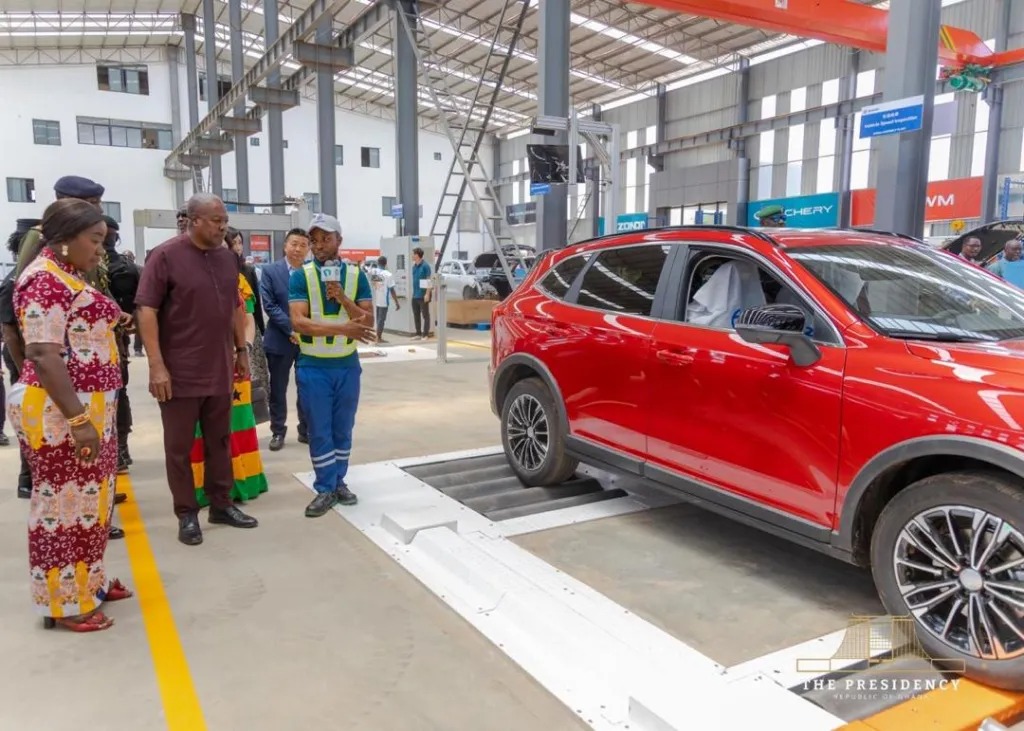
President John Dramani Mahama has inaugurated Phase III of Zonda Tech Ghana Limited’s Automobile Assembly Plant in Tema, calling for increased local production of vehicle components to strengthen Ghana’s automotive industry.
The expansion raises the company’s annual production capacity to about 3,000 heavy and light-duty vehicles, including tipper trucks, cargo trucks, trailers, semi-trailers and tankers.
The facility currently employs more than 800 Ghanaians, with the expansion expected to create additional direct and indirect jobs across the automotive value chain.
Speaking at the inauguration, President Mahama described the expansion as an important milestone in Ghana’s industrialisation drive and said the country must reduce its dependence on imports by strengthening domestic production.
He said sustainable economic growth would require Ghana to produce more of what it consumes while expanding its capacity to manufacture goods for export.
According to the President, investments such as the Zonda Tech plant demonstrate growing confidence in Ghana’s economy and contribute to job creation, skills development and increased domestic production.
He noted that the Tema industrial enclave had witnessed increased industrial activity in recent months, with several factories and other industrial facilities being commissioned or under development.
President Mahama said Ghana’s industrialisation agenda remained consistent with the vision of the country’s first President, Osagyefo Dr Kwame Nkrumah, who advocated industrial self-reliance as a foundation for economic independence.
He described the growth of Zonda Tech as a success story, noting that its Chief Executive Officer, Madam Yang Yang, started as a vehicle distributor in 2010 before expanding into local vehicle assembly.
The company has since grown into an assembler of heavy-duty vehicles, passenger cars, sports utility vehicles and light trucks.
President Mahama said Ghana’s ambition to become an automotive manufacturing hub in West Africa was deliberate and achievable, but stressed that vehicle assembly should not be the country’s final destination.
He said the next phase of Ghana’s automotive development must focus on increasing local content through the domestic production of vehicle components.
“Assembling, however, cannot be our final destination. Our goal is to develop an integrated automotive industry in which locally produced materials and components feed directly into vehicle manufacturers,” he said.
The President identified batteries, tyres, wiring harnesses, seats, glass, plastics and metal parts among components that could be produced locally to support vehicle manufacturing.
He said developing the local component industry would create stronger linkages between vehicle manufacturers and Ghanaian small and medium-sized enterprises, retain more value within the economy and create additional jobs.
President Mahama therefore urged Zonda Tech to explore opportunities to invest in local component production and increase its use of locally manufactured inputs.
Ghana Targets EV Value Chain
The President also outlined the government’s ambition to position Ghana within the growing electric vehicle and battery manufacturing industry.
He said Ghana could leverage its strategic minerals, including lithium, together with its renewable energy potential, to develop an integrated battery and electric vehicle value chain for domestic and export markets.
“Our vision is from minerals to batteries, from batteries to vehicles, from vehicles to exports, all proudly made in Ghana,” President Mahama said.
He disclosed that the Ministry of Energy and Green Transition was developing an Electric Vehicle Policy, with particular attention to the establishment and regulation of charging infrastructure.
President Mahama cautioned that the uncontrolled establishment of charging stations could put pressure on electricity infrastructure, particularly transformers and substations.
He said proper regulation would therefore be required to ensure that the expansion of EV charging infrastructure did not create imbalances in electricity supply.
The President also said the government would encourage the development of solar-powered charging systems as part of efforts to promote renewable energy in the transport sector.
Skills Development
President Mahama commended Zonda Tech Ghana Limited for establishing the Zonda Tech Academy to provide practical technical and vocational training in the automotive sector.
He said skills development would be critical to ensuring that Ghanaians benefit from the country’s expanding automotive industry and emerging opportunities in advanced vehicle manufacturing.
Chief Executive Officer of Zonda Tech Ghana Limited, Madam Yang Yang, said the Phase III facility represented more than an expansion in vehicle production capacity.
She said the investment demonstrated the company’s long-term commitment to Ghana, particularly in the areas of industrial development, employment creation and skills training.
