
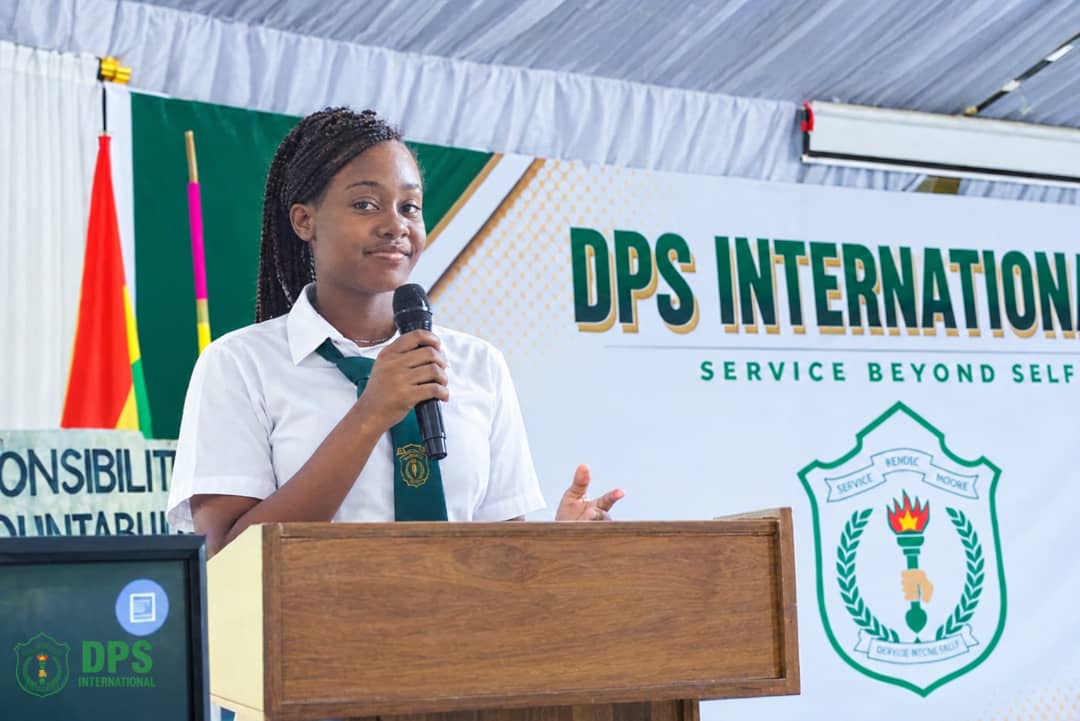
Liberian student Charlia Kweh has called for women to be placed at the centre of climate resilience, disaster response and post-conflict recovery, arguing that women should be recognized not merely as victims of crises but as “architects of resilience.”
Kweh, a student of DPS International Ghana, made the call while representing Pakistan at the DPS International Model United Nations (MUN) 2026 under the UN Women committee. She addressed the agenda, “Women as Architects of Resilience: Enhancing Gender-responsive Strategies in Post-Conflict and Climate Stressed Zones.”
Speaking on behalf of Pakistan, Kweh said the country was among the nations most vulnerable to climate change despite contributing less than one per cent of global greenhouse gas emissions.
“Pakistan comes to this committee not necessarily as a contributor to the global climate crisis, but as one of its most severe victims,” she said.
She said Pakistani women were often among the first to respond when floods, droughts, heatwaves and displacement occur, helping families and communities survive and rebuild despite having limited access to land, credit, resources and decision-making structures.
Kweh cited Pakistan’s devastating 2022 floods as a major example of the intersection between climate vulnerability and gender inequality.
According to the figures presented, the floods affected about 33 million people, left one-third of the country underwater, caused US$14.9 billion in physical damage and US$15.2 billion in economic losses, and displaced more than eight million people. More than US$16.3 billion was estimated to be needed for rehabilitation and reconstruction.
Kweh noted that the disaster also had significant consequences for women, with the United Nations estimating that 8.2 million women of reproductive age were among those affected, including approximately 650,000 pregnant women who required urgent maternal health services.
She also highlighted increased risks of gender-based violence in displacement settings, as well as disruptions to education, healthcare, livelihoods and access to essential services.
According to Kweh, the impact of disasters is not experienced equally by men and women. She pointed to women’s increased unpaid care responsibilities, limited access to financial resources and land, interruptions to girls’ education, maternal healthcare needs and protection risks in emergency shelters as key areas requiring gender-responsive planning.
She said the destruction of more than 27,000 schools during the 2022 floods also demonstrated how climate disasters could disrupt education, particularly for girls.
“Yet the same women are already leading resilience: managing household water, preserving seeds, organizing community savings, leading agricultural adaptation,” Kweh said. “The problem is not capability — it is exclusion.”
Kweh further connected Pakistan’s climate resilience efforts to the Women, Peace and Security agenda and United Nations Security Council Resolution 1325, arguing that women should participate meaningfully in prevention, peacebuilding, recovery and climate adaptation.
She said Pakistan’s Updated Nationally Determined Contribution (NDC) 2021 already recognizes the importance of women’s participation in decision-making, gender-responsive budgeting, nutrition monitoring and women’s involvement in water-resource management.
Five-pillar framework
Kweh presented a five-pillar framework that she said Pakistan would like the UN Women committee to consider.
The first pillar focuses on gender-responsive disaster planning, including gender analysis in disaster-risk assessments and the collection of data disaggregated by sex, age and disability.
The second calls for greater participation of women in decision-making, including a proposed target of at least 30 per cent women’s representation in local disaster management committees, climate institutions and reconstruction planning bodies.
The third pillar addresses protection and essential services during emergencies, including secure and lockable sanitation facilities, adequate lighting, privacy, menstrual hygiene supplies and confidential reporting mechanisms for gender-based violence.
The fourth pillar focuses on economic resilience and education continuity, with proposals including climate-resilient livelihoods, access to microfinance and crop insurance, climate-smart agricultural technologies, social protection and measures to keep girls in school during and after disasters.
The fifth pillar calls for international solidarity through finance, technology and capacity building, particularly predictable, grant-based adaptation finance for climate-vulnerable developing countries.
Kweh argued that adaptation funding should receive the same level of seriousness as climate mitigation efforts.
Concluding her presentation, she urged delegates to recognize women as active leaders in rebuilding communities affected by conflict and climate disasters.
“If we rebuild a village without asking women where the water should be, we will rebuild vulnerability,” she said. “If we negotiate peace and climate plans without women at the table, we are negotiating failure,” adding that “Let this committee recognize them not as beneficiaries of resilience, but as its architects.”
She said Pakistan was prepared to work with other member states to ensure that communities affected by conflict and climate stress are rebuilt with women playing a leading role.
