
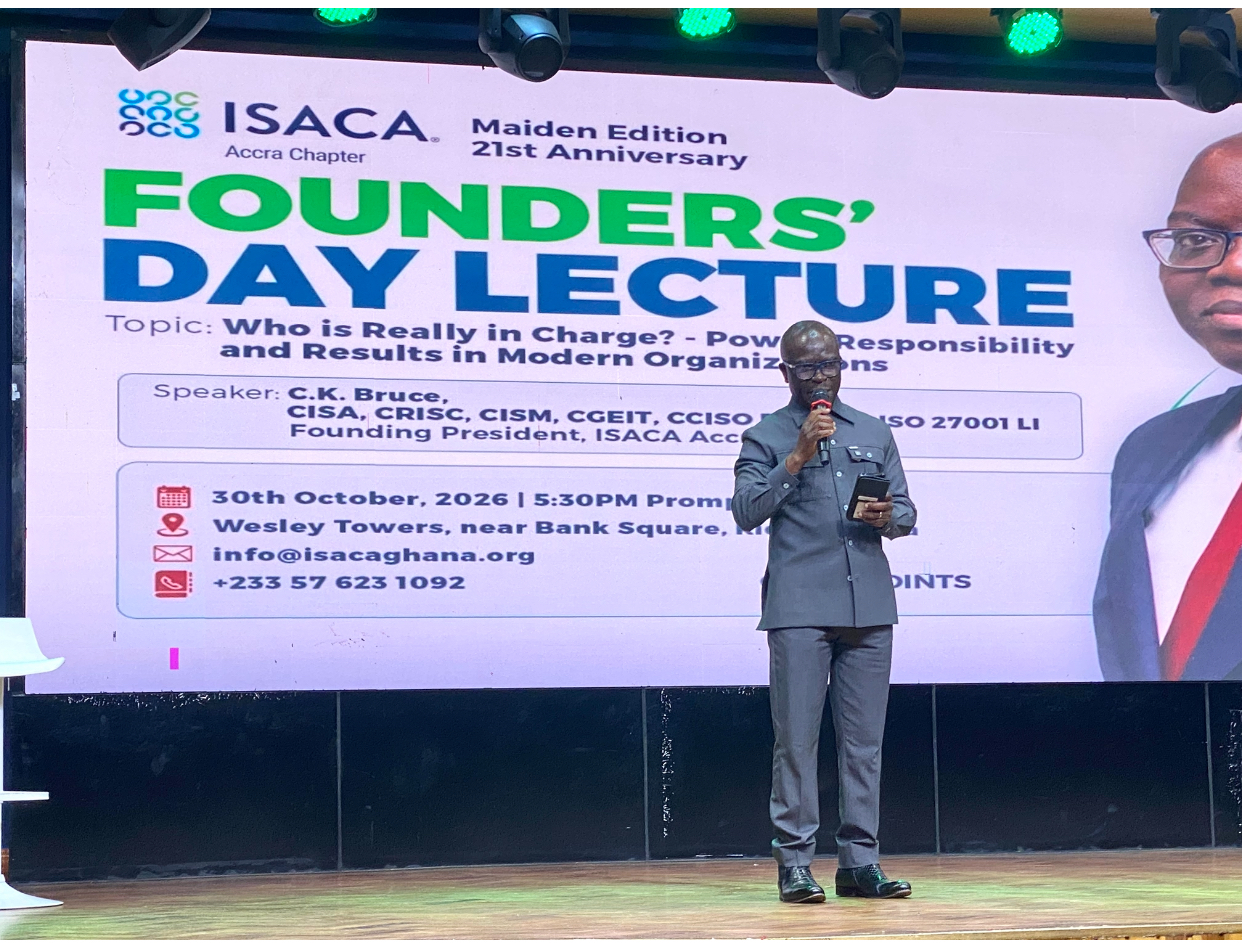
The ISACA Accra Chapter has highlighted the growing importance of artificial intelligence (AI) auditing and responsible technology governance as it marked 21 years of professional service and contributions to Ghana’s digital development.
The chapter’s Founding Member, Mr Solomon H. H. Ackom, who delivered the opening speech at its inaugural Founders’ Day Lecture in Accra, said the organisation had evolved from a modest meeting of 11 professionals into a vibrant association with approximately 800 members.
He recalled that on October 5, 2005, the 11 founding members met at Alisa Hotel in Accra to discuss the possibility of establishing a local ISACA chapter.
What began as an exploratory meeting, he said, had grown into a recognised professional institution and one of Ghana’s leading bodies in information technology and cybersecurity.
Mr. Ackom attributed the chapter’s growth to the vision, commitment, and sacrifices of its founders, past presidents, successive boards, members, and partners.
He said the chapter had, over the years, contributed to national policies and guidelines, banking sector regulation, and the development and governance of emerging technologies.
Its members, he noted, served in various organisations and institutions across the country, contributing to the security, resilience, and effective governance of Ghana’s information and communication infrastructure.
Mr Ackom said the rapid advancement of AI had created both opportunities and risks for organisations, regulators, and society, particularly as the technology increasingly influenced decision-making, service delivery, and business operations.
While acknowledging AI’s potential to improve productivity and innovation, he cautioned that its misuse for harmful, unethical, and criminal purposes presented an urgent challenge requiring stronger professional capacity and institutional safeguards.
He highlighted ISACA’s introduction of the Advanced in AI Audit Certification, designed to strengthen professional competence in AI auditing and assurance.
He said the Accra Chapter was committed to equipping its members with the knowledge and capabilities to audit AI systems, address emerging technology risks, strengthen security, and promote the responsible application of AI across organisations and institutions.
“Our mission is very clear: to ensure that as technology advances, professional competence, sound governance, and accountability advance with it,” he said.
Mr Ackom described the inaugural Founders’ Day Lecture as more than an anniversary activity, saying it was intended to honour the chapter’s history, recognise the contributions of those who established it and create a platform for reflection on leadership and issues affecting organisations and the country.
The lecture, held on Friday, October 30, 2026, at Wesley Towers, Ridge, Accra, was on the theme “Who is Really in Charge? Power, Responsibility, and Results in Modern Organizations.”
The guest speaker, Mr. C.K Bruce, Founding President of the ISACA Accra Chapter, called for a new approach to leadership and governance in response to the growing influence of technology.
He argued that leadership was not defined by titles or authority alone but by character, ethical conduct, and accountability.
Mr Bruce said business leaders could no longer delegate all technology-related decisions to IT departments, insisting that they needed to understand how technologies such as AI, cloud computing, and data systems affected their organisations.
He also emphasised continuous learning, data-driven decision-making, risk management, and ethical leadership as essential qualities for executives operating in an increasingly technology-driven environment.
A representative of the Bank of Ghana, Mr. Kingsley Kpodoh, Assistant Director in charge of Governance, Risk and Compliance at the ICT Department, reinforced the need for board-level accountability in technology management.
He said although decision-making power in modern organisations was increasingly distributed among management, technology vendors, and algorithms, ultimate responsibility remained with the board.
“Power has become distributed, but responsibility has not. The board is always responsible,” he said.
Mr. Kpodoh identified board accountability, third-party technology risks, and artificial intelligence as critical areas requiring stronger oversight, particularly within the banking sector.
He urged financial institutions to strengthen their supervision of technology service providers, protect customer data, and ensure that AI-driven decisions were explainable, documented, and subject to appropriate human oversight.
The event formed part of activities marking the ISACA Accra Chapter’s 21st anniversary and is expected to become an annual platform for professional reflection, knowledge-sharing, and discussions on technology leadership and governance.
Source: Joseph Kobla Wemakor
