
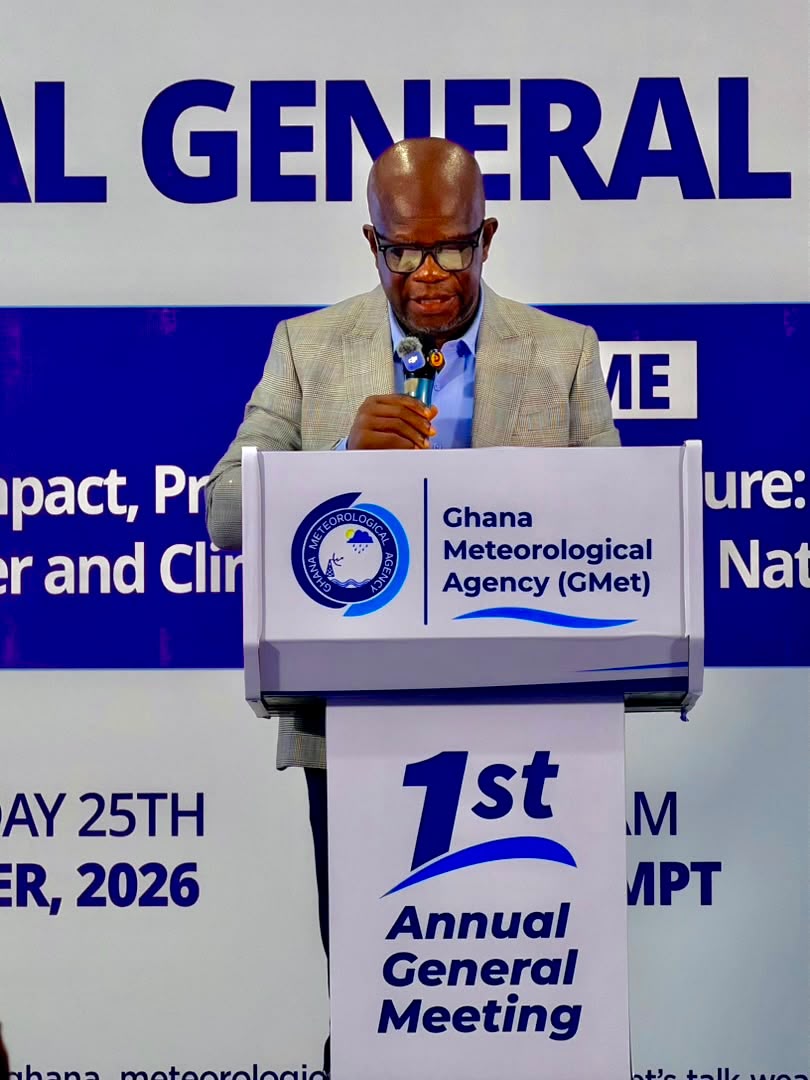
The Director-General of the State Interests and Governance Authority (SIGA), Prof. Michael Kpessa-Whyte, has backed moves to establish the Ghana Meteorological Agency (GMet) as the single official source of severe weather warnings in the country.
He said the proliferation of unverified weather alerts on social media underscored the need for an authoritative national voice to provide accurate and reliable information during emergencies.
Prof. Kpessa-Whyte was speaking at the maiden Annual Stakeholder Meeting of GMet at The Palms by Eagles Hotel in Accra.
His comments come amid ongoing consultations on the proposed Ghana Meteorological Authority Bill, which seeks to elevate the Agency into an Authority with regulatory oversight.
“In an emergency, a nation needs one trusted voice, not a hundred competing ones,” he stated.
While welcoming the proposed reforms, the SIGA Director-General cautioned that the expanded mandate must be accompanied by stronger accountability mechanisms.
He acknowledged concerns raised by stakeholders over the proposed dual role of GMet as both a service provider and regulator, calling for clear governance arrangements, transparent licensing procedures and robust oversight.
“The true test of an Authority is not the power it holds, but the public value it delivers,” he stressed.
Early Warning Systems
Prof. Kpessa-Whyte underscored the importance of effective early warning systems in protecting lives, livelihoods and the national economy against the growing threats posed by climate change.
Citing figures from the World Meteorological Organization (WMO), he said extreme weather and climate events affected at least 13 million people across Africa in 2025 and claimed more than 3,000 lives.
He expressed concern that fewer than half of the people affected by recent disasters in Central and West Africa received timely warnings.
“A warning that never reaches the people is not a warning at all. It is merely a record of what we knew and failed to share,” he stated.
He called for increased investment in weather observation infrastructure and effective dissemination of weather information, describing early warning systems as a cost-effective means of preventing disasters.
“Early warning is the cheapest insurance a nation can buy. The cost of a weather station is modest beside the cost of a flood, and the cost of a timely alert is nothing beside the value of a single human life,” he said.
Prof. Kpessa-Whyte further stressed that meteorological services must be recognised as essential to national security, economic planning and disaster preparedness.
“As our climate grows more volatile, the meteorologist has become more than a scientist. The meteorologist is a first responder who arrives before the disaster,” he added.
He reaffirmed SIGA’s readiness to contribute to discussions on the proposed reforms and support GMet in strengthening its governance and institutional capacity.
