
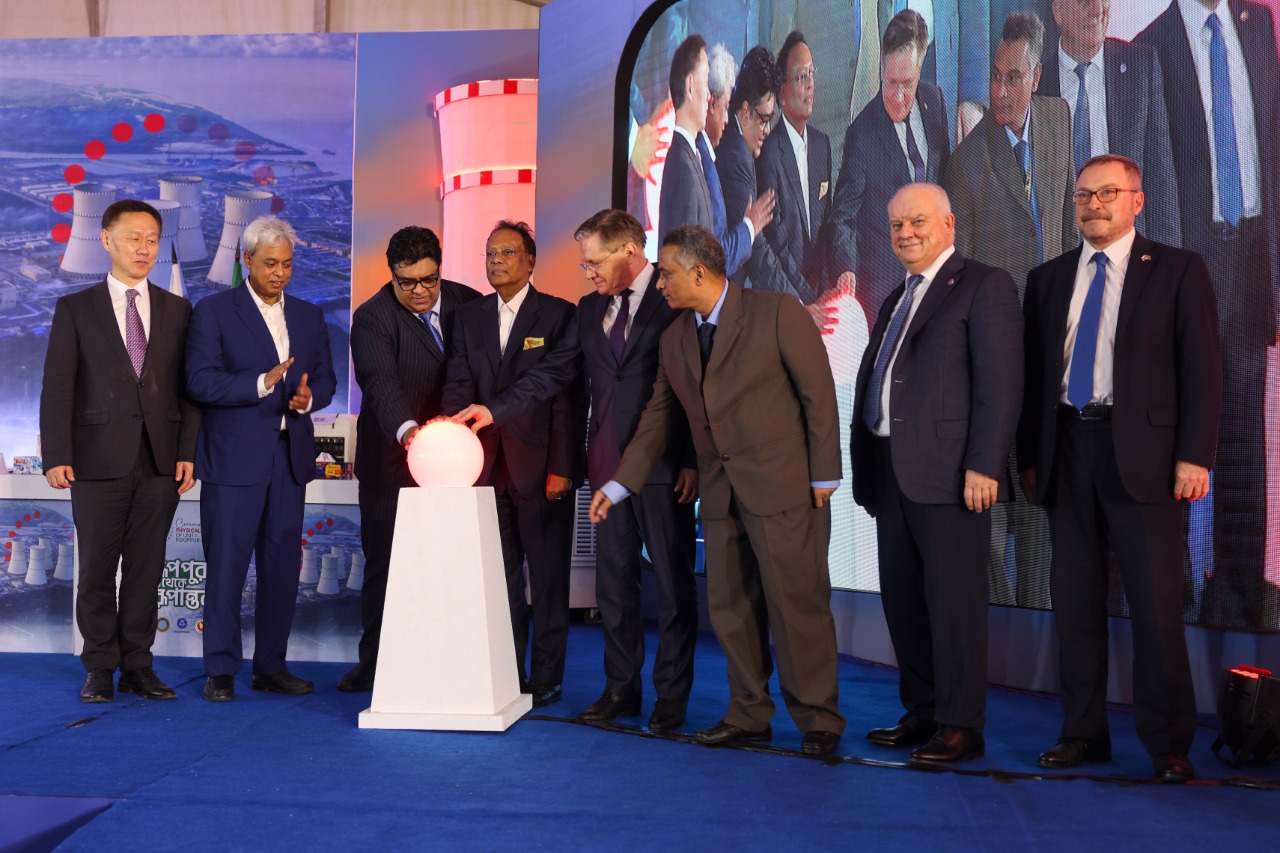
The fuel loading milestone at Bangladesh’s first NPP provides a valuable real world example for Ghana, which is actively shaping its national nuclear programme and weighing different options for atomic generation.
On 28 April 2026, loading of fresh nuclear fuel began at power unit 1 of Rooppur Nuclear Power Plant in Bangladesh. The power plant designed by Rosatom will be equipped with two VVER-1200 reactors with a total capacity of 2,400 MW. VVER-1200 reactors belong to Generation III+; they are already in operation in Russia and Belarus. This phase was the first one within the framework of the key commissioning stage of the unit.
The event was attended by Rosatom Director General Alexey Likhachev and Minister of Science and Technology of Bangladesh Fakir Mahbub Anam, who gave symbolic permission to load nuclear fuel into the first power unit of Rooppur NPP.
Later, the reactor will be brought to minimum controlled level (MCL), that is, to a stable controllable power level, after which a gradual increase of power will begin. The next stage will be the power start-up when the generated electricity will be transmitted to the power grid of Bangladesh.
“Today Bangladesh has joined the club of the countries who use peaceful atom as a reliable source of sustainable development. Rooppur NPP will definitely become the most important element of the energy system of the country. For Rosatom, this project is another important step in developing peaceful nuclear power, strengthening friendly relations with our foreign partners.
We are happy that we participate in construction of a modern and reliable nuclear power plant together with our Bangladeshi friends and we can see further prospects of our cooperation,” noted Alexey Likhachev.
“The peaceful utilisation of nuclear energy will play a vital role in ensuring national energy security, accelerating industrialisation and fostering the growth of a technology-driven economy. The Rooppur project stands as a symbol of Bangladesh’s scientific advancement and demonstrates our readiness and capability to harness advanced technologies responsibly and effectively”, highlighted Fakir Mahbub Anam.
For Ghana, which is currently shaping its national nuclear programme and exploring various options for nuclear generation, Bangladesh’s experience offers an instructive example of practical implementation by a newcomer country.
The fuel loading milestone at the Rooppur NPP demonstrates how a state without prior nuclear energy can progress from construction to the start of commissioning while adhering to international standards and the IAEA Milestones Approach. Such an example may be valuable for West African countries where energy access and grid stability remain key development priorities.
