
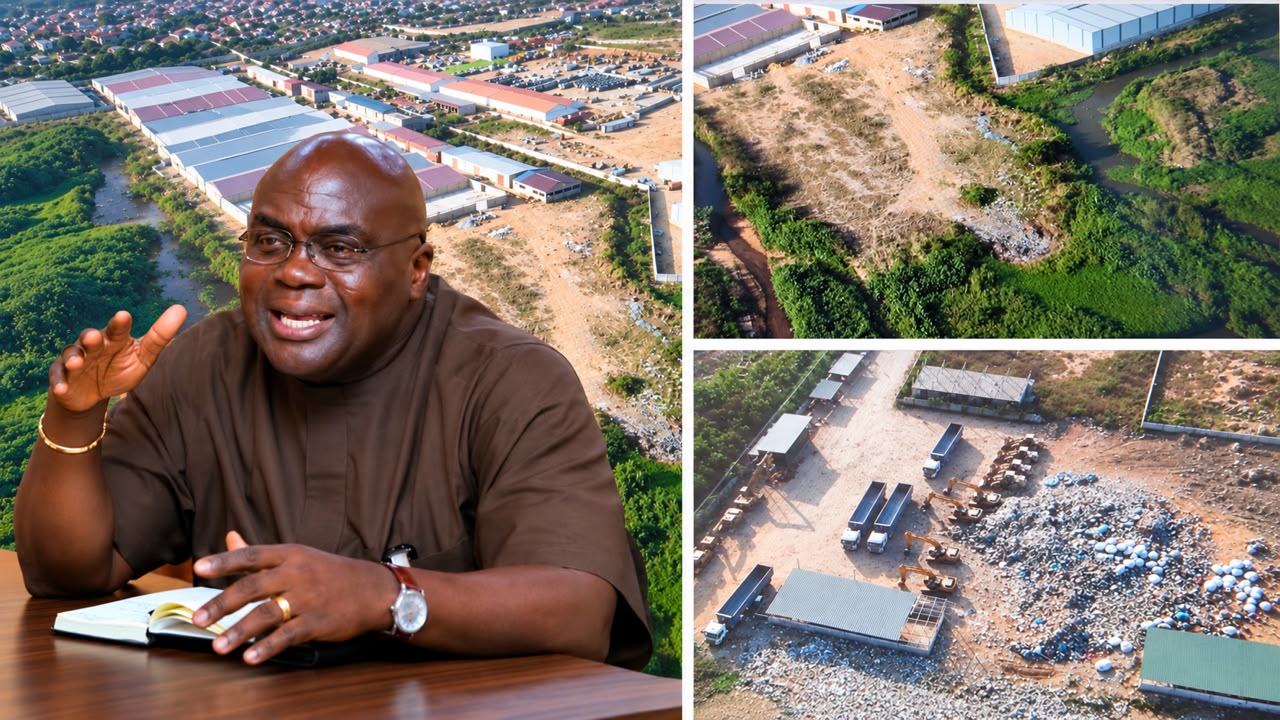
The renewed intervention by Chief of Staff Julius Debrah and the government’s Flooding Taskforce at Mallam Junction is beginning to generate relief among residents, motorists and businesses operating around the flood-prone area, following intensified efforts to tackle the landfill and drainage challenges that have contributed to flooding in the community.
The latest development comes after the government moved personnel and relevant operational teams to the Mallam landfill area as part of efforts to confront the underlying causes of flooding and improve the flow of stormwater through the area.
Residents who have followed the situation closely say the renewed presence of the taskforce is a welcome departure from the cycle of waiting until heavy rains create an emergency before intervention begins.
The development is also being viewed by businesses around Mallam Junction as a positive indication that the government is determined to address the problem before the next major rainfall creates another crisis.
The intervention follows earlier engagements initiated from Jubilee House under the leadership of Chief of Staff Julius Debrah, bringing together government agencies, the Weija-Gbawe Municipal Assembly and private-sector stakeholders whose operations are located around the affected area.
Those engagements focused attention on the landfill, blocked drainage channels and other environmental factors associated with flooding around Mallam Junction.
The renewed action is particularly significant because Mallam Junction has repeatedly experienced flooding during periods of intense rainfall, disrupting traffic, affecting businesses and creating serious inconvenience for residents and commuters.
Rather than allowing the matter to remain at the level of meetings and discussions, the latest deployment of personnel to the Mallam landfill site is being interpreted by residents as evidence that the government is now moving from consultation to practical implementation.
Some residents and business operators around the area have reportedly expressed appreciation for the renewed attention, saying a sustained government presence could help prevent the recurrence of the flooding that has affected the community over the years.
They have also welcomed the involvement of the Weija-Gbawe Municipal Assembly, describing cooperation between the Assembly and central government as critical to achieving a lasting solution.
The Weija-Gbawe Municipal Assembly has previously acknowledged the landfill as a major environmental concern linked to the flooding problem, while calls have been made for coordinated action involving the Assembly, businesses and other government institutions.
Among the businesses operating in the area, CAITECH has previously indicated its willingness to support efforts to address the challenge, including offering funding, equipment and logistics for dredging and other remedial works.
The latest government intervention therefore creates an opportunity for public authorities and private-sector operators to build on those commitments and pursue a coordinated solution.
Residents say the presence of government teams at the landfill is important because the flooding problem cannot be solved solely by clearing water after a downpour. The conditions that obstruct drainage and contribute to the accumulation of floodwater must also be addressed.
The renewed operation also comes against the background of national post-flood clean-up efforts, with Mallam Junction among the locations specifically identified for intensive cleaning, desilting and debris clearance in the Weija-Gbawe Municipality.
For commuters who regularly use the Mallam corridor, any sustained improvement in drainage and waste management would have a direct effect on traffic movement and access to surrounding communities.
Business operators also stand to benefit from a cleaner and safer environment, particularly because flooding around major commercial and transport corridors can result in damaged property, interrupted operations and reduced customer access.
Residents are therefore urging the government not to lose momentum, but to maintain the current intervention until the landfill and drainage challenges are comprehensively addressed.
The latest developments have also renewed appreciation for the leadership role being played by Julius Debrah in bringing stakeholders together and pushing the flooding issue onto the government’s priority agenda.
According to residents familiar with the situation, the most encouraging aspect of the current intervention is the apparent willingness of the central government, the Weija-Gbawe Municipal Assembly and businesses in the area to work together rather than treating the flooding problem as the responsibility of one institution.
The Weija-Gbawe Assembly’s involvement is equally important because it provides the local-government structure required to sustain monitoring, sanitation enforcement and maintenance after the immediate government operation.
The emerging cooperation also provides an opportunity to establish a more permanent framework for preventing illegal dumping, maintaining drainage channels and ensuring that commercial activities around Mallam do not worsen the environmental situation.
The government’s renewed attention to Mallam Junction has consequently shifted the conversation from whether authorities are acting to how the current intervention can be sustained and translated into a permanent solution.
For many residents, the immediate objective is simple: they want to see Mallam Junction protected from the recurring flooding that has disrupted their lives and livelihoods.
The latest movement at the landfill site has therefore been welcomed as a step in the right direction, with residents and businesses expressing hope that the combined efforts of the Chief of Staff, the Flooding Taskforce, the Weija-Gbawe Municipal Assembly and other stakeholders will finally produce a lasting solution.
The intervention also demonstrates the importance of acting before the next major rainfall rather than waiting for another emergency before mobilising resources.
With the government now focusing attention on the landfill and drainage situation, residents are calling for the momentum to be maintained and for all stakeholders to fulfil their respective responsibilities.
The people of Mallam and surrounding communities have lived with the consequences of flooding for too long.
The current intervention offers renewed hope that sustained government action, local-assembly support and private-sector cooperation can finally change that situation.
For now, the renewed presence of the taskforce and the movement of men and resources to the Mallam landfill site are being viewed locally as a welcome development — and residents say they appreciate President John Dramani Mahama’s government, Chief of Staff Julius Debrah and the Weija-Gbawe Municipal Assembly for giving the problem renewed attention.
What residents now want is continuity: that the work will continue beyond the immediate operation until the landfill, drainage and environmental challenges around Mallam Junction receive a durable and coordinated solution.
Writer: Investigative Journalist Daniel Benin Ohim
