
The People’s National Convention (PNC) has cautioned the New Patriotic Party (NPP) against amending its constitution to make its presidential candidate the automatic leader of the party while in opposition, warning that such a move could weaken internal democracy and restrict opportunities for new leadership to emerge.
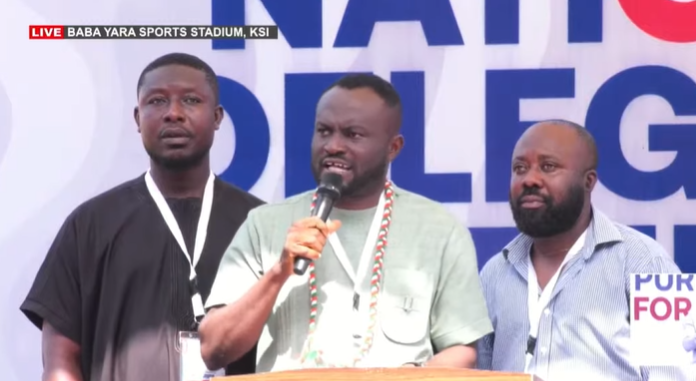
The PNC raised the concern while delivering a solidarity message at the NPP’s National Delegates Conference at the Baba Yara Sports Stadium in Kumasi on Saturday, October 3.
The party said it had taken note of proposals before the conference seeking to alter the NPP’s leadership structure by making its flagbearer the leader of the party.
“Reports have reached us that this conference may consider amending the party’s constitution so that the flagbearer becomes the leader of the party even when the party is in opposition,” the PNC said.
It urged delegates to carefully consider the implications of the proposal before taking a decision, arguing that the responsibilities of a presidential candidate differ from those of a party leader.
According to the PNC, while a flagbearer is primarily responsible for leading a political party into a general election, the party leadership has a broader responsibility to strengthen internal structures, reconcile competing interests and ensure accountability between elections.
“A flagbearer carries the party’s banner in election, a party leader must build structures, reconcile factions, and hold the party accountable between elections,” it stated.
The PNC warned that placing both responsibilities in the hands of one individual could concentrate power and reduce opportunities for alternative leadership within the party.
“Concentrating both roles in one person risks weakening internal democracy and the space for new leadership to emerge,” it cautioned.
The party, however, stressed that its intervention should not be interpreted as an attempt to interfere in the internal affairs of the NPP.
“We say this in the spirit of fraternity, not in interference,” it said.
The leadership proposal is among constitutional changes placed before NPP delegates at the conference.
Under a provision adopted at the NPP’s January 2026 constitutional conference, the National Chairman was designated as the leader of the party at all material times. The new proposal seeks to reverse that arrangement and designate the party’s flagbearer as its leader.
Chairman of the NPP Constitutional Amendment Committee, Frank Davies, had earlier said delegates would determine the fate of the proposed amendments, stressing that the final decision rested with the party’s conference.
Beyond the constitutional amendment, the PNC used its solidarity message to call for greater responsibility in Ghana’s political discourse.
It urged political parties and their supporters to discourage insults, inflammatory rhetoric and other forms of political communication capable of deepening divisions in the country.
“Words can divide, harm. Words can divide a nation. Political parties must lead in ending this,” the party said.
The PNC called on the NPP, the National Democratic Congress (NDC) and other political parties to take greater responsibility for the tone of political discourse and address what it described as declining standards in political communication.
It also urged NPP delegates to elect competent and effective national officers capable of strengthening the party while contributing to the consolidation of Ghana’s democratic system.
“Our democracy does not need people who merely occupy positions, but leaders who are efficient and can help consolidate it,” the PNC stated.
The party also used the occasion to promote itself as an alternative to the NPP and NDC ahead of the 2028 general election, expressing confidence that it could attract greater support from voters.
“We are confident that in 2028 Ghanaians are going to place their trust in the PNC,” it said.
The NPP’s National Delegates Conference brought together 7,163 delegates from across the country at the Baba Yara Sports Stadium to consider constitutional proposals and elect national officers.
Among the constitutional changes under consideration was the proposal concerning who should be recognised as the leader of the party, alongside changes to the party’s vice-chairmanship structure, communications structure and other organisational arrangements.
