
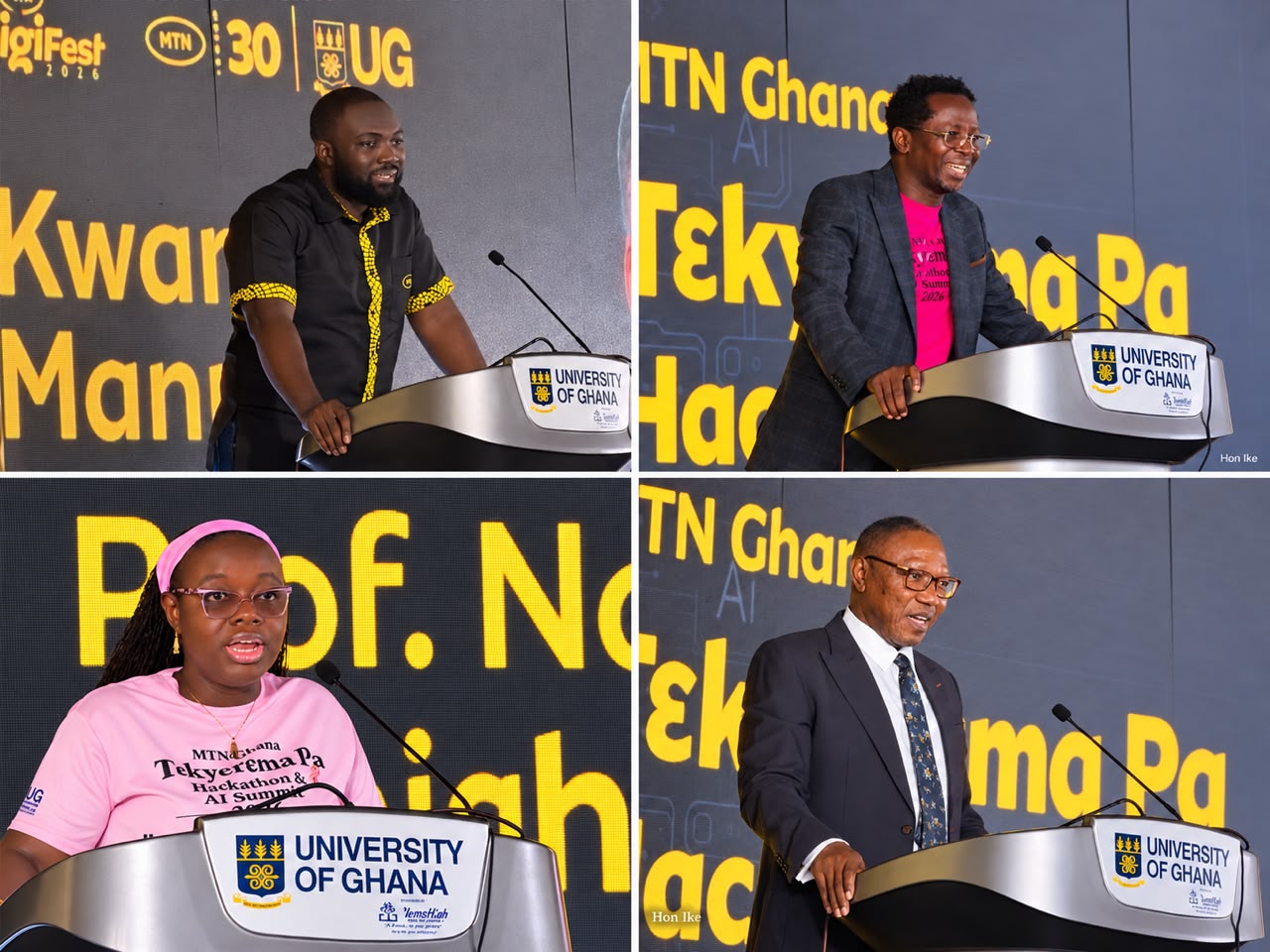
As part of sustained efforts to promote digital inclusion and linguistic equity, MTN Ghana, in partnership with the University of Ghana, has organised the 2026 Tɛkyerɛma Pa Hackathon and AI Summit to develop artificial intelligence solutions for Ghanaian languages and improve technology access for persons with disabilities.
The initiative seeks to advance artificial intelligence solutions for Ghanaian languages with limited digital resources and improve access to technology for persons with disabilities. Tɛkyerɛma Pa means “Good Tongue” in Akan.
This year’s hackathon attracted 131 teams comprising 550 participants, including 85 women and 54 persons with visual, hearing, speech or physical impairments. Five teams advanced to the finals after approximately two months of online training and mentoring.
The summit, held at the University of Ghana’s Great Hall, brought together government officials, academics, industry representatives, researchers, students and persons with disabilities to explore how AI could address local challenges and expand digital opportunities.
Language and Disability Inclusion
The Vice-Chancellor of the University of Ghana, Prof. Nana Aba Appiah Amfo, said the summit demonstrated the importance of collaboration among academia, industry, government and the communities whose needs innovations are intended to serve.
Speaking on the theme “Shaping an Inclusive and Accessible AI Future: Perspectives from Industry, Academia, Government, and Persons with Disabilities,” she said developers must consider who benefits from emerging technologies. “Who are we developing these technologies for, and who is being left behind?” she asked.
Prof. Amfo noted that many African languages remain inadequately represented in existing AI systems, while persons with speech impairments face additional barriers when digital systems fail to recognise their speech patterns.
She highlighted ongoing work by the university’s Human-Computer Interaction Lab in the Department of Computer Science to develop Ghanaian language resources and datasets for more inclusive speech technologies.
“I want to emphasise something: the real value of this research will be seen in the difference it makes to people’s lives,” she said.
She stressed that persons with disabilities must participate in shaping solutions intended for them, with inclusion incorporated from design through development and testing.
Prof. Amfo launched a voice and text AI assistant developed by the lab to help prospective and current students, faculty, staff and the public access information on programmes, admissions and policies.
She acknowledged MTN Ghana, the principal sponsor, and other partners for supporting local talent and urged sustained support beyond the hackathon to help promising prototypes progress through research, testing and deployment.
MTN Backs Talent Development
The Senior Manager for Digital Analytics and Monetisation at MTN Ghana, Kwame Manu, said the company’s involvement reflects its ambition to lead digital solutions for Africa’s progress.
He said solutions do not build themselves and noted that global AI platforms were all developed by people. The hackathon was therefore organised to encourage Africans, particularly students in Ghana, to build solutions addressing local challenges.
“We want to reach a point where we can refer to their innovations just as we refer to these global platforms today,” he said.
He said MTN wants students to remain in school, participate in hackathons and collaborate across institutions, citing participation from the University of Cape Coast, Kwame Nkrumah University of Science and Technology and other universities. “Networks connect us, but people transform us,” he added.
Mr Manu explained that the name T3kyer3ma Pa was chosen to reflect the focus on communication and inclusion, citing applications that allow the purchase of airtime or data through voice commands to enable persons with visual impairments to perform tasks independently without navigating screens.
He highlighted the MTN Ghana Digital Excellence Award, which recognises the best Computer Science student, the best female Computer Science student and the best AI project, to encourage women in STEM and innovations with wider applicability.
He cited a real-time scoring platform developed by an intern through MTN’s partnership with Thrive and Shine as an example of practical outcomes, noting it enabled in-person and online audiences to follow scores live and has since attracted interest from other organisations.
On next steps, he said monitoring, evaluation and learning would be critical, with MTN intending to partner promising teams through incubation, mentorship and industry exposure to turn innovations into household solutions.
Government Calls for Responsible AI
In a speech delivered on his behalf, the Minister for Communication, Digital Technology and Innovations Samuel Nartey George called for sustained investment in Ghanaian language technologies and responsible AI development.
He said Ghana’s digital transformation agenda seeks to position the country as a creator of technological solutions, intellectual property and economic value, which would require stronger computing infrastructure, skilled local talent, access to quality data and support for research and education.
He cited investment in national AI computing infrastructure and the One Million Coders Programme as part of broader efforts to strengthen digital capabilities.
Government, he said, welcomes partnerships that develop local expertise and create lasting value, stressing that AI solutions must be assessed for accuracy, reliability, interoperability, cybersecurity and measurable public benefit.
The minister warned that systems unable to understand Ghanaian languages and speech patterns risk excluding citizens from digital opportunities and called for investment in high-quality local language datasets, speech recognition, translation tools and language models reflecting Ghana’s linguistic and cultural diversity.
He said such technologies could help learners access educational support in familiar languages, enable farmers to receive agricultural information through voice services and improve access to public services, urging collaboration among universities, industry and communities with safeguards for personal data.
He cautioned that AI can generate inaccurate results, reproduce bias and expose sensitive information, making testing, human oversight and accountability essential.
Reimagining Education
In a speech delivered by Deputy Education Minister Dr Clement Abas Apaak, Education Minister Haruna Iddrisu said Ghana must equip young people with the skills to develop technologies and apply them to solving national challenges.
Speaking on “Reimagining Education for an AI-Driven Future,” he said education must equip learners with critical thinking, problem-solving and collaborative skills alongside technological competence.
He identified early exposure to coding, robotics and electronics, equitable access to education, technical and vocational training and stronger links between digital skills and employment as priorities, citing the One Million Coders Programme as a model.
He called for investment in teachers’ digital competence, noting that while AI can support lesson preparation, assessment and feedback, teachers remain central to learners’ development.
He cautioned that AI can reproduce bias, generate inaccurate information and undermine academic integrity, requiring ethical responsibility and sound human judgement, and urged policymakers to address gaps in electricity, access to computers and affordable internet.
The minister encouraged universities to help students develop and commercialise ideas and appealed to industry to expand mentorship, internships and support for student-led innovations.
From Research to Practical Applications
Lead Researcher at the Human-Computer Interaction Lab, Prof. Isaac Wiafe, said the hackathon emerged from research aimed at improving the representation of Ghanaian languages in AI and making digital technologies more accessible.
He said after developing research resources, the next step was to help students and young innovators turn them into applications addressing real communication needs, expanding this year to communication, accessibility and financial inclusion.
Prof. Wiafe explained that AI can support persons with disabilities in multiple ways. For visual impairments, his team has developed a mobile application that helps users navigate homes, campuses and markets by pointing their phone camera ahead, providing real-time information about surroundings, obstacles, distance and hazards.
He added that the lab is exploring robotics and AI-supported prosthetics, including artificial limbs, noting that Ghana has the expertise but requires substantial funding, which remains a major barrier for researchers.
On accessibility without the internet, he said student solutions are designed as standalone mobile applications that work offline. Some use voice-based interaction in local languages, allowing users to initiate mobile money transfers or other transactions without touching the screen or speaking English.
“This could make a significant difference in the lives of persons with visual impairments,” he said, noting that voice commands enable users who cannot read phone screens to transact independently.
Prof. Wiafe disclosed that the lab has released three open-source text-to-speech models — an Akan male voice and male and female Ewe voices — freely available for developers, with proposals covering assistive technologies, speech and language processing, financial inclusion, agentic AI, computer vision, health and education.
He said the competition started about three to four months ago with 131 teams, shortlisted to 50, then 25, with five finalists selected, drawn from institutions including Academic City University, KNUST and the University of Ghana. Participants received technical training and mentoring to strengthen practical application and commercialisation.
On awards, he said the winning team will receive GH¢70,000 to help develop the solution into a start-up, with GH¢20,000 for second place and GH¢10,000 for third. Beyond prize money, the lab will continue to support teams with free access to foundational models that would otherwise be costly.
He acknowledged persons with disabilities who visited the lab and shared experiences and called for sustained collaboration among researchers, industry and communities to ensure innovations help more Ghanaians communicate, access opportunities and participate fully in the digital economy.
Source: Isaac Kofi Dzokpo
