
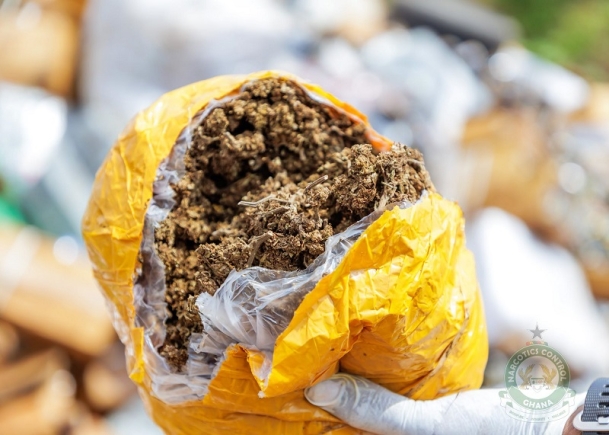
The Narcotics Control Commission (NACOC) has undertaken a major drug destruction exercise involving illicit substances valued at approximately US$10.25 million, as part of intensified efforts to combat drug trafficking, protect public health and prevent dangerous substances from returning to circulation.
The exercise, held on Thursday, November 5, 2026, involved the destruction of large quantities of cannabis, synthetic opioids and banned codeine-based cough mixtures seized during the Commission’s enforcement operations.
Speaking at the exercise, the Director-General of NACOC, Major General Maxwell Obuba Mantey, reaffirmed the Commission’s commitment to dismantling organised drug trafficking networks and strengthening intelligence-led operations to combat the illicit drug trade.
He explained that the destruction was carried out following the necessary court orders and legal procedures, with representatives of the Judiciary, security agencies, regulatory institutions and other stakeholders present to ensure transparency and accountability.
According to him, the exercise represented an important step in ensuring that seized narcotic substances were permanently removed from circulation.
“Today, we are doing more than destroying seized drugs. We are making sure that substances capable of destroying lives and harming our communities are permanently taken out of circulation,” he stated.
Over $10 Million Worth of Drugs Destroyed
Providing details of the substances, Maj. Gen. Mantey disclosed that the exhibits comprised 564.39 kilograms of cannabis and related products, 4,730,100 tablets and capsules of synthetic opioids, including Tapentadol and Tramadol, and 338,000 bottles of banned codeine cough mixtures, including infused cough mixtures.
He indicated that the combined estimated value of the substances stood at approximately US$10.25 million.
The Director-General, however, stressed that the significance of the exercise went beyond the monetary value of the confiscated drugs, pointing to the devastating consequences their distribution and misuse could have had on individuals, families and communities.
He noted that drug abuse, dependency and addiction continued to pose serious threats to public health, particularly among young people.
Maj. Gen. Mantey emphasised that NACOC’s responsibility did not end with the seizure of illicit substances but extended to ensuring that all exhibits were properly documented, subjected to the required legal processes and permanently removed from circulation.
NACOC Intensifies Crackdown on Drug Trafficking Networks
The Director-General announced that the Commission was strengthening its operational presence, intelligence gathering and investigative capabilities to confront the increasingly sophisticated activities of organised drug trafficking syndicates.
He explained that NACOC was shifting greater attention towards intelligence-led enforcement, disrupting illicit supply chains and identifying the financiers and facilitators behind drug trafficking operations.
According to him, the illegal drug trade extends beyond individuals arrested while transporting narcotics, as it involves complex transnational networks of financiers, suppliers, distributors and other criminal actors operating across national borders.
He stressed the need for comprehensive investigations capable of identifying the masterminds behind these operations rather than focusing solely on individuals found in possession of illicit substances.
The Commission, he said, would intensify efforts to trace proceeds from drug-related crimes, strengthen intelligence sharing and collaborate with international law enforcement institutions to bring perpetrators to justice.
“Ghana must never become a safe haven for drug traffickers. NACOC will continue to pursue those involved, regardless of the sophistication of their operations or where their networks lead,” he warned.
Stronger International Cooperation Needed
Maj. Gen. Mantey acknowledged the government’s continued support towards strengthening the Commission’s operational capacity and improving its effectiveness in combating drug-related crimes.
He also commended sister security agencies and international partners for providing technical assistance, specialised training and operational cooperation in the fight against illicit drug trafficking.
He observed that the transnational nature of drug trafficking required sustained collaboration among law enforcement institutions, intelligence agencies and international partners.
According to him, timely intelligence sharing, coordinated investigations and mutual trust among security institutions remained essential to disrupting criminal networks operating across borders.
He further emphasised that law enforcement agencies must continuously adapt their strategies to respond effectively to the changing methods employed by drug trafficking organisations.
NACOC Calls for Public Support Against Drug Abuse
The Director-General also called on Ghanaians to support the national campaign against illicit drugs by reporting suspicious activities and helping to protect vulnerable groups, particularly young people.
He said the responsibility for combating drug trafficking and substance abuse extended beyond NACOC to include parents, traditional authorities, religious leaders, educational institutions, civil society organisations and the media.
Maj. Gen. Mantey underscored the importance of public education in preventing drug abuse and protecting young people from addiction and its associated social and health consequences.
He encouraged citizens to remain vigilant and cooperate with law enforcement agencies by providing credible information on suspected drug-related activities.
The Director-General also appealed to journalists and media organisations to promote responsible reporting and sustained public awareness of the dangers associated with illicit drugs.
NACOC Reaffirms Commitment to Protecting Ghana
Concluding his remarks, Maj. Gen. Mantey assured Ghanaians that the Commission would remain resolute in its mandate to combat illicit drug trafficking and protect communities from the harmful effects of narcotic substances.
He maintained that the success of NACOC’s operations should not be measured solely by the quantities of drugs seized or the number of arrests recorded, but also by the criminal networks dismantled, cases of addiction prevented and lives protected.
He stressed that achieving lasting results would require adequate resources, sustained commitment and stronger cooperation among relevant institutions and the general public.
“Our measure of success cannot simply be the quantity of drugs seized or the number of arrests made. It must also be the networks we disrupt, the addiction we help prevent, the lives we protect and the communities we make safer,” he stated.
He reiterated the Commission’s determination to pursue drug traffickers and prevent Ghana from becoming a destination or operational base for international narcotics syndicates.
“We will not relent, and we will not surrender our young people, our communities or our country’s future to drug traffickers,” he declared.
