
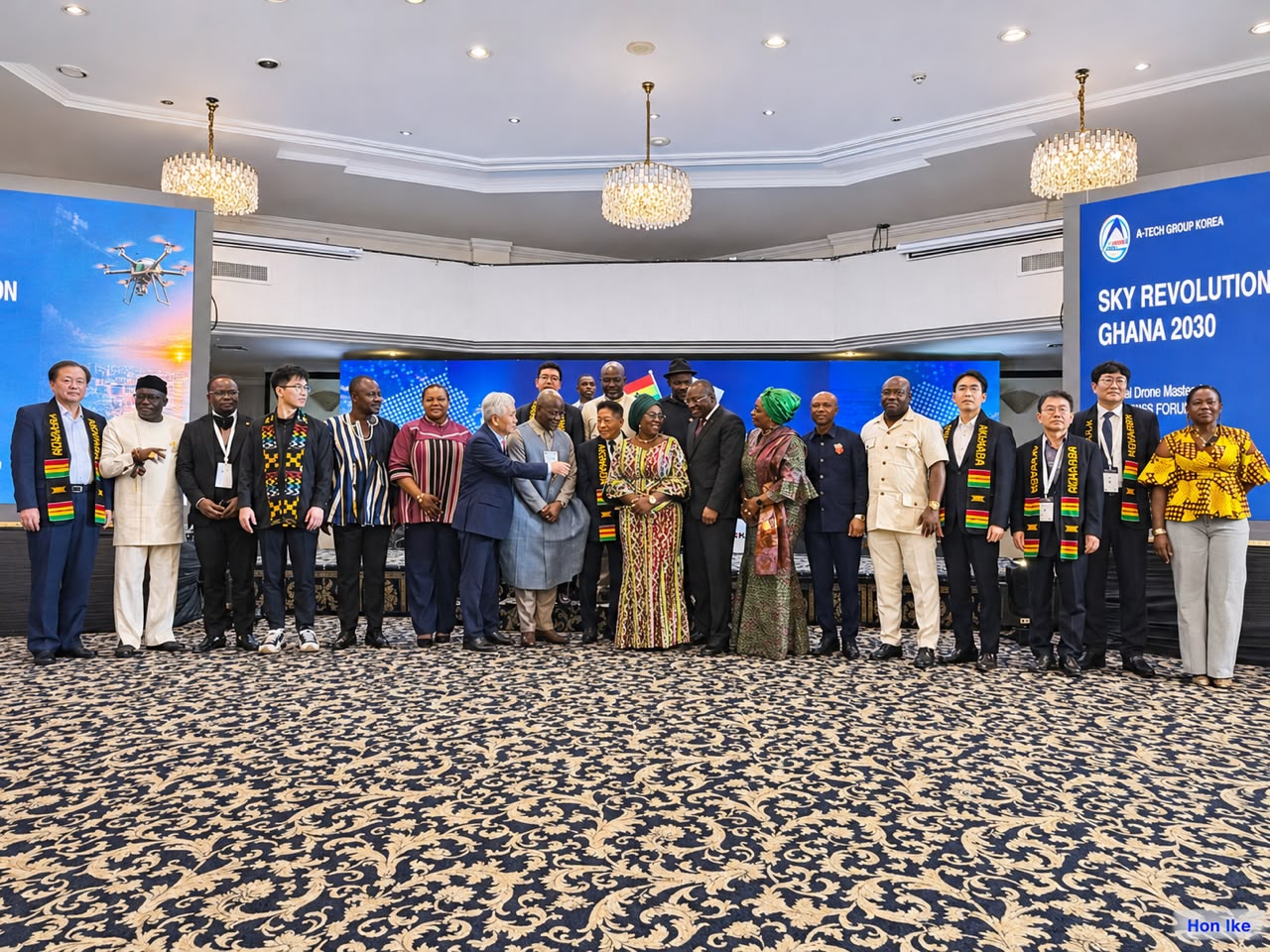
The Ghana–Korea Business Forum has been held as part of efforts to position Ghana as a production hub for Korean investors, boost local manufacturing, promote technology transfer and create jobs while reducing the country’s reliance on imports.
The forum held under the theme “Business • Innovation • Partnership,” brought together government officials, a Korean delegation, Ghanaian businesses and other stakeholders to explore joint ventures, local production and skills development in manufacturing, agriculture, tourism, infrastructure, digital finance and emerging technologies.
Government: Ghana Is for Production, Not Just Consumption
In speech delivered on behalf of the Chief of Staff, Julius Debrah, a presidential adviser said Ghana’s economic transformation agenda was anchored in value addition, industrialisation and strategic partnerships.
He urged Korean investors to see Ghana as a production base, citing the country’s political stability and its hosting of the African Continental Free Trade Area (AfCFTA) Secretariat as advantages for businesses seeking access to African markets.
Mr Debrah identified transport and logistics, manufacturing, agribusiness, renewable energy, artificial intelligence (AI), smart mobility and defence technologies as priority areas for cooperation.
He stressed that investments must be commercially viable, environmentally responsible and beneficial to local communities. “We invite you to see Ghana as a destination for production, not simply as a consumer market,” he said.
“We seek partnerships that establish industries, strengthen local supply chains, promote technology transfer, develop technical skills, empower youth and create meaningful employment for future generations.”
Tourism Looks to Drones to Tell Ghana’s Story
The Minister for Tourism, Culture and Creative Arts, Abla Dzifa Gomashie, said drone technology could transform how Ghana showcases its culture and heritage to visitors.
She proposed synchronised drone displays during Independence Day celebrations, PANAFEST and the Chale Wote Street Art Festival to tell Ghanaian stories in creative and engaging ways.
Ms Gomashie also invited Korean partners to collaborate on developing an immersive visitor experience at the Kwame Nkrumah Memorial Park.
She acknowledged Korea’s support for heritage preservation, including US$4.5 million in financial assistance associated with cooperation involving the Korean National Commission for UNESCO to support the restoration and protection of Ghana’s forts and castles.
She also highlighted specialised training opportunities for heritage professionals in climate adaptation and announced an African cultural festival scheduled for December 9 to 12, which is expected to attract up to 600 participants from across the continent.
“We see enormous potential for long-term collaborations in developing drone entertainment, immersive cultural production and technology-driven visitor experiences,” she said.
Nsarko: Success Will Be Measured by Skills and Jobs
The Convener of the forum, Dr Chief Nat Nsarko, said the partnership must go beyond the supply of equipment and give Ghanaians a direct role in developing new industries.
He explained that Korea’s industrial expertise, combined with Ghana’s youthful population, offered opportunities for mutual benefit if properly harnessed.
He identified drone technology, aerospace, satellite systems, cybersecurity, smart agriculture, water treatment and digital infrastructure as sectors where cooperation could deliver significant results.
Dr Nsarko stressed that technology transfer must be accompanied by practical training to enable Ghanaians to operate, maintain and develop the systems.
“We seek more than suppliers. We seek strategic investors, joint venture partners, technology transfer agreements, local assembly and manufacturing facilities,” he said.
“Ghana’s greatest investment attraction is not only what lies beneath our soil, but also what lives within our people,” he added.
He called for a disciplined approach to implementation to ensure that proposals were translated into practical projects. “What we need now is the courage to collaborate, the discipline to execute and the leadership to deliver,” he said.
Technology Takes Centre Stage
The Chief Executive Officer of A-Tech Group Korea (ATHK), Cheol Soo Lee, also known as Charles Lee, highlighted how Korean drone, satellite and AI technologies could help address Ghana’s development challenges.
He explained that satellites could provide a broad view of conditions on the ground, while AI could identify priority areas and drones could carry out closer inspections.
He cited the monitoring of environmental damage caused by illegal mining as one area where the technologies could be applied.
Mr Lee stressed that the long-term success of such investments would depend on developing local expertise. He therefore proposed partnerships with Ghanaian universities to train professionals to operate and maintain the systems.
He outlined a framework under which government institutions would identify development priorities, businesses would provide technological solutions, academic institutions would train the workforce and financial institutions would fund viable projects, beginning with feasibility studies.
He also highlighted proposals to introduce drone soccer in Ghana through equipment supply, training and certification.
MMFL: No Financial Inclusion Without Connectivity
During a panel discussion, the Chief Technology and Service Delivery Officer of MobileMoney Fintech Ltd (MMFL), Charles Asamoah Assah, stressed that financial inclusion could not be achieved without reliable connectivity and secure digital platforms.
He explained that the growing volume of digital transactions required resilient systems that could protect users and build public confidence.
“If we are talking about financial inclusion, we must have the right connectivity to support that growth,” he said.
“People must feel confident that their transactions are safe and that their money will reach the intended recipient,” he added.
He cited the response of residents following MTN’s extension of network coverage to a previously unconnected community as an example of the opportunities that improved connectivity could create.
Mr Assah proposed establishing a regional knowledge-sharing hub that would extend beyond major cities, enabling young Ghanaian innovators to learn from Korean expertise and develop solutions suited to local needs.
He also advised prospective investors to assess local market demand and regulatory requirements before introducing new products and services.
“From there, we can develop and scale solutions that support new industries, strengthen our infrastructure and create opportunities for our people,” he said.
Partners Commit to Continued Engagement
The forum was organised with support from A-Tech Group Korea, Digital Eye, the Daejeon Defense Industry Cooperative Association and Rock Africa.
