
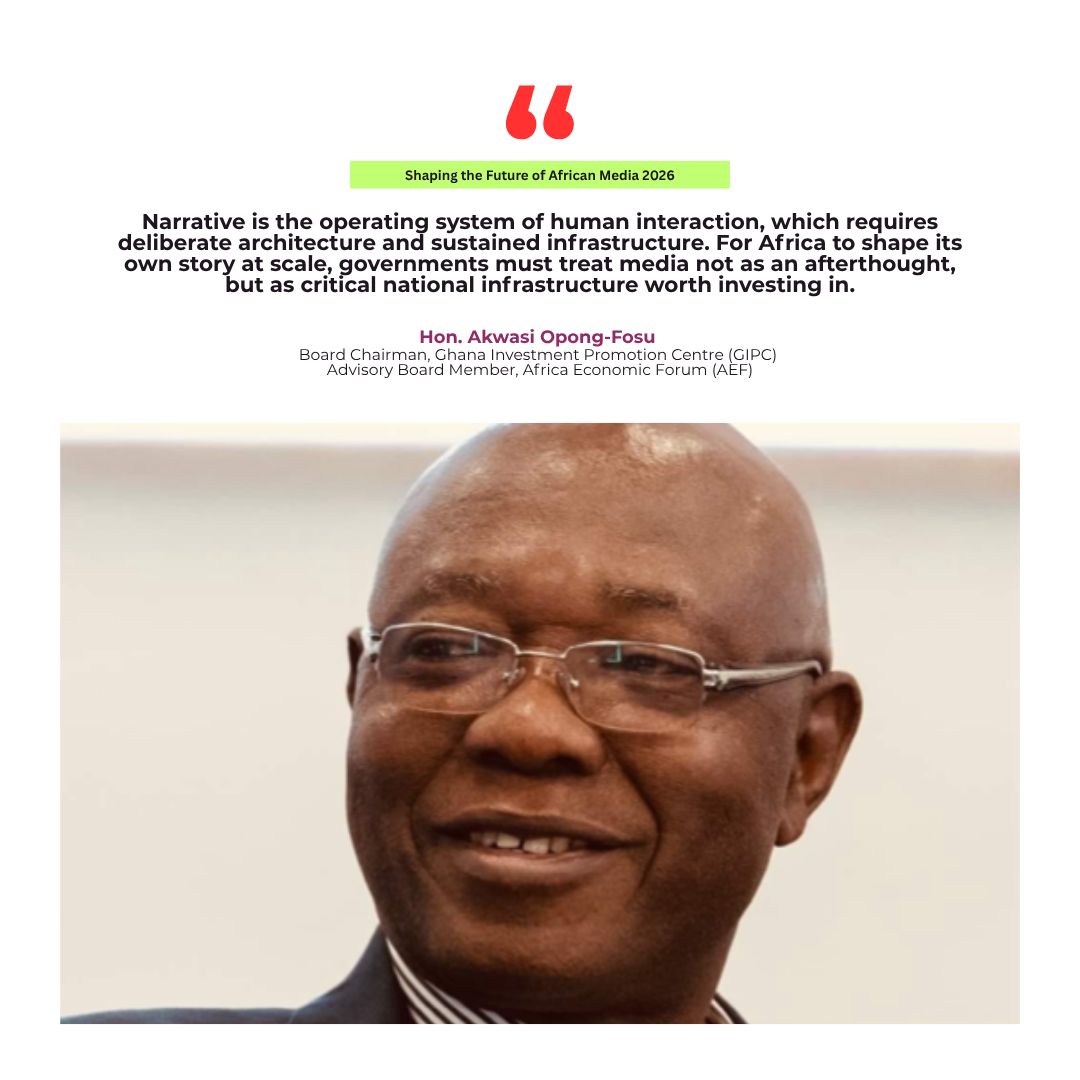
At the just ended Pan-African media event, Shaping the Future of African Media, a central theme emerged strongly throughout the discussions: Africa’s development challenge is not only about resources, policy, or infrastructure, but also about who defines and projects the continent’s economic story to the world.
Speaking on the theme “African Narratives: An Economic Sovereignty,” Akwasi Opong-Fosu, Board Chairman of the Ghana Investment Promotion Authority (GIPA) and Advisory Board Member of the Africa Economic Forum, delivered a compelling intervention on what he described as one of the most overlooked barriers to Africa’s economic transformation — the global mispricing of Africa through distorted narratives.
His central argument was both provocative and deeply strategic:
“Narrative is infrastructure. Whoever constructs the narrative controls policy, pricing, the present and the future.”
For decades, Africa has largely been discussed, interpreted, rated, and explained by external institutions, foreign media systems, and global financial actors. According to Opong-Fosu, this has created a structural imbalance where Africa exports resources, opportunities, and events, but imports explanations about itself.
That imbalance, he argued, comes at a very high cost.
Africa Is Not Poor — Africa Is Mispriced
One of the strongest moments of the address came when Opong-Fosu challenged the long-standing portrayal of Africa as a uniformly high-risk investment destination.
He pointed to available data showing that Africa’s infrastructure default rate stands at approximately 5.3%, lower than Asia’s 8.6% and Latin America’s 10.1%. Yet despite these realities, African countries and businesses continue to borrow at significantly higher rates due largely to perception-driven risk premiums.
This disconnect between actual risk and perceived risk, he argued, is costing Africa billions annually.
According to Opong-Fosu, Africa paid an estimated USD 24 billion in what he termed a “Narrative Tax” last year alone — excess costs arising from inflated risk perceptions, insurance premiums, sovereign spreads, and capital pricing distortions.
In essence, the continent is paying more not necessarily because of the data, but because of the story told about the data.
“Africa is not poor but mispriced. The data proves it. The Narrative Tax proves we have not acted on it.”
His framing introduces an important shift in how Africa’s development debate is understood. Traditionally, conversations around Africa’s economic challenges have focused on debt, governance deficits, corruption, or infrastructure gaps. While these issues remain relevant, Opong-Fosu’s intervention suggests that Africa’s informational and narrative deficit is itself an economic vulnerability.
In a world driven increasingly by perception-sensitive capital flows, geopolitical competition, and media influence, narrative has become an economic instrument.
Narrative as Economic Infrastructure
Perhaps the most intellectually significant contribution of the speech was the reframing of media and narrative as forms of infrastructure.
Africa has historically understood infrastructure through the lens of roads, ports, railways, energy systems, and telecommunications. Opong-Fosu expanded this definition by arguing that narrative infrastructure — the systems through which information about Africa is produced, validated, and distributed — now plays a direct role in determining investment flows and economic outcomes.
Under this framework, a continent that does not control its own narrative cannot fully control its economic destiny.
This argument resonates strongly within a global financial system where ratings agencies, international media institutions, think tanks, and investment research platforms shape investor confidence. Perceptions generated within those systems often determine borrowing costs long before investors engage with actual local data.
According to Opong-Fosu, Africa’s failure has not merely been the absence of positive storytelling, but the absence of institutional mechanisms capable of producing authoritative, real-time, trusted African economic intelligence.
That is where his proposal for a Pan-African Corridor Data Center becomes significant.
The Pan-African Corridor Data Center: From Rhetoric to Economic Intelligence
Moving beyond speeches and symbolic calls for “telling Africa’s story,” Opong-Fosu proposed a concrete institutional solution.
He called for the establishment of a Pan-African Corridor Data Center (PCDA) — a continental institution dedicated to publishing audited, real-time data on African trade corridors, infrastructure performance, logistics efficiency, debt servicing reliability, and default patterns.
The objective, according to him, is straightforward: Africa must become the first author of its own economic explanation.
Rather than waiting for external institutions to define Africa’s risk profile, the continent must proactively produce credible and investable economic intelligence capable of influencing markets directly.
The proposed institution would focus on measurable indicators such as:
- Trade corridor performance
- Debt Service Coverage Ratios (DSCR)
- Infrastructure repayment patterns
- Port and logistics efficiency
- Commodity movement data
- Regional trade reliability
- Infrastructure default performance
- Cash cycle data across trade routes
In Opong-Fosu’s words:
“Africa must price corridors, not focus on speeches and slogans.”
This statement reflects a deeper policy philosophy. Investors do not allocate capital based on rhetoric alone. They allocate capital based on measurable predictability, data integrity, and institutional confidence.
By developing a continental data architecture around African trade and infrastructure corridors, the proposed center aims to reduce information asymmetry and challenge outdated assumptions about African risk.
Africa Growth Solutions and Africa Economic Forum to Champion the Initiative
Importantly, Opong-Fosu hinted that the proposed initiative may soon move beyond concept stage.
He indicated that Africa Growth Solutions (AGS), the Africa Economic Forum, and other strategic partners are expected to champion the establishment of the Pan-African Corridor Data Center and support the publication of Africa’s own economic narrative architecture.
This signals a potentially important transition from intellectual discourse to institutional action.
If implemented effectively, such a platform could become one of the continent’s most strategic soft-power and economic coordination instruments. It could also complement broader African Continental Free Trade Area (AfCFTA) ambitions by generating trusted trade and corridor intelligence across regions.
More significantly, the proposal attempts to reposition Africa from being merely a subject of global economic commentary to becoming an active producer of investment-grade knowledge.
The Role of African Media
A major portion of the speech focused on African media institutions themselves.
Opong-Fosu argued that African media must move beyond event coverage and begin seeing themselves as participants in economic transformation.
“Media is not coverage. Media is infrastructure.”
This assertion places a new responsibility on journalists, editors, researchers, broadcasters, digital creators, and policy communicators across the continent.
For decades, global media narratives about Africa have often centred disproportionately on instability, poverty, conflict, coups, corruption, and crisis. While those realities cannot be ignored, Opong-Fosu argued that Africa’s economic potential, innovation ecosystem, trade opportunities, infrastructure resilience, and investment performance have frequently been underreported or poorly contextualised.
The consequence is not merely reputational damage. It is financial.
Higher insurance costs, increased sovereign spreads, capital flight, and reduced investor confidence are all influenced by how markets perceive political and economic stability.
According to Opong-Fosu, if African media institutions fail to build their own explanatory frameworks, Africa will continue paying premium costs for narratives produced elsewhere.
“We export events and import explanations. Sovereignty begins when we export our own explanations at 8:00am, before others export theirs.”
Economic Sovereignty in the 21st Century
The broader implication of Opong-Fosu’s address is that economic sovereignty in the modern era extends beyond control over territory, resources, or political institutions.
It also includes control over:
- Data
- Interpretation
- Information systems
- Financial perception
- Narrative framing
- Institutional credibility
In many respects, his speech reflects an emerging school of thought across the Global South — that information asymmetry has become a geopolitical and economic issue.
Countries and regions that cannot produce trusted economic intelligence about themselves become vulnerable to external pricing mechanisms and reputational dependency.
For Africa, this challenge is especially critical given the continent’s growing demographic importance, expanding urbanisation, strategic minerals, energy resources, and infrastructure financing needs.
The struggle for narrative sovereignty, therefore, is increasingly becoming part of the struggle for economic sovereignty itself.
Beyond Symbolism
What made Opong-Fosu’s intervention particularly significant was not merely the strength of the rhetoric, but the attempt to translate the conversation on African narratives into a practical institutional and economic framework. Rather than limiting the discussion to calls for positive storytelling, he advanced the argument that Africa must deliberately build systems capable of producing credible data, shaping investor perception, and influencing global pricing mechanisms.
This approach aligns with broader conversations around:
- AfCFTA implementation
- Sovereign credit rating reform
- African capital market integration
- Infrastructure financing
- Trade corridor optimisation
- Economic data sovereignty
- Strategic communication ecosystems
READ ALSO:No Safe Haven: Illegal Mining Network Disrupted
Whether the proposed Pan-African Corridor Data Center materialises remains to be seen. However, the broader conversation it has triggered may prove consequential.
At a time when Africa is seeking larger investment inflows, better financing terms, stronger regional integration, and greater geopolitical relevance, the issue of how the continent is priced — and who controls that pricing narrative — may become increasingly central to Africa’s future.
And perhaps that is the real significance of Opong-Fosu’s intervention:
Africa’s next development frontier may not only be physical infrastructure.
It may also be narrative infrastructure.
— Akwasi Opong-Fosu
•Former Member of Parliament & Minister of State
•President of Africa Growth Solutions
