
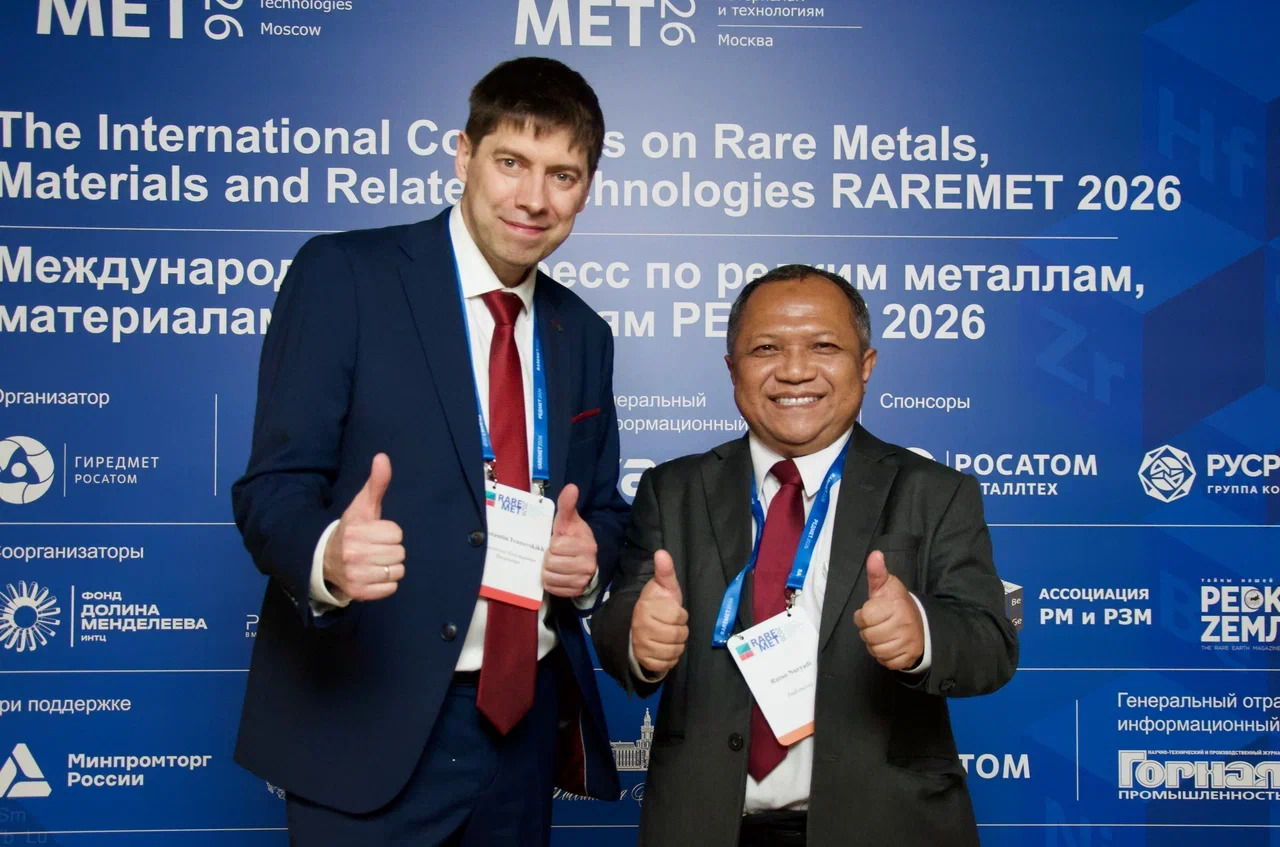
The Congress brought together experts from 20 countries, including African states. The experience of establishing processing clusters and technological partnerships can support Ghana’s ambitions in critical minerals and local value addition.
The International Congress on Rare Metals, Materials and Technologies “Raremet 2026” was held in Moscow from 20 to 22 May 2026. It was organised by Giredmet (a part of Rosatom Group). The largest industry-focused venue brought together more than 750 participants from 20 countries, including leading scientists, government representatives, top executives of industrial corporations, and engineering companies.
Delegates from South Africa, Egypt, Russia, China, and other states took part in the Congress.The main topics of discussion were innovation, technological sovereignty, international cooperation, technology exchange, and workforce training in the field of extraction, processing, and application of rare and rare-earth metals.
Participants spoke about the development of processing clusters, full-cycle technologies – from ore to finished products, as well as new approaches to partnership between countries.For Ghana, these issues are closely linked to the country’s green industrialisation agenda and growing role in global critical minerals value chains.
Ghana is already a significant producer of manganese and is advancing projects in other critical minerals such as lithium and graphite, which are essential for batteries, renewable energy and electric mobility.
Government initiatives, including policies on green minerals and energy transition, place strong emphasis on domestic value addition, local processing and job creation.“The forum is organised by the Giredmet Institute, the flagship of the domestic rare earth industry. This year it celebrates its 95th anniversary. Rosatom is actively involved in developing the rare-earth sector in the country.
We are restoring rare-earth production at the Solikamsk Magnesium Plant, modernising the enrichment plant at the Lovozero Mining and Processing Plant, and creating a processing cluster in Yakutia.
Very soon, the country’s first large-scale production facility for permanent rare-earth magnets will begin operation in Glazov. We expect these efforts to help solve a strategic task: reducing Russia’s dependence on rare-earth imports and ensuring domestic industry is supplied with national resources,” highlighted Rosatom Director General Alexey Likhachev.
The experience presented at Raremet 2026 demonstrates how countries can move from primarily exporting raw materials to building integrated value chains and advanced manufacturing capacities. This approach is directly relevant for Ghana as it seeks to expand local processing of lithium, manganese and other critical minerals, create skilled jobs and attract long-term investment into downstream industries.Key industry development directions were also examined at the event.
On the first day, three panel discussions addressed the role of rare-earth metals in the energy transition, the Angaro-Yenisei cluster as a platform for new technological policy, and workforce training.
The congress then continued with four parallel tracks covering the full technological cycle – from mineral processing and metallurgy to ultra-pure substances and functional materials for electronics and energy. The programme also included discussions on digital design and AI, the new geography of critical metals, and an expert session on their economics.
A specialised exhibition, RAREMET:Expo, ran alongside, showcasing technologies and equipment from leading companies and research centres.Director of Giredmet Andrey Goliney noted that Raremet 2026 continued the tradition of the “Sazhin Readings” scientific seminars and previous international scientific and practical conferences dedicated to the development of the industry.
According to him, the rare and rare-earth metals sector is currently undergoing a global transformation that requires new approaches to strategic partnerships and international cooperation in “closed-cycle” technologies – from mining and processing to extraction and final products.
He noted that the Congress is intended to become the largest platform for constructive dialogue between fundamental and applied science, government authorities, and the real sector of the economy.At Raremet 2026, participants also discussed projects on establishing processing clusters and technological partnerships involving African countries.
Potential areas of cooperation include joint research on critical minerals, training programmes for geologists and engineers, and the use of digital tools and AI to design efficient processing facilities. These initiatives can support Ghana’s efforts to strengthen its position in regional and global value chains while ensuring that more of the benefits from its mineral resources are realised at home.
