
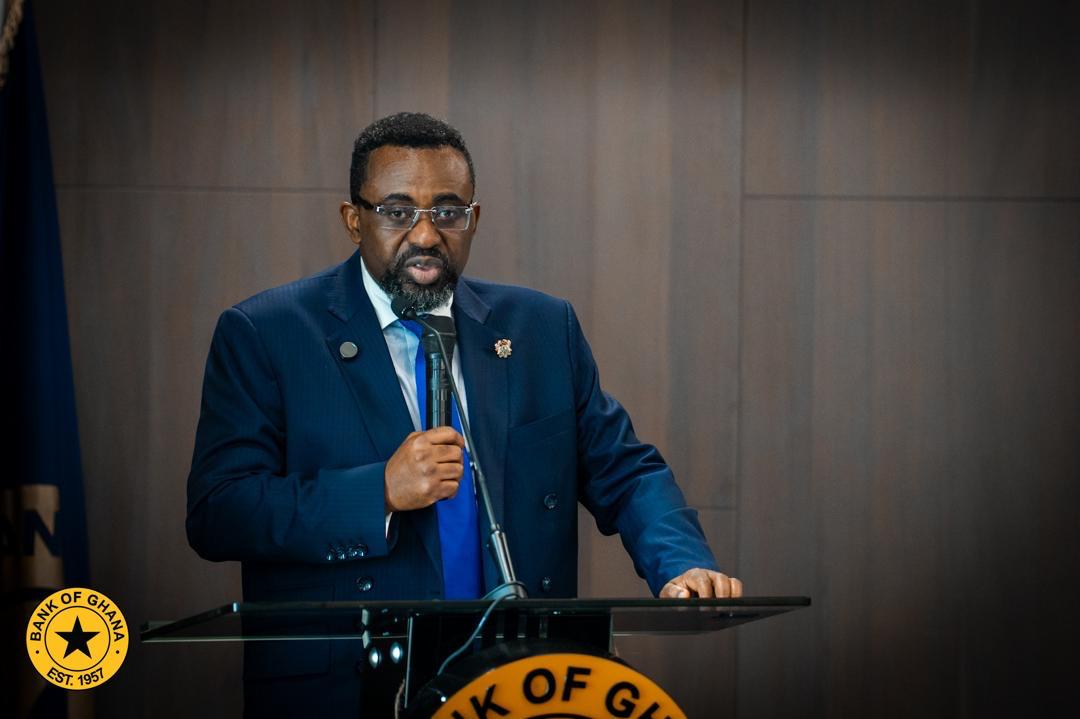
Ghana’s foreign exchange reserves have climbed to about US$12.9 billion, providing a stronger buffer against external shocks as the cedi recovers from pressures experienced earlier in the year, Governor of the Bank of Ghana (BoG), Dr Johnson Pandit Asiama, has said.
The reserves, equivalent to roughly five months of import cover, come amid an improving external position supported by strong gold and cocoa exports, which helped generate a higher trade surplus in the first half of the year.
Speaking to business stakeholders in Sunyani on Wednesday, Dr Asiama said the stronger reserve position was supporting stability in the foreign exchange market despite persistent risks from global economic and geopolitical developments.
The cedi came under pressure earlier in the year amid heightened global uncertainty, including conflict in the Middle East, but has since recovered.
“We remain committed to maintaining an orderly and well-functioning foreign exchange market,” Dr Asiama said.
Despite the improving external position, the Governor warned that rising global crude oil prices remained a significant risk, with higher petroleum costs already increasing Ghana’s import bill and contributing to renewed inflationary pressures.
Inflation rose to 5.3 per cent in June from 3.7 per cent in May, driven mainly by higher transport costs following increases in international crude oil prices.
The central bank, however, expects the increase to be temporary.
“We believe this is temporary, and we will continue to monitor developments closely to ensure that inflation remains under control,” Dr Asiama said.
The Bank of Ghana’s Monetary Policy Committee last month maintained the benchmark monetary policy rate at 14 per cent, balancing the need to contain inflationary pressures with efforts to support economic activity.
Economy Maintains Growth Momentum
Beyond the external sector, the Governor said Ghana’s domestic economy continued to show signs of resilience, with Gross Domestic Product expanding by 6.4 per cent in the first quarter, compared with 6.2 per cent during the same period last year.
Growth was driven largely by the services and industrial sectors, while activity strengthened across trade, industrial production, tourism and bank lending.
Business and consumer confidence have also improved as macroeconomic conditions stabilise.
One of the strongest indications of improving financial conditions has been the sharp expansion in credit to businesses and households.
Private-sector credit grew by more than 41 per cent in June, compared with about nine per cent a year earlier, with declining lending rates improving access to financing for businesses seeking to invest and expand.
Dr Asiama also described Ghana’s banking sector as “strong and stable,” saying banks remained well-capitalised while deposits continued to grow and loan quality improved.
Global Risks Remain
Despite the positive indicators, the Governor cautioned against complacency, warning that external developments, particularly higher global oil prices and geopolitical uncertainty, could threaten Ghana’s improving economic outlook.
He said the central bank would remain focused on maintaining price and financial stability, protecting the value of the cedi and creating conditions that support sustainable economic growth. Dr Asiama stressed that preserving the gains achieved so far would require coordinated action beyond the central bank.
READ ALSO: MTN Ghana Launches Heroes of Change Season 8, Doubles Grand Prize to GH¢400,000
“Macroeconomic stability is not the responsibility of the Bank of Ghana alone – it is a partnership between policymakers, businesses, financial institutions, traders, farmers, and households,” he said.
The improving indicators come as Ghana works to consolidate its macroeconomic recovery following years of elevated inflation, currency volatility and debt pressures, with the Bank of Ghana signalling that maintaining stability will remain critical in the face of an uncertain global environment.
