
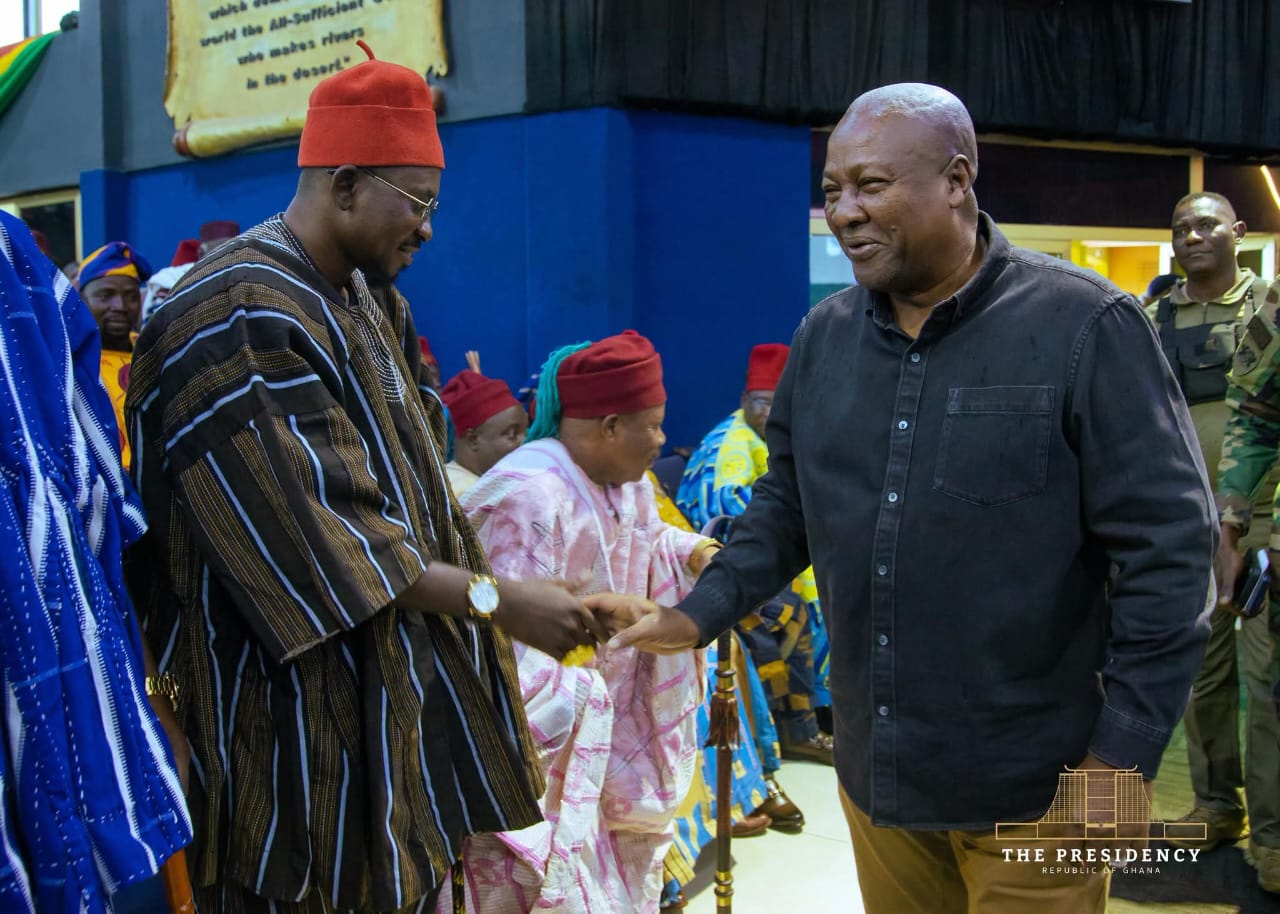
President John Dramani Mahama has unveiled an ambitious plan to channel $5 billion into agriculture and agro-processing as part of a broader $10 billion investment drive aimed at boosting local food production, expanding irrigation and reducing Ghana’s dependence on food imports.
The President said agriculture and agro-processing would command half of the proposed investment under his government’s New Economy programme, making the sector the biggest beneficiary of the four-year initiative.
Speaking during a citizens’ engagement in Navrongo in the Upper East Region, President Mahama said the government intends to invest $2.5 billion annually over the next four years across seven strategic sectors.
“Every year, for the next four years, we’re going to invest $2.5 billion in those seven pillars,” he said.
According to him, agriculture and agro-processing will receive 50 per cent of the projected $10 billion investment, translating into approximately $5 billion over the period.
“The biggest is agriculture and agro-processing. And that’s where the Upper East comes in,” President Mahama said.
A major component of the plan will be the revival of the Pwalugu Tomato Factory, which the government intends to transform into a processing hub for tomatoes produced across the Upper East Region.
President Mahama said about 2,500 acres of land would be brought under tomato cultivation, creating a production base to feed the rehabilitated factory.
“We can bring in 2,500 acres of land under tomato production. And the Pwalugu tomato factory is going to be the epicentre of it,” he said.
“We’re going to rehabilitate the Pwalugu tomato factory so that we can process the tomatoes that Upper East is producing to feed the rest of the country,” he added.
The intervention is expected to strengthen the link between commercial farming and local processing while reducing post-harvest losses and creating a ready market for tomato farmers.
President Mahama said the government had already begun laying the groundwork through the Tomato Revitalisation Project, with the Upper East expected to play a significant role in expanding Ghana’s domestic vegetable production.
Irrigation Push Targets Year-Round Farming
Beyond tomato production, the government plans to expand irrigation infrastructure to move farmers away from dependence on seasonal rainfall and unlock year-round agricultural production.
President Mahama said improved irrigation would particularly create opportunities for young people to engage in farming during both the rainy and dry seasons.
The government also intends to complete the Tamne irrigation dam to support dry-season farming across four districts in the Bawku area.
“We’ll finish the Tamne irrigation dam so that the four districts in the Bawku area can also go into their dry-season production,” he said.
Mahama Targets Onion Imports
The President identified onion production as another major opportunity for the Upper East Region, declaring the government’s intention to reduce Ghana’s dependence on imported onions, particularly supplies from Niger.
“We want to cut down the amount of onions we import from Niger. And if we put enough land under irrigation, we should be able to import, substitute, and produce our own onions,” he said.
READ ALSO: NPP Must Bury Internal Rivalries to Win 2028 — Bawumia
The strategy places irrigation, expanded cultivation and domestic agro-processing at the heart of the government’s attempt to strengthen Ghana’s food security and retain more of the country’s food expenditure within the local economy.
If implemented, the Pwalugu factory rehabilitation, 2,500-acre tomato cultivation programme and completion of the Tamne irrigation dam could position the Upper East Region as a major production and agro-processing hub while creating jobs and expanding markets for farmers.
