

As part of sustained efforts to combat the growing threat of fraud in the banking sector, the Ghana Association of Banks (GAB) and its 23 member banks have intensified their long-running nationwide anti-fraud awareness campaign to protect customers and their deposits.
The campaign, dubbed “Shine Your Eye,” is aimed at promoting fraud awareness, protecting bank customers, and safeguarding public trust in Ghana’s financial sector.
Under the initiative, GAB and its member banks have been carrying out public sensitisation exercises, including a roadshow and market storm across principal streets and markets in Accra.
The campaign seeks to educate Ghanaians on emerging fraud risks, particularly social engineering scams in which fraudsters impersonate bank officials to obtain confidential information and gain unauthorised access to customers’ accounts.

Head of Regulatory, Ethics, Forensics and Special Duties at GAB, Collins Boamah, said fraud has become a major threat to the banking industry, adversely affecting operations and causing customers and potential customers to lose their hard-earned money to criminals.
Speaking on the sidelines of the roadshow, Mr. Boamah said the increasing sophistication of fraud requires a coordinated, industry-wide response rather than isolated interventions by individual banks.
He said GAB instituted the campaign to bring all member banks together to pool resources and collectively tackle the menace.

The initiative is being implemented in collaboration with key institutions, including the Ghana Police Service, the Bank of Ghana (BoG), the Cyber Security Authority (CSA), and the Financial Intelligence Centre (FIC).
Mr. Boamah said that over the years, the Association and its member banks have sustained public education across traditional and digital media platforms, including Facebook, LinkedIn, X, and TikTok.
“The essence is to reach every part of our country, be it the high level, the middle level, or the low level. We want every member of this country to be aware of the risk of fraud,” he said.

Social Engineering a Growing Threat
Mr. Boamah identified social engineering as one of the major tactics increasingly being employed by fraudsters to target unsuspecting customers.
Under the scheme, criminals call customers while posing as bank officials and claim they need to verify, update, or work on their accounts. Victims are then asked to disclose confidential information such as passwords, Personal Identification Numbers (PINs), and One-Time Passwords (OTPs), or to click on suspicious links.
He cautioned that legitimate banks will never request such confidential information through unsolicited calls.
“No bank will ever call you to ask you to share your personal information. Anybody who calls you from a bank asking you to share any of this information or giving you a link to click is a potential fraudster,” he warned.
“If you share the information, your hard-earned deposits will be wiped off.”

Nationwide Rollout
Touching on the nationwide rollout, Mr. Boamah said the public outreach has, over time, included roadshows and market storms in Tamale, Kumasi, and Accra, where residents, traders, and bank customers have been engaged directly on fraud prevention.
He described the Accra exercise as highly successful, noting that taking the campaign directly to communities is critical to ensuring that anti-fraud messages reach people across different sections of society.
The campaign continues to feature radio and television interviews, advertisements, and other media engagements to broaden its reach.
According to the Association, the objective is to build a more fraud-conscious public capable of recognising and resisting scams, anchored on a simple message: never disclose passwords, PINs, OTPs, or other confidential banking credentials to anyone, regardless of who they claim to represent.
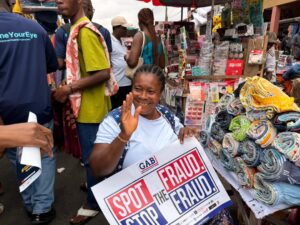
Traders Welcome Anti-Fraud Education
Meanwhile, the traders welcomed the campaign, describing it as timely and an eye-opener. They said the sensitisation had deepened their understanding of fraudsters’ tactics, especially impersonation of bank officials to obtain PINs, passwords, and OTPs.
The traders noted that the engagement had made them more vigilant about suspicious calls, messages, and links, and had equipped them to identify warning signs.
They expressed gratitude to GAB and its member banks for bringing education directly to the markets, promised to protect their banking credentials and pass the lessons along, and encouraged keeping the campaign going while reaching more communities.
