
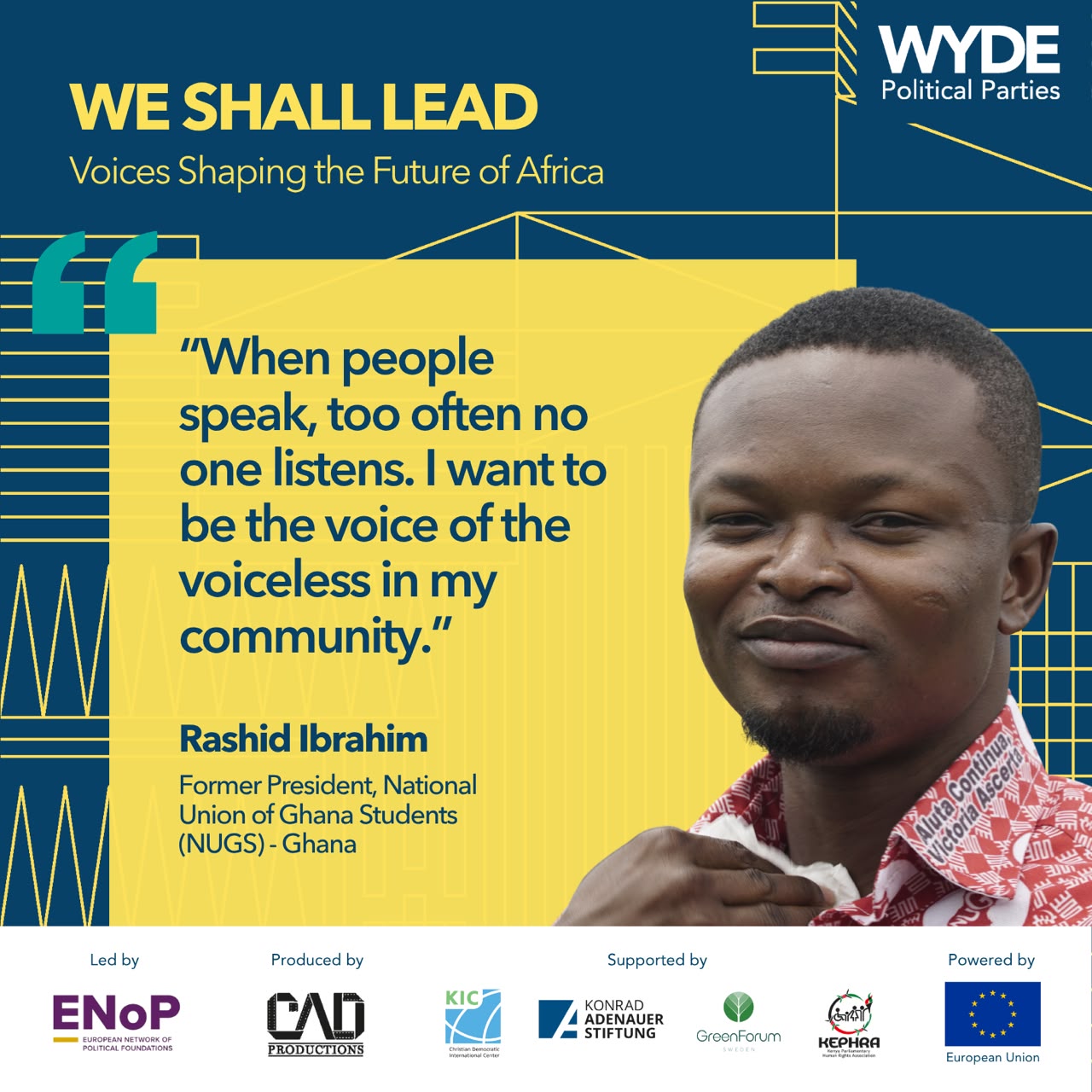
Challenging entrenched political gatekeeping that sidelines young citizens and underserved communities, National Union of Ghana Students (NUGS) President Rashid Ibrahim is urging a new generation to prepare for governance and claim a seat at the national decision-making table.
For Ibrahim, that call is rooted in his upbringing in a rural farming community of about 500 residents in the Nkoranza South Municipality. As the son of peasant farmers, he saw how easily the concerns of people in underserved communities could go unheard. Student leadership offered him a platform to help change that.
“I wanted to be the voice for the voiceless in my community,” he says. “When they speak, no one listens. When they have someone like me, the president of all Ghanaian students, speaking on their behalf, leaders will listen.”
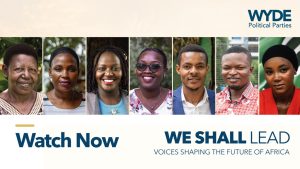
His journey features prominently in We Shall Lead: Voices Shaping the Future of Africa, a European Union-funded documentary exploring the experiences of emerging African leaders and their efforts to open political institutions to women and young people.
Filmed across Ghana, Kenya and Uganda under the Women and Youth Democratic Engagement (WYDE) Political Parties project, the documentary brings personal experiences into a wider conversation about representation, accountability and the transfer of leadership between generations.
Ibrahim, whose tenure at NUGS ends this year and who now practises law, specialising in international commercial arbitration, sees political participation as a means of connecting communities with the institutions that make decisions about their lives.
From Rural Concerns to National Advocacy
Growing up in an agricultural household helped Ibrahim understand the distance between having a concern and having the influence to get it addressed.
In the documentary, he explains that his ambition to lead grew from a desire to give his community a stronger voice. Becoming a national student leader placed him in a position to raise issues that might otherwise have remained outside the attention of policymakers.
That experience informs his belief that young Africans can contribute meaningfully to governance when given opportunities.
“Leaders are making themselves life leaders when we have youthful leaders ready to take control of affairs,” he says. “When the youth are given the chance and the right opportunities, they can contribute significantly to national development.”
Yet Ibrahim also places responsibility on young people themselves. His criticism of politicians who hold on to power is accompanied by an appeal to aspiring leaders to develop the knowledge and judgement needed to govern.
“Let us always aspire to develop ourselves, go to school, and learn from existing leaders before taking up leadership roles,” he urges. “If you are offered an opportunity without experience or knowledge in the field, that creates a problem.”
For him, education and mentorship are essential parts of preparing for public responsibility. Access to leadership must be matched by the ability to serve effectively.
His concerns extend to the economic opportunities available to young people. Addressing youth unemployment, he calls on policymakers to “improvise and find ways to support young African entrepreneurs to build businesses on their own.”
Challenging Barriers on Campus
The documentary places Ibrahim’s experiences alongside those of Hariratah Ibrahim Doudu, former Vice President of the Student Representative Council (SRC) at the Ghana School of Law’s GIMPA Campus.
Doudu’s decision to contest the SRC vice-presidential seat began with an observation: no female student had run for the position at her campus in approximately five years, despite women forming the majority of the student body.
For her, that absence raised questions about whose participation the system encouraged and whose it discouraged.
“I think, and I believe, that the system in politics is not really created to accommodate women,” she says, pointing to longstanding institutional habits that limit broader participation.
She built her campaign by listening to fellow law students, identifying their everyday challenges and mobilising practical solutions. Her approach placed responsiveness at the centre of her bid for leadership. Doudu argues that institutions lose opportunities to innovate when young people are excluded from decisions.
“Our generation thinks differently. We move differently. We see the world in a whole different light,” she says.
Her determination was shaped by personal hardship. Doudu, who has roughly 24 siblings, lost her father, the family’s breadwinner, shortly before completing senior high school.
The loss brought uncertainty at a critical point in her education. She recalls finding the resolve to continue even when the way forward seemed unclear.
“Right before I completed my senior high school education, I lost my dad, and during that time, I thought life was over because he was the breadwinner of the family,” she says. “It was quite challenging, but there was something in me that kept telling me: ‘Don’t give up. Focus on your exam. Pass. Help will come.'” Years later, her election victory became a deeply personal affirmation of her ability to lead.
“I remember that day I was so emotional. I was just crying my eyes out,” she recalls. “In that moment, nobody knew why I was crying. I was crying because I had proven to myself that I’m capable, that I’m competent, and that indeed I’m going to help create change.”
Her experience reinforces a message running through the documentary: young people seeking institutional change must also be willing to participate, demand accountability and take on responsibility.
A Seat With the Power to Decide
For Ghana Youth Federation President Sherif Ghali, gaining access to political spaces is only part of the challenge. What matters is whether young people can influence the decisions made there.
“The struggle is so serious that young people don’t even want to go into politics,” he says. “You go into politics, and still your voices are not heard. It’s not just about including us; it’s about allowing us to take decisions. If I am at the table and what I say is not heard, then why am I at the table?”
His concern is that invitations and visibility can create the appearance of participation while leaving decision-making power untouched.
Ghali also questions constitutional age restrictions across Africa that prevent younger citizens from seeking the presidency, arguing that age alone does not determine a person’s capacity to lead.
“We need to change the way we look at leadership in Africa,” he says. “Most African constitutions still say you must be 40 or 45 years old before you can become president. I don’t think leadership goes with age. Whether you are female or a young person aged 25 or 30, you should be allowed to lead.”
At the same time, he believes a greater role for young people should preserve the tradition of respecting and consulting elders.
“One thing I would like to remain is the African tradition of respect for elders,” he says. “No matter where we are, we still respect elders, listen to them, and bring them along.” His appeal to young people is to stop postponing their participation.
“Enough of waiting for permission. Enough of waiting for clarity. Enough of waiting for somebody to tell you that you are ready,” he says. “It’s our time. They call us the leaders of the future, but the future is now.”
Taking the Conversation to Students
In Ghana, the documentary’s campus campaign is led by the European Network of Political Foundations (ENoP), with support from the Konrad-Adenauer-Stiftung (KAS) Ghana Office.
Screenings and peer-led dialogues at institutions including the Ghana Institute of Management and Public Administration (GIMPA), the University of Professional Studies, Accra (UPSA), and the Kwame Nkrumah University of Science and Technology (KNUST) are intended to encourage discussion about stronger representation for women and young people in democratic institutions.
The three leaders approach that conversation from different experiences: Ibrahim through rural advocacy and national student leadership, Doudu through her challenge to barriers in campus governance, and Ghali through his demand for meaningful decision-making power.
For Ibrahim, the value of leadership remains closely connected to the community where his ambition began. The opportunity to speak on a national platform carries a responsibility to ensure that people whose concerns are easily overlooked can finally be heard.
By Isaac Kofi Dzokpo
