
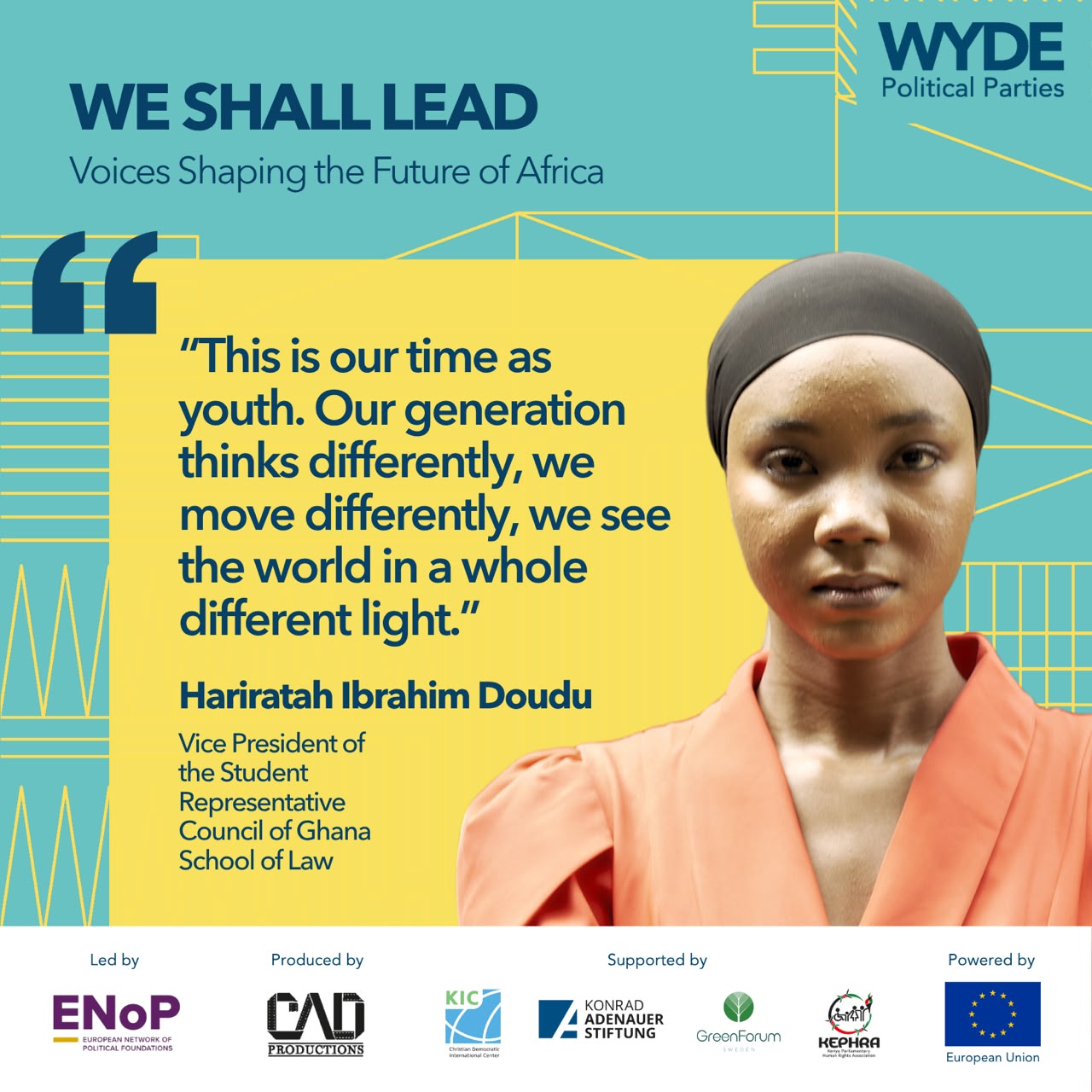
Confronting decades of political marginalization, emerging Ghanaian youth leaders—led by Ghana School of Law student executive Hariratah Ibrahim Doudu—are demanding genuine representation for women and young people in governance through a nationwide university screening campaign.
Doudu, former Vice President of the Student Representative Council (SRC) at the Ghana School of Law’s GIMPA Campus, headlines We Shall Lead: Voices Shaping the Future of Africa, a European Union-funded documentary geared towards promoting inclusive leadership and institutional reforms.
Filmed across Ghana, Kenya, and Uganda under the Women and Youth Democratic Engagement (WYDE) Political Parties project, the documentary examines how emerging leaders are stepping inside traditional political institutions to reshape them from within rather than remaining on the sidelines.
Breaking Barriers in Student Governance
In the film, Doudu recounts her decision to contest the SRC vice-presidential seat after noticing that no female student had run for the position at her campus in approximately five years—despite women forming the majority of the student body. Rather than chasing a political title, she said her goal was to challenge a governance culture that felt disconnected from the people it served.
“I think, and I believe, that the system in politics is not really created to accommodate women,” Doudu says, pointing to longstanding institutional habits that discourage broader participation.
Instead of relying on traditional political orthodoxy, Doudu built her campaign at the grassroots level by listening to the everyday challenges of fellow law students and mobilizing practical solutions—an approach she said proves leadership renewal starts with responsiveness and trust. She also argued that shutting young people out of decision-making spaces stalls institutional innovation and national development.
“Our generation thinks differently. We move differently. We see the world in a whole different light,” she says in the film, reflecting a broader theme across We Shall Lead that leadership is not merely a future promise to be handed down, but a responsibility exercised in the present.
Doudu, who grew up in a family of roughly 24 siblings and lost her father—the household’s breadwinner—shortly before completing senior high school, credited her upbringing with instilling the resilience that shapes her approach to public service.
“I have about 24 [siblings], so I think that has built some sort of resilience in me,” she says. “Right before I completed my senior high school education, I lost my dad, and during that time, I thought life was over because he was the breadwinner of the family. It was quite challenging, but there was something in me that kept telling me: ‘Don’t give up. Focus on your exam. Pass. Help will come.'”
She described her eventual election victory as a defining validation that competence and purpose can break through traditional barriers.
“I remember that day I was so emotional. I was just crying my eyes out,” she says. “In that moment, nobody knew why I was crying. I was crying because I had proven to myself that I’m capable, that I’m competent, and that indeed I’m going to help create change.”
Advising her peers across the country, Doudu emphasized that institutional change will not happen from the outside looking in, urging young Ghanaians to step forward, demand accountability, and actively reshape the systems that govern their future.
Advocating for Rural Communities and Youth Opportunity
Doudu’s call for inclusive governance is echoed by National Union of Ghana Students (NUGS) President Rashid Ibrahim, who traces his entry into student leadership to a rural farming community of about 500 residents in the Nkoranza South Municipality.
“It’s a total population of about 500 inhabitants, and my parents are peasant farmers,” Ibrahim says in the documentary. “As the son of a farmer, I saw the need to aspire for a position that would project me so that when I speak, leaders will understand. I wanted to be the voice for the voiceless in my community. When they speak, no one listens. When they have someone like me, the president of all Ghanaian students, speaking on their behalf, leaders will listen.”
Ibrahim, whose term at NUGS ended earlier this year and who now practices law specializing in international commercial arbitration, contends that young people are ready to govern but are routinely blocked by incumbents reluctant to step aside.
“Leaders are making themselves life leaders when we have youthful leaders ready to take control of affairs,” he says. “When the youth are given the chance and the right opportunities, they can contribute significantly to national development.”
At the same time, Ibrahim urged young Africans to prepare thoroughly for governance through formal education and mentorship. “Let us always aspire to develop ourselves, go to school, and learn from existing leaders before taking up leadership roles,” he says. “If you are offered an opportunity without experience or knowledge in the field, that creates a problem.”
On youth unemployment, he called on policymakers to “improvise and find ways to support young African entrepreneurs to build businesses on their own.”
Moving From Tokenism to Decision-Making Power
Ghana Youth Federation President Sherif Ghali also features prominently in the film, arguing that the central challenge facing young people is not simply being invited into political spaces, but being allowed to make real decisions once inside.
“The struggle is so serious that young people don’t even want to go into politics,” Ghali says. “You go into politics, and still your voices are not heard. It’s not just about including us; it’s about allowing us to take decisions. If I am at the table and what I say is not heard, then why am I at the table?”
Ghali challenged constitutional provisions across Africa that set minimum presidential age requirements at 40 or 45, arguing that leadership capability is not tied to age.
“We need to change the way we look at leadership in Africa,” he says. “Most African constitutions still say you must be 40 or 45 years old before you can become president. I don’t think leadership goes with age. Whether you are female or a young person aged 25 or 30, you should be allowed to lead.”
While calling for a shift in attitudes toward youth governance, Ghali emphasized that political modernization should not erode cultural values. “One thing I would like to remain is the African tradition of respect for elders,” he notes. “No matter where we are, we still respect elders, listen to them, and bring them along.”
His message to peers in the documentary is a direct call to action: “Enough of waiting for permission. Enough of waiting for clarity. Enough of waiting for somebody to tell you that you are ready. It’s our time. They call us the leaders of the future, but the future is now.”
Campus Campaign Targets Representation
In Ghana, the campus campaign is led by the European Network of Political Foundations (ENoP) with local support from the Konrad-Adenauer-Stiftung (KAS) Ghana Office.
“WE SHALL LEAD: Voices Shaping the Future of Africa” is a new 2026 Women and Youth Democratic Engagement (WYDE) Political Parties of the European Union documentary brings together voices from Kenya, Uganda and Ghana to explore why people still choose politics — and what it means to pursue change from within political institutions.
By Isaac Kofi Dzokpo
